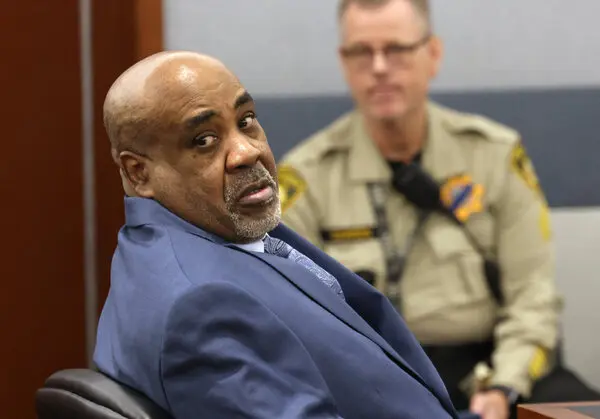
The Duane Davis trial took its most consequential turn Thursday when jurors spent hours listening to the defendant himself, in a 2008 recording, walk investigators through the night Tupac Shakur was shot.
The recording arrived days after Davis’s own attorney told the court during opening statements that his client’s public statements were, in his words, nonsense. The problem for that argument is how closely the recording tracks what Davis later published in his own memoir.
How the Recording Reached the Jury
The interview came from a proffer agreement connected to drug charges.
Greg Kading, then a Los Angeles Police Department detective, told Davis on tape that nothing he said that day would be used against him.
Prosecutors argued that Davis forfeited that protection when he published his 2019 memoir, Compton Street Legend, and discussed the events openly in interviews. The judge agreed, allowing the recording to be played.
That ruling transformed a conversation conducted under promised immunity into evidence at a murder trial.
What Davis Described
The account begins after the fight at the MGM Grand between Davis’s nephew, Orlando Anderson, and people connected to Death Row Records, the label co-founded by Marion “Suge” Knight.
Davis said his group drove to Knight’s Las Vegas Club 662, stayed briefly, and gave up on finding their targets.
Later, driving after a stop at a liquor store, he described hearing people on the street shouting Tupac’s name and seeing the rapper hanging out a car window, waving.
His car made a U-turn.
Inside the Vehicle
Davis identified everyone’s position for investigators. Terrence Brown was driving. Davis sat in the passenger seat. Deandre Smith occupied the left rear seat, with Anderson, known as Baby Lane, on the right.
The driver pulled alongside the passenger side of Shakur’s car.
Davis told investigators that if they had been positioned on his side, he would have fired himself. Since they were not, he passed the gun into the back seat.
He described Smith declining, saying no repeatedly, before Anderson asked for it and took it.
Davis said Knight looked over at him during the shooting. Asked why, his answer was blunt: he did not know. He noted that he had known Knight since they were seven or eight years old.
He believed Knight had been killed, since a bullet struck him in the back of the head. He described Shakur apparently attempting to get into the back seat while Knight ducked away, and estimated roughly six shots.
In the Courtroom
The jury remained visibly attentive as this section played, more engaged than during the earlier hours of the recording.
As Davis described seeing the ambulance carrying the rapper, Shakur’s sister pressed her left hand against her mouth. A family friend put an arm around her.
The Getaway
Davis said the group abandoned their car at the nearby Carriage House and left the gun resting on a tire, returning the following day to retrieve it.
Investigators pushed back, telling him that made no sense.
His response was characteristically unbothered. Did they want the truth or a lie, he asked, before repeating that they left the gun on the car.
The Tone of the Interview
Much of the recording carried an unexpectedly casual quality, with back-and-forth between Davis, his attorney and investigators as the former South Side Compton Crip recounted periods of his own influence.
After detailing his plan to go after Shakur, Davis said he had never told anyone that story.
An officer asked whether it felt good to get it off his chest.
Detective Daryn Dupree, who testified in court Wednesday, joked that Oprah would thank him for the revelation. Another officer added that Davis would tell her to read his book.
Where the Accounts Diverge
The recording and the memoir align closely, with two notable exceptions.
On the gun: In the book, Davis wrote that he took the weapon during the liquor store stop and tossed it into the back seat. In the recording, he described deliberately handing it to Smith at the moment the cars pulled alongside each other.
On who fired first: The book claims that Shakur made an erratic move, reached beneath his seat, pulled out a weapon, and that only then did one of Davis’s associates grab the Glock and return fire.
In the police recording, Davis said Anderson leaned toward the window, rolled it down and fired. He made no mention of Shakur having or using a gun.
That second difference matters enormously. The book version describes a response to an armed threat. The recording describes an attack.
The Diddy Allegation
The interview extended beyond the shooting into the internal dynamics of the South Side Crips and figures associated with Death Row Records.
Davis alleged that Sean “Diddy” Combs offered him a million dollars to kill Shakur and Knight.
CNN has sought comment from Combs’s representatives regarding the claimed bounty.
Why the Defense Faces a Difficult Position
The argument that Davis exaggerated for publicity works better against a memoir than against a recorded police interview.
A book sells on drama. A proffer session, conducted with an attorney present under a promise of immunity, offers no obvious incentive to invent involvement in a murder.
The consistency between the two accounts is what makes the recording powerful. Prosecutors can argue that Davis told the same essential story in both settings, one motivated by profit and one motivated by legal protection.
What Comes Next
Court resumes Friday morning, with prosecutors expected to play an additional recording from 2009.
For now, the Duane Davis trial has heard the defendant describe the shooting in his own voice, and the jury has watched his family’s account of that night collide with the version he later sold in bookstores.
Author