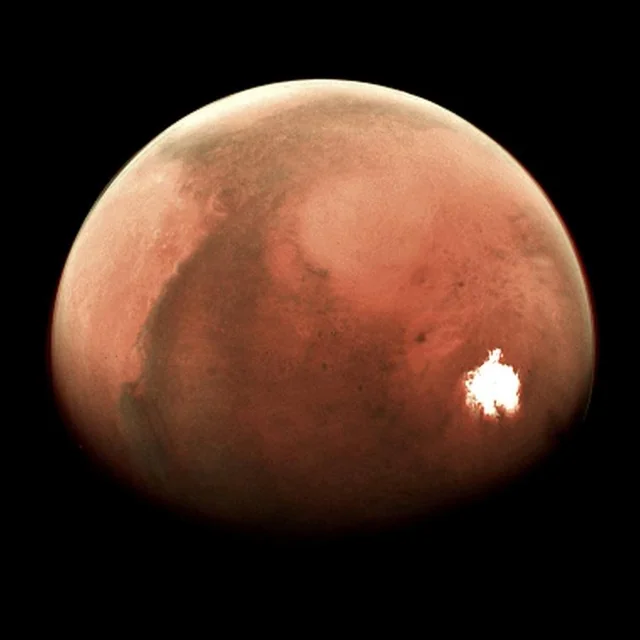
NASA Psyche Mars Flyby Delivers Stunning New Views of the Red Planet
The NASA Psyche Mars flyby has captured the imagination of space lovers around the world, delivering rare and beautiful new perspectives of Mars as a spacecraft makes its long journey toward one of the most mysterious objects in our solar system. As part of its multi-billion-mile trek, the Psyche mission used Mars’ gravity to give itself a much-needed speed boost, while also testing its cameras and instruments in real space conditions.
The result was a spectacular blend of science and visual artistry, with the red planet captured in a way that’s rarely seen even by long-time astronomy enthusiasts.
Where Is Psyche Headed?
NASA’s Psyche spacecraft launched in October 2023 with a bold mission. It’s heading for Asteroid 16 Psyche, a strange, metallic space rock located in the outer part of the main asteroid belt between Mars and Jupiter.
What makes this target so unique is the asteroid itself. Unlike most asteroids, which are rocky or icy, Psyche appears to have a highly reflective, metal-rich surface. Scientists believe it could be the exposed core of an early planetary building block, possibly similar to the inner cores of planets like Earth, Mars, Mercury, and Venus.
Studying Psyche up close could:
- Reveal new clues about how rocky planets formed
- Provide an unprecedented look at planetary cores
- Help scientists understand the origins of Earth’s own interior
- Open a new chapter in solar system science
To do this, the spacecraft must travel a staggering 2.2 billion miles, with an expected arrival at the asteroid in 2029.
Why Visit Mars Along the Way?
Long-distance space travel isn’t just about pointing a spacecraft and going. Every mile of fuel, every degree of trajectory, and every second of timing matters. To make the journey to Psyche more efficient, NASA built a strategic flyby of Mars into the mission plan.
This gravity-assisted slingshot maneuver allowed the spacecraft to:
- Save valuable propellant
- Boost its solar-electric propulsion system
- Adjust its trajectory naturally using Mars’ gravity
- Gain extra speed without burning more fuel
- Stay on course for its 2029 asteroid arrival
According to Don Han, Psyche’s navigation lead at NASA’s Jet Propulsion Laboratory, the Mars flyby gave the spacecraft a 1,000 mile-per-hour boost while shifting its orbital plane by about one degree relative to the Sun. That kind of precision is the result of careful planning years in advance.
The Mars Flyby in Action
On May 15, the Psyche spacecraft swung around the red planet, coming within just 2,864 miles of its surface. While most of the world experienced just another quiet day on Earth, Psyche was busy making history above Mars.
During this close encounter, the spacecraft:
- Activated all of its scientific instruments and cameras
- Performed a complete test run of operations it will later conduct at the asteroid
- Captured thousands of images and detailed sensor readings
- Provided engineers with critical calibration data
- Demonstrated that its systems can handle complex, fast-moving tasks
This flyby served not just as a navigational maneuver, but as a full system check ahead of the mission’s most important goal.
A Rare and Beautiful View of Mars
What truly set this flyby apart was the unique angle from which Mars came into view. As Psyche approached, it flew in from a high angle, allowing its cameras to capture Mars as a thin illuminated crescent. After passing the planet, it then captured the iconic “nearly full Mars” view as the planet’s full sunlit face came into focus.
According to Jim Bell, Psyche’s imager instrument lead at Arizona State University, these unusual angles created not only valuable calibration data but also some of the most striking and unusual Mars photos taken in recent years.
The cameras captured incredible details, including:
- Crescent illumination on the planet’s edge
- Nighttime and daytime views across different regions
- Wind-scattered dust streaking across surface craters
- Views of Mars’ south pole region
- Atmospheric textures and color contrasts
This kind of perspective is rare because most missions are designed to orbit Mars directly or land on its surface. A high-angle flyby like this isn’t something photographers typically get the chance to capture.
Why Calibration Matters So Much
While the photos are stunning, the most important aspect of the flyby was its scientific purpose. Calibrating instruments using real planetary targets is a key step in mission preparation. Mars, with its size, brightness, and atmospheric variation, provides an ideal subject for testing the spacecraft’s tools.
Calibrating Psyche’s cameras and instruments helps engineers:
- Ensure the equipment performs accurately in deep space
- Test imaging quality and consistency
- Identify and resolve any technical issues early
- Prepare the spacecraft to study Asteroid 16 Psyche with full precision
Every test conducted during this flyby brings the team closer to a successful arrival and analysis at the asteroid.
What Happens Next?
After this big milestone, Psyche will continue its long journey across the solar system. Once it arrives at Asteroid 16 Psyche in August 2029, the spacecraft will enter a special orbit that shifts in altitude over time, allowing it to map the asteroid in detail from multiple distances.
During its time at the asteroid, Psyche will:
- Examine the asteroid’s surface composition
- Measure its gravity, magnetic properties, and structure
- Search for evidence of whether it’s truly a metal core
- Compare its makeup to known planetary cores
- Help researchers reconstruct the early history of the solar system
If everything goes as planned, this mission could rewrite parts of our understanding of how planets, including our own, are built from the inside out.
Why This Mission Matters
The Psyche mission isn’t just another science project. It’s one of the most ambitious efforts to study planetary cores ever attempted. Because no spacecraft can directly travel to the molten cores of planets like Earth, Mars, or Mercury, the next best option is to study an asteroid that might already be such a core in exposed form.
If the asteroid turns out to be what scientists hope, it could offer:
- A natural laboratory to study planetary formation
- New insights into the materials that make up the inner solar system
- Clues about how early collisions shaped the planets we see today
- Inspiration for future missions exploring metal-rich celestial objects
Discoveries from missions like this often ripple across fields ranging from geology and physics to astrobiology and engineering.
The Bigger Picture: Exploring With Precision
Missions like Psyche demonstrate how far space exploration has come. Modern spacecraft no longer simply travel in straight lines. Instead, they leverage:
- Gravity assists from nearby planets
- Solar-electric propulsion for efficient travel
- High-resolution imaging and sensing equipment
- Sophisticated trajectory calculations
- Long-distance autonomous operations
These tools allow NASA and its partners to push deeper into the solar system without massive increases in cost or fuel.
The Mars flyby also serves as a reminder of how interconnected the planets are when it comes to space exploration. Even when a mission isn’t focused on Mars, the red planet remains an essential partner in helping spacecraft travel farther into the unknown.
What This Means for the Public
For everyday space enthusiasts, this flyby is a powerful reminder of just how exciting and active space exploration has become. Stunning images, ambitious missions, and groundbreaking science come together to deliver one of the most awe-inspiring moments in modern astronomy.
The pictures alone are worth pausing to admire, while the science behind them promises insights that could shape generations of research to come.
Final Thoughts
The NASA Psyche Mars flyby is a perfect blend of science, strategy, and beauty. By using Mars’ gravity to gain speed and adjust its course, the spacecraft has set itself up for a successful arrival at one of the most fascinating asteroids in the solar system. Along the way, it gave the world rare and stunning views of the red planet that few people ever expect to see. As Psyche continues its long journey toward 2029, this milestone serves as a thrilling reminder that every great discovery often begins with a single, well-timed turn through space.
Author