Puffins do something that sounds physically impossible. They fly through air at speed, then dive into water and keep flapping — swimming after prey through a medium a thousand times denser than the one they just left. Then they burst back out and fly away.
Engineers at MIT and EPFL in Lausanne have now built a flapping-wing robot that does the same thing.
And in the process, they discovered something the birds themselves might find surprising: you don’t actually need feet.
What They Built
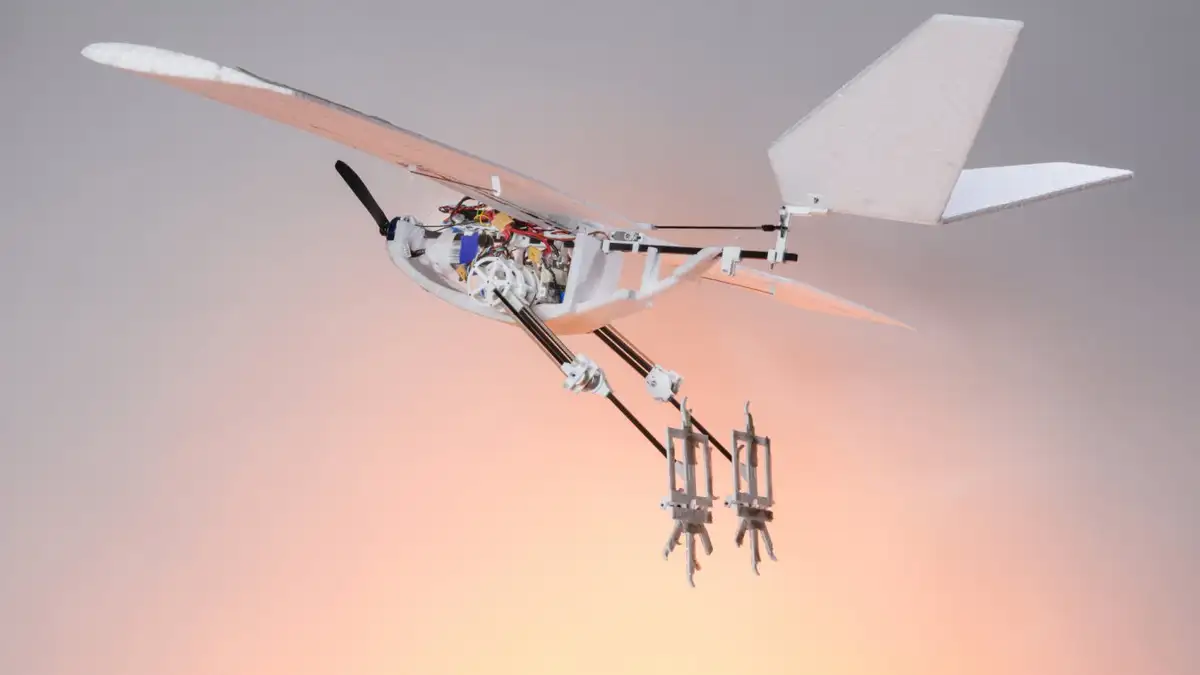
The device is called a flapping-wing aerial-aquatic vehicle, or FAAV.
It weighs under 300 grams — about 10.6 ounces. It has a central fuselage, two flexible flapping wings, and a steerable tail. Both the wings and tail can be swapped for different sizes.
Inside the body sits a battery and a waterproof electric motor driving a crankshaft, which pumps the wings up and down at programmable frequencies.
The wings are thin membranes coated with hydrophobic nanoparticles to shed water. The motorized tail changes angle to pitch the robot up or down.
The results were published in the journal Science.
The Problem It Had to Solve
Water is roughly a thousand times denser than air. Moving through each requires fundamentally different mechanics.
That would seem to rule out a single machine doing both.
“You have to do some adaptation to make that transition work. But there’s a solution that exists in nature,” says Raphael Zufferey, assistant professor of mechanical engineering at MIT and lead author of the study.
“Birds like puffins can fly very fast through the air, and can dive and swim through water at speeds of 3 meters per second. They’re able to do pretty amazing things. So we knew it was possible. Just no one had tried this in a mobile robotic system.”
Learning From the Birds
Before building anything, the team combed through scientific literature on puffins, petrels, kingfishers and other diving species.
A clear pattern emerged in flapping frequency:
- Smaller birds flap around 10 times per second in air
- The same birds drop to roughly four flaps per second in water
- Larger birds flap more slowly in both media, owing to wider wingspans
The robot was designed to operate in that same range.
Testing in a Tank, Then a Lake
The researchers fabricated three wing sets — small at 60 centimeters, medium at 80, and large at 100.
They began in a water tank, then moved to Lake Geneva.
The procedure was straightforward: place the robot roughly half a meter underwater, program a flapping frequency and tail angle, and observe whether it could swim upward, break the surface, and fly.
Across many flights with varying configurations, one combination proved reliable.
What Worked
Medium wings.
Flexibility turned out to be the crucial variable. The wings needed to be pliable enough to reduce flapping amplitude underwater, yet firm enough to generate lift in air.
The performance numbers landed remarkably close to biology:
- Swimming: nearly 1 meter per second at around 5 flaps per second
- Flying: roughly 6 meters per second at a similar flapping frequency
Both speeds and frequencies closely mirror actual diving birds.
The 70-Degree Answer
The hardest moment is the transition — the instant the robot leaves water and enters air.
The team found the answer lies in pitch angle: 70 degrees.
Steep enough that the wingtips clear the water’s surface while flapping. Any steeper, and the robot tips backward and falls in.
The Feet Discovery
Here is the genuinely unexpected finding.
When puffins and ducks take off from water, they paddle furiously with their feet while flapping and pitching. It looks essential.
The robot has no feet. It launches anyway.
“If you look at birds, most birds need to paddle at the surface to take off. And the question was, do we need the same for robots? And it turns out we don’t,” Zufferey says.
That is a meaningful result for both engineering and biology — a demonstration that paddling may be one solution to the takeoff problem rather than the only one.
Why This Matters Beyond the Lab
Zufferey runs MIT’s AURA Lab, where the goal is building small vehicles that can monitor oceans and waterways unobtrusively.
His vision for the FAAV is specific.
“Our dream vision is for oceanographers, marine biologists and members of coastal communities to launch this robot from a boat, or from shore, and it would fly close to the area of interest, such as an iceberg or a port facility, or over a pod of whales,” he says.
“It would dive into the water to take a measurement or collect a sample, and fly back to deliver the data at a fraction of the cost of traditional methods. Then it could go back out to dive for more.”
The core problem in ocean science is coverage — collecting data frequently, across many locations, without a ship.
“You could send this out not just every week, but every hour,” Zufferey says.
What Comes Next
The team is now redesigning the wings so they can turn as well as flap up and down, adding maneuverability.
They also plan to test performance under turbulent conditions — choppy water, gusting wind — the realistic environments any deployed vehicle would face.
After that: actual ocean science.
A 300-gram machine that swims like a puffin, flies like a bird, and needs no feet to do either. Nature found one answer. Engineering just found another.
Author