Tylosaurus rex Texas Discovery: The Ancient Seas Just Got Their Own T. Rex
The Tylosaurus rex Texas discovery has officially given the world a new ruler of the prehistoric oceans. Paleontologists at the American Museum of Natural History, the Perot Museum of Nature and Science in Dallas, and Southern Methodist University have identified a massive new species of mosasaur that prowled the ancient seas around 80 million years ago. Stretching up to 43 feet in length, this sea-dwelling beast has been named Tylosaurus rex, or “king of the tylosaurs,” and it’s already shaking up what we thought we knew about marine reptiles from the age of the dinosaurs.
The discovery, based on fossils unearthed primarily in northern Texas decades ago, marks one of the largest mosasaurs ever documented. It’s a name that fittingly mirrors the iconic Tyrannosaurus rex, only this one ruled the oceans instead of the land.
Why Tylosaurus rex Is Such a Big Deal
Mosasaurs were a group of giant marine reptiles that lived during the Late Cretaceous period. While they shared the world with dinosaurs, they were not dinosaurs themselves. Instead, they were apex marine predators with long bodies, paddle-like limbs, and powerful jaws designed for swift, deadly attacks.
Tylosaurus rex stands out for several reasons:
- It grew anywhere from 25 to 43 feet long, roughly the length of a school bus
- It was nearly twice the size of the largest modern great white sharks
- It had a suite of physical adaptations suited for incredible jaw and neck strength
- It featured finely serrated teeth, an unusual trait among mosasaurs
- It shows clear evidence of aggressive behavior, including fights with its own species
In short, this wasn’t just another large prehistoric reptile. Tylosaurus rex appears to have been a hyper-powerful, deeply violent predator in a class of its own.
A Discovery Decades in the Making
The story behind this new species is almost as fascinating as the creature itself. Many of the fossils that have now been classified as Tylosaurus rex were collected decades ago in north Texas. For years, they were assumed to belong to a different species: Tylosaurus proriger.
That assumption began to fall apart when researcher Amelia Zietlow, then a comparative biology Ph.D. student at the Richard Gilder Graduate School at the American Museum of Natural History, started examining a mosasaur fossil in the museum’s research collection. The fossil seemed to be incorrectly labeled.
After careful comparison with the original holotype of Tylosaurus proriger, which has been housed at the Harvard Museum of Comparative Zoology for more than 150 years, Zietlow and her colleagues realized they were looking at something different. The fossils:
- Were significantly larger than typical T. proriger remains
- Had finely serrated teeth, which T. proriger did not
- Were found primarily in Texas, not Kansas
- Were younger than T. proriger by about 4 million years
It quickly became clear that these fossils represented a new species altogether.
A Tribute to a Forgotten Pioneer
The team chose to name the new species T. rex as a respectful nod to paleontologist John Thurmond, who back in the late 1960s first noticed that tylosaurs from northeast Texas seemed unusually large and possibly distinct. He had informally referred to them as “Tylosaurus thalassotyrannus,” meaning “sea tyrant,” even acknowledging at the time that the nickname might sound a bit dramatic.
Decades later, his early instincts have been proven correct.
The Holotype: A Texas Treasure
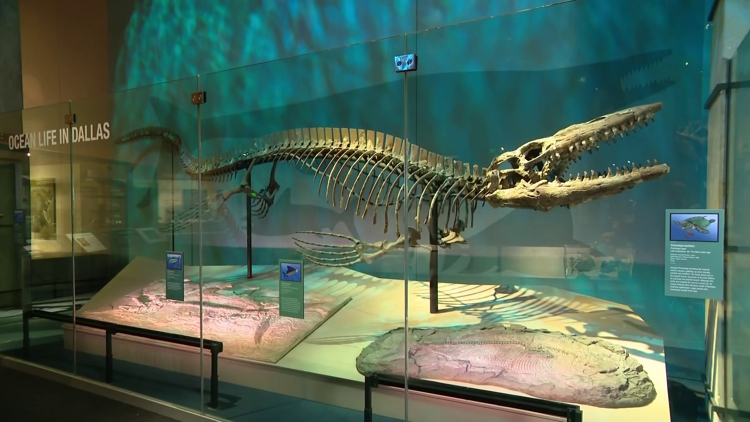
The official holotype, the name-bearing specimen, of the new T. rex is displayed at the Perot Museum of Nature and Science in Dallas. It was originally discovered in 1979 along an artificial reservoir near Dallas, and it remains one of the most impressive mosasaur specimens ever found.
This single fossil has now taken on a much larger role in scientific history, serving as the foundational reference for the entire newly defined species.
A Predator Unlike Any Other
What truly sets Tylosaurus rex apart from other mosasaurs is its aggressive nature. While many marine reptiles were certainly dangerous in their own right, T. rex shows evidence of violence that goes beyond what scientists have observed in other mosasaur species.
Some of the most telling evidence includes:
- A specimen nicknamed “The Black Knight,” found in the Perot Museum’s collection
- Missing tip of the snout and a fractured lower jaw on this specimen
- Damage that researchers believe could only have come from another T. rex
In other words, these animals weren’t just dangerous to their prey. They likely engaged in violent confrontations with each other as well.
Other Famous Specimens Now Reclassified
Several previously well-known mosasaur specimens that were once labeled as Tylosaurus proriger are now being reclassified as Tylosaurus rex. Two standout examples include:
- “Bunker,” a massive mosasaur discovered in 1911 and currently displayed at the University of Kansas
- “Sophie,” a striking mosasaur exhibit at the Yale Peabody Museum
These specimens will now carry the new T. rex label, giving them renewed scientific significance.
Rewriting the Evolutionary Map
The implications of this discovery go beyond simply naming a new species. The research also addresses a long-standing issue in mosasaur science. The data scientists have used to track mosasaur evolutionary relationships has remained mostly unchanged for nearly three decades.
The team behind the new T. rex study put together a comprehensively revised dataset that introduces:
- Updated anatomical comparisons
- New arrangements of evolutionary relationships among tylosaurs
- A modernized framework for studying these marine reptiles
- A push to challenge outdated assumptions long held in the field
This means the scientific understanding of mosasaurs may need to be reexamined from the ground up.
Why Texas Plays Such a Big Role
Texas has long been recognized as a key region for understanding the ancient marine ecosystems that once thrived where dry land sits today. Millions of years ago, much of the region was covered by warm seas teeming with marine life.
According to co-author Michael Polcyn of Southern Methodist University, these new findings reinforce just how essential Texas is in helping researchers understand the evolutionary story of ancient marine predators. The state’s unique geological history continues to deliver some of the most significant prehistoric finds in the world.
A Discovery That Sparks New Questions
While the identification of Tylosaurus rex answers many questions, it also raises plenty of new ones. Researchers are now interested in:
- What other mosasaur species may have been misidentified in museum collections
- Whether other regions hosted similarly massive predators
- How aggressive intraspecies behavior shaped mosasaur evolution
- What other evolutionary patterns may have been overlooked due to outdated data
- How modernized analytical tools will reshape future marine reptile research
This discovery essentially throws open the doors to a deeper, fresher era of mosasaur research.
A Reminder of Texas-Sized Surprises
It’s no coincidence that the sea T. rex was discovered in Texas. As Amelia Zietlow noted, the saying that “everything is bigger in Texas” appears to apply to ancient marine reptiles as well. The fact that this giant predator stayed unrecognized for so long despite being hiding in plain sight inside museum collections is a powerful reminder of how much there is still to learn about prehistoric life.
Sometimes the most exciting discoveries don’t come from new digs in the ground but from a closer look at fossils that have been sitting on shelves for decades.
Final Thoughts
The Tylosaurus rex Texas discovery is one of the most thrilling paleontological revelations in recent years. It introduces the world to a true sea T. rex, a massive, aggressive predator that ruled the ancient oceans 80 million years ago. Beyond its impressive size and violent reputation, the discovery is also a major step forward for science. It pushes researchers to revisit long-held assumptions, modernize their tools, and re-examine the very foundation of mosasaur evolution. As more fossils come to light and old collections get a second look, this newly crowned king of the tylosaurs may turn out to be just the beginning of an exciting new chapter in marine paleontology.
Author