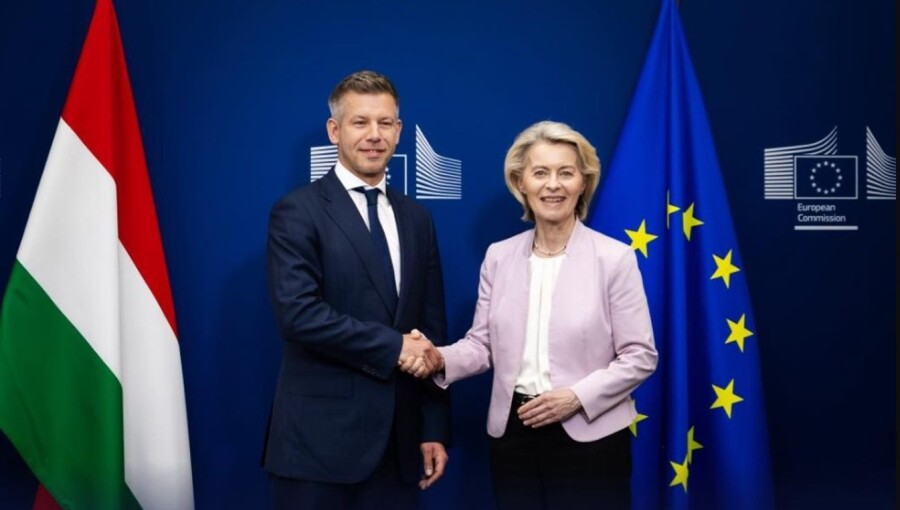
Hungary EU funds unlocked has become the headline of the week in European politics, after Prime Minister Péter Magyar struck a landmark agreement with the European Commission. The deal frees up nearly all of the recovery and cohesion funds that had been frozen under his predecessor, Viktor Orbán, opening access to a substantial €16.4 billion.
A Breakthrough in Brussels
On Friday, Magyar sealed the agreement with European Commission President Ursula von der Leyen, securing the release of money that had long been out of Hungary’s reach. The funds had been suspended throughout Orbán’s tenure over persistent concerns about corruption and the rule of law.
Von der Leyen was notably warm in her praise. She commended Magyar for assembling a government in record time and for pushing through what she called long-overdue reforms in a matter of weeks. In her view, the hard work had clearly paid off.
The breakdown of the released funds reflects the scale of the agreement:
- €10 billion will be released from the bloc’s post-pandemic Recovery and Resilience Facility.
- €4.2 billion will come from cohesion funds.
- An additional €2.2 billion will be drawn from a separate tranche within the same cohesion funding envelope.
The End of an Era
This agreement carries deep political symbolism. Magyar won April’s general election, bringing an end to Orbán’s 16-year grip on power. The contrast between the two leaders was front and center in Magyar’s own remarks.
He pointedly noted that three weeks had been enough to accomplish what Orbán could not achieve in three years. He also stressed that his government had fought for the full amount rather than settling for a partial release, framing the outcome as a complete victory.
Conditions Still Attached
Despite the celebratory tone, the money does not come without strings. Hungary must still satisfy a set of demanding conditions, known as super-milestones, before the full payment can be completed.
There are 27 such milestones tied to the recovery funds, and failure to meet them could result in losing parts of the funding. The required measures are significant and strike at the heart of governance concerns that had frozen the money in the first place. They include:
- Joining the European Public Prosecutor’s Office.
- Strengthening the Integrity Authority.
- Revising public procurement rules.
- Phasing out public-interest foundations.
Magyar acknowledged the weight of these obligations. He described the agreement as a strong political signal while admitting that a great deal of work lies ahead, including the passage of considerable new legislation.
How the Money Will Be Spent
The sums involved are enormous, amounting to roughly 13% of Hungary’s GDP. Magyar laid out clear priorities for putting the funds to use, with an emphasis on modernizing the country’s core infrastructure.
The planned allocations include €4.2 billion directed toward transport infrastructure, healthcare, and small and medium-sized enterprises. A further €2.2 billion is earmarked for education, while €1.5 billion will go toward upgrading the country’s electricity grid. Beyond these, Magyar outlined broader ambitions to modernize Hungary’s energy network, railways, and rental housing.
Budapest and Brussels also agreed on a timeline for the legislative steps required to keep the funding flowing, signaling a structured path forward rather than a one-time release.
There was good news for students as well. Beginning in the next academic year, Hungarian students will once again be able to take part in the EU’s Erasmus+ exchange programme, restoring an opportunity that adds a tangible benefit for young people.
Untangling the Ukraine Question
Magyar also addressed one of the more sensitive issues looming over Hungary’s relationship with the EU: Ukraine’s accession process. Under Orbán, Hungary had blocked progress on that front, and questions naturally arose about whether the funding deal was linked to lifting that veto.
Magyar firmly rejected any such connection. He insisted there was absolutely no link between the unfreezing of the funds and the opening of the first chapter of the Ukraine talks.
Instead, he reiterated Hungary’s specific condition for lifting its veto: the resolution of educational and language rights for the Hungarian minority living in Ukraine. These concerns are laid out in an 11-point list, and technical talks between the two countries remain ongoing.
Magyar expressed hope that these points could be concluded soon, provided Ukraine offers a guarantee to implement them into its legislation within a few months. Notably, his remarks suggested that Budapest would not necessarily wait for Ukraine to formally amend its minority laws, but might instead accept formal guarantees as sufficient.
A Shift on Migration
Perhaps one of the more surprising elements of Magyar’s remarks was his softened stance on the EU’s migration pact. During the election campaign, his Tisza Party had opposed the new legislation, making his more conciliatory tone noteworthy.
Rather than ruling out compliance, Magyar acknowledged that Orbán himself had approved the pact, which is binding on all member states. He offered a nuanced assessment, granting that Orbán had been right about some of the pact’s weaknesses and shortcomings, and noting that several areas had needed change while the protection of external borders had been strengthened.
He also raised a striking domestic detail. Under Orbán, Hungary had released 2,200 people-smugglers because of prison overcrowding. Magyar indicated that his government was prepared to build new facilities to house both smugglers and, pointedly, corrupt politicians.
Looking Ahead
The unlocking of these funds represents far more than a financial transaction. It signals a potential reset in Hungary’s relationship with the European Union after years of friction under Orbán. The agreement ties access to money directly to reforms on corruption, the rule of law, and democratic institutions, areas that had defined the standoff with Brussels.
Yet the work is far from finished. With 27 super-milestones to meet, sensitive negotiations over Ukraine still unresolved, and a delicate balancing act on migration, Magyar faces a demanding road ahead. For now, though, the message from Budapest is one of momentum and renewed cooperation, as Hungary EU funds unlocked marks a decisive break from the politics of the past.
Author