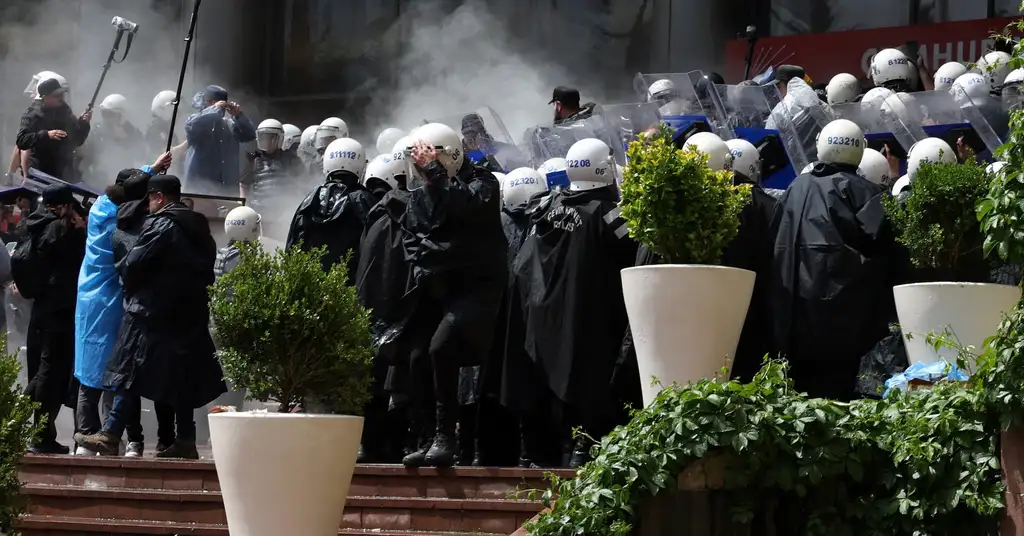
The Turkish police raid on CHP offices in Ankara on Sunday brought a dramatic and violent conclusion to a three-day standoff between Turkey’s main opposition party and a court-appointed leadership team. Officers used tear gas and rubber bullets to break through barricades, sparking outrage among supporters and intensifying the already tense political climate under President Recep Tayyip Erdogan’s government.
A Three-Day Standoff Ends in Chaos
For three days, members and loyalists of the Republican Peoples’ Party, widely known as the CHP, had taken refuge inside the party’s Ankara headquarters. They had set up makeshift barricades using buses at the courtyard entrance and stacked furniture against doors to keep out the leadership team appointed by an appeals court.
That resistance came to a sudden end on Sunday morning when riot police forced their way into the building. Local media captured chaotic scenes inside the headquarters, with clouds of tear gas filling the hallways. Journalists who were documenting the events were soon removed by officers.
Supporters inside tried to push back, even spraying fire extinguishers at advancing officers, but their efforts were quickly subdued. By the time police took full control, doors had been smashed, furniture overturned, and ground-floor windows shattered.
Ozgur Ozel Defies the Court Ruling
At the center of the standoff was Ozgur Ozel, who had been elected CHP chairperson back in November 2023 but was dismissed by a recent court decision. Footage captured inside his office during the raid showed him being formally handed the court order that stripped him of leadership. In a defiant gesture, Ozel tore up the document on the spot.
As he eventually walked out of the building, he was greeted by chants and applause from supporters waiting outside. Ozel told reporters that leaving the headquarters was only temporary and vowed that the party would return stronger, free from outside interference.
A March to Parliament
After leaving the building, Ozel led a determined march toward Turkey’s Parliament, located roughly 8 kilometers (5 miles) away. Despite heavy rain and even hailstorms, hundreds of people joined the procession along the way.
Before reaching Parliament, the group paused at the National Sovereignty Park, where Ozel addressed the crowd and asked whether they were prepared to rebuild the CHP for a third time in its history.
A Brief History of the CHP
The Republican Peoples’ Party holds enormous symbolic weight in Turkey’s political history. Founded in 1923 by Mustafa Kemal Ataturk, the country’s founding father, it was the first major political party in modern Turkey. However, its existence has been turbulent:
- It was shut down during the military coup of 1980
- It re-emerged in 1992 as a reformed political force
- It has long served as the main secular opposition to Erdogan’s ruling party
Now, with Ozel signaling a possible third rebirth, the party once again finds itself at the crossroads of Turkish political life.
Outside Parliament: A Defiant Speech
Standing before a crowd of hundreds gathered outside the legislature, Ozel declared the CHP to be effectively shut down but vowed it would rise again. Although the court ruling stripped him of his role as party chairperson, he remains an elected member of Parliament from the western province of Manisa, as well as the CHP’s group speaker — positions that allow him to retain a strong political voice.
His supporters see him as a symbol of resistance against what they consider growing authoritarianism in Turkey, while his critics accuse him of resisting lawful court decisions.
The Court Ruling That Triggered the Crisis
The political storm began last Thursday when an appeals court nullified Ozel’s election as CHP chairperson, suspending both him and members of the party’s executive board. The court ordered that Kemal Kilicdaroglu, Ozel’s predecessor, return to lead the party.
Kilicdaroglu had served as CHP chairperson for 13 years but never managed to win a national election. By contrast, Ozel — in his very first leadership role — led the party to a landmark victory against Erdogan’s Justice and Development Party in the 2024 municipal elections.
Opposition leaders argue that the court ruling is politically motivated, designed to cripple the CHP through legal pressure as it prepares for upcoming political battles.
Erdogan’s Long Shadow Over Turkish Politics
President Erdogan has ruled Turkey since 2003, first as prime minister and then as president. While the next presidential election is officially scheduled for 2028, Erdogan retains the power to call an early vote.
His chief political rival, Istanbul Mayor Ekrem Imamoglu — also a CHP member — has been imprisoned since March last year and is currently facing corruption charges. Many analysts believe the legal pressure on the CHP, including the latest court rulings, is part of a broader strategy to weaken the opposition before the next presidential race.
The Turkish government, however, insists that the country’s judiciary operates independently and is free from political influence.
Why Imamoglu Matters
Imamoglu became a major political figure after the CHP’s 2019 local election victories, particularly in Istanbul, where he was seen as a charismatic and credible challenger to Erdogan. His arrest and ongoing trial have only deepened concerns about Turkey’s democratic trajectory.
A Raid During a National Holiday
The timing of the Turkish police raid on CHP offices has raised additional eyebrows. It occurred at the very start of a nine-day national holiday for Eid al-Adha, a period when most citizens are on vacation and major cities are noticeably quieter. Critics argue that the timing was strategic, designed to limit public response and media coverage.
Ahead of the raid, Kilicdaroglu’s lawyer formally requested police intervention to clear the building, a move approved by the provincial governor.
A Political Crisis With Far-Reaching Consequences
The events in Ankara mark a major escalation in Turkey’s political tensions. With Ozel calling for the party’s rebirth and supporters rallying behind him, the CHP appears poised for a prolonged struggle — both legally and politically.
For now, Turkey finds itself watching closely as one of its most historic political parties faces a defining moment. Whether the CHP will emerge stronger or further weakened may well shape the country’s political future in the years ahead.
Author