West Bank arrests accelerated sharply over the weekend as Israeli forces expanded a military operation launched after a shooting near Nablus left four Palestinians and two Israeli soldiers dead.
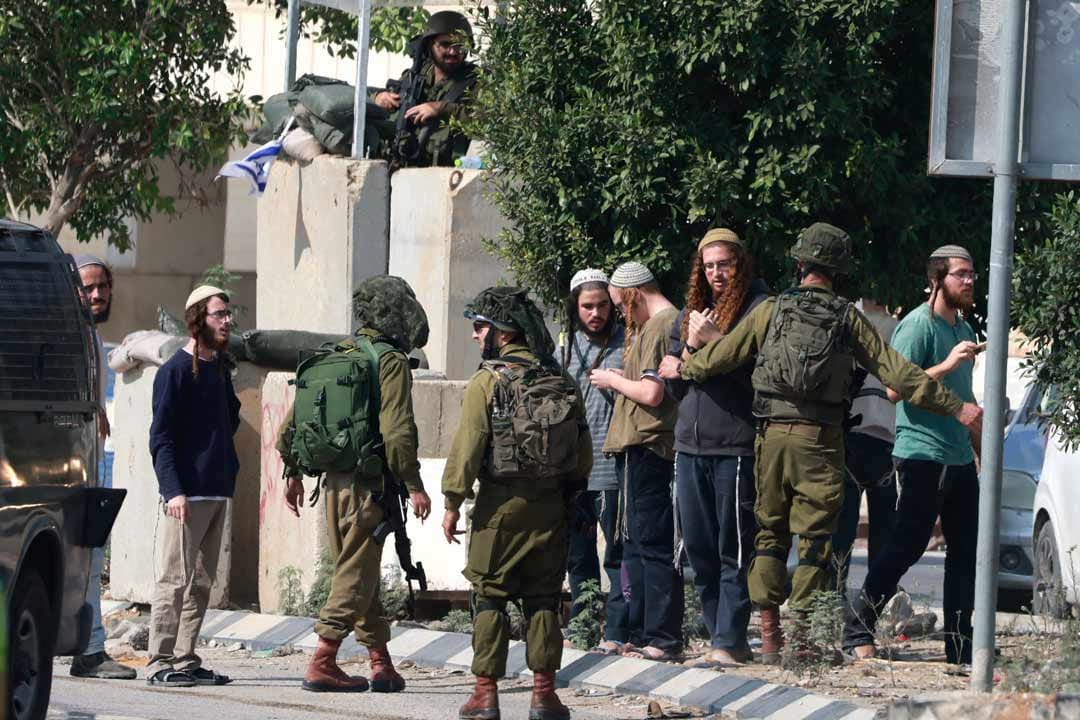
On Saturday morning, troops detained close to 50 Palestinians in the village of Tal, southwest of Nablus, where Friday’s violence occurred. Roughly 70 homes were searched during the sweep. Footage circulated by Quds News Network showed two blindfolded men being escorted away by soldiers.
The Israeli military has described the campaign as extensive, framing it as a direct response to the attack.
The Order From the Top
Prime Minister Benjamin Netanyahu and Defence Minister Israel Katz instructed the military on Friday to carry out what they called a wide-scale operation across Palestinian villages in the occupied West Bank.
The trigger was an incident near the Havat Gilad settlement, considered illegal under international law, in which two Israeli soldiers were killed and three others wounded.
Around the same period, according to witnesses and local sources, Israeli settlers attacked several Palestinian communities across the Nablus governorate, setting fire to homes and other property.
Disputed Accounts From Tal
What actually happened in Tal remains contested, with each side offering a different sequence.
Tal falls under Palestinian Authority control, and Israeli civilians are not permitted to enter it. Video from the scene shows settlers carrying rifles confronting a crowd of Palestinians. Additional footage appears to show a Palestinian man taking a weapon from a settler and fatally shooting him in what looks like self-defence. Israeli soldiers then shot and killed that man. Three other Palestinians also died.
It was the deadliest incident in the village in months.
Funerals for the four were held overnight. Residents said Israeli authorities prohibited daytime burials, and reports indicate only a restricted number of mourners were permitted to attend.
Raids Across Multiple Governorates
The operation extended well beyond Tal.
Arrests were reported in the northern city of Jenin and in surrounding towns and villages, accompanied by home raids and a substantial troop presence.
In Tubas, in the northeast, soldiers arrived in a large convoy and deployed across several neighbourhoods, searching homes for roughly three hours before moving on to the nearby Far’a refugee camp, according to the Palestinian news agency Wafa.
Other locations targeted included Far’ata, east of Qalqilya, where at least eight Palestinians were reported injured by Al Mayadeen English, along with the Aqbat Jabr refugee camp in Jericho and the village of Kobar in the Ramallah and el-Bireh governorate.
The Casualty Figures
The Palestinian Health Ministry reports that at least 87 Palestinians have been killed by Israelis in incidents across the West Bank since the start of the year. Of those, 21 deaths are attributed to settlers rather than security forces.
Critics argue settler violence has intensified because of limited international pressure on Israel over its conduct in Gaza, and because of rhetoric from far-right ministers Itamar Ben-Gvir and Bezalel Smotrich. Israeli officials reject the characterisation that settler attacks are state-sanctioned, and the military has occasionally arrested settlers involved in violent incidents, though prosecution rates have long drawn criticism from Israeli legal advocacy groups.
A UN Official’s Sharp Language
Francesca Albanese, the UN Special Rapporteur on the occupied Palestinian territories, used unusually severe terminology on Saturday, describing attacks on Palestinian civilians across the West Bank as pogroms while Gaza remains under bombardment.
Writing on X, she accused Israeli civilians and the army of acting together, arguing that responsibility extends beyond Netanyahu or what she dismissed as a few bad actors. She called for an immediate arms embargo and a halt to trade with Israel, describing both as obligations under international law.
Albanese’s mandate has been a persistent point of friction. Israel has repeatedly rejected her findings and questioned her impartiality, while her supporters maintain that her reporting reflects documented conditions on the ground. Her recommendations carry no binding force.
Israeli human rights organisations have separately urged international actors to intervene against settler violence, which they say has escalated significantly since the Gaza war began in 2023.
“Not Isolated Incidents”
Ubai Al Aboudi, a rights activist based in Ramallah, told Al Jazeera that attacks on Palestinian villages follow a systemic pattern carried out with what he described as complete impunity. In his account, these are not scattered events but something occurring throughout the territory.
He noted that Tal had already been targeted a week earlier, on July 18. Describing that incident, he said individuals whom Israeli officials characterised as hikers entered the village and set fire to a family home while the family was still inside. Residents managed to pull them out in time, which he called a miracle.
Human Rights Watch Warns of Escalation
Human Rights Watch called on the Israeli government to act immediately to prevent revenge attacks.
Sarah Sanbar, the organisation’s acting Israel and Palestine researcher, argued that authorities failed to prevent the settler attacks on Tal and now bear responsibility for stopping both reprisals and expanding military action that she said will worsen an already dangerous situation.
She described years of lawlessness and unpunished violence as having turned the West Bank into a powder keg, and said decisive intervention is urgently required.
The Underlying Dynamic
The pattern visible this week is one that has repeated across the West Bank for years, though at increasing frequency. An attack occurs. Settlers retaliate against nearby Palestinian communities. The military launches a large-scale operation involving mass detentions and home raids. Each round leaves more grievance behind than it resolves.
The territory’s fragmented administrative structure compounds the problem. Areas nominally under Palestinian Authority control sit alongside Israeli-administered zones and settlements, producing constant friction over movement, land and jurisdiction with no clear enforcement authority acceptable to both populations.
Israeli officials maintain that operations of this kind are necessary to locate those responsible for attacks on soldiers and civilians and to deter future violence. Palestinian residents and rights organisations counter that collective raids on entire villages punish populations rather than individuals.
With arrests continuing and the military operation described as ongoing, neither the immediate situation nor the underlying dispute appears close to resolution.
Author
-
Lucienne Albrecht is Luxe Chronicle’s wealth and lifestyle editor, celebrated for her elegant perspective on finance, legacy, and global luxury culture. With a flair for blending sophistication with insight, she brings a distinctly feminine voice to the world of high society and wealth.