Many Americans Believe Trump Assassination Attempts Were Staged, New Survey Reveals
Trump assassination attempts staged conspiracy theories have gained surprising traction across the United States, with a new survey revealing that a significant portion of Americans now doubt the authenticity of the recent attacks on the president. The findings highlight a troubling trend of rising distrust toward both the government and the media, fueled by viral online misinformation.
A Startling Divide in Public Opinion
According to a survey released on Monday by NewsGuard, a company that evaluates the credibility of online news sources, roughly one in four Americans believes the April shooting at the White House correspondents’ dinner was staged. The poll, conducted by YouGov between April 28 and May 4, surveyed 1,000 U.S. adults and revealed sharp partisan and generational divisions.
About one in three Democratic respondents said they believed the incident was orchestrated, compared to roughly one in eight Republicans. Younger Americans, particularly those aged 18 to 29, were also more likely than older generations to suspect the event was not genuine.
Overall, 24 percent of respondents called the Washington Hilton incident fake, 45 percent considered it legitimate, and another 32 percent admitted they simply weren’t sure what to believe.
The Indictment Behind the Headlines
The conspiracy theories continue to spread despite formal legal action against the alleged shooter. Last week, a federal grand jury in Washington, D.C. indicted Cole Tomas Allen on four felony charges, including the attempted assassination of President Donald Trump. Allen was arrested following the incident at the Washington Hilton in April.
Yet almost immediately after the shooting, social media platforms filled with unverified claims suggesting the Trump administration had orchestrated the attack to boost the president’s image, strengthen Republican momentum, and rally support for his planned White House ballroom project. No evidence has emerged to back any of these theories, but they continue circulating widely.
Distrust Toward Government and Media
Sofia Rubinson, an editor at NewsGuard, called the survey results “very striking.” She explained that the findings reflect broader public skepticism in the United States, where trust in both political institutions and traditional journalism is eroding rapidly.
According to her, more Americans are now willing to accept unverified online content as truth while doubting credible sources. This shift, she noted, cuts across party lines, with people on both ends of the political spectrum increasingly questioning what they see and hear from official channels.
The White House Responds
The Trump administration firmly rejected the conspiracy theories. White House spokesman Davis Ingle dismissed the claims in blunt terms, stating that anyone who believes the president staged his own assassination attempts is “a complete moron.”
Despite the strong pushback, the theories persist, suggesting that official denials alone may not be enough to counter the influence of online misinformation.
A Pattern of Conspiracy Across Multiple Incidents
The April incident is not the first time Trump has faced an attempt on his life. In 2024, there were two other high-profile attacks:
- A shooting at a rally in Butler, Pennsylvania
- An attempted attack at Trump International Golf Club in West Palm Beach, Florida
The survey shows that conspiracy theories surround all three incidents:
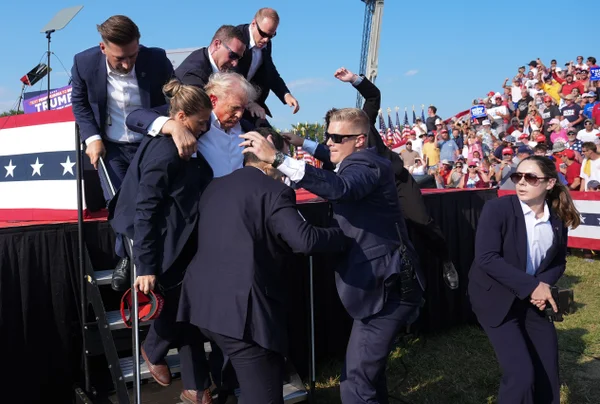
- 24 percent of Americans believe the Butler shooting was staged, including 42 percent of Democrats and just 7 percent of Republicans
- 16 percent think the golf club attempt was fake, with 26 percent of Democrats and 7 percent of Republicans agreeing
- 21 percent of Democrats believe all three events were staged, compared to 11 percent of independents and only 3 percent of Republicans
These numbers reveal how deeply political identity now shapes American perceptions of major national events.
Why Are So Many Americans Skeptical?
Joan Donovan, a Boston University professor who studies media manipulation, said the findings show how Trump’s political style — heavy on spectacle and showmanship — has fueled suspicion. She compared the modern political landscape to a “reality TV show,” noting that for many Americans, real events now feel scripted or theatrical.
Donovan also pointed out that conspiratorial thinking is rising on the political left, driven by deep uncertainty about the reliability of institutions. According to her, when people feel that systems are corrupt, broken, or unaccountable, it becomes easier to believe in hidden agendas than to accept reality at face value.
The Spread of Conspiracy Culture
Jared Holt, a senior researcher at the online extremism tracking group Open Measures, said the survey results align with troubling trends he has observed. He described conspiracy theorizing as a “gut reflex” for a growing segment of the American population.
Several factors are driving this shift:
- Declining trust in mainstream media outlets
- The rise of social media as a primary news source
- Increasing polarization between political groups
- Skepticism toward government transparency
- A constant flood of viral misinformation
Holt noted that while the numbers are “bleak,” they are not surprising given how widespread conspiratorial thinking has become.
A Reflection of a Divided Nation
Donovan added that turning to conspiracy theories is often a way for people to cope with confusing or distressing events. When institutions appear secretive or inconsistent, citizens often find it easier to believe in coordinated plots than to accept that the system itself may be flawed or failing.
The result is a political environment where even acts of violence — backed by federal indictments and physical evidence — can be dismissed as fabrications by a significant share of the public.
What This Means Going Forward
The NewsGuard findings raise serious questions about the future of American democracy and public discourse. If a large portion of the population doubts the reality of major national events, it becomes increasingly difficult to maintain shared facts, productive debate, or trust in democratic institutions.
As conspiracy theories continue to spread online, experts warn that combating misinformation will require more than denials from officials. It will demand a renewed effort to rebuild public trust, strengthen credible journalism, and promote media literacy across all age groups and political affiliations.
For now, the belief that Trump assassination attempts were staged stands as a powerful symbol of just how deep America’s crisis of trust has become.
Author