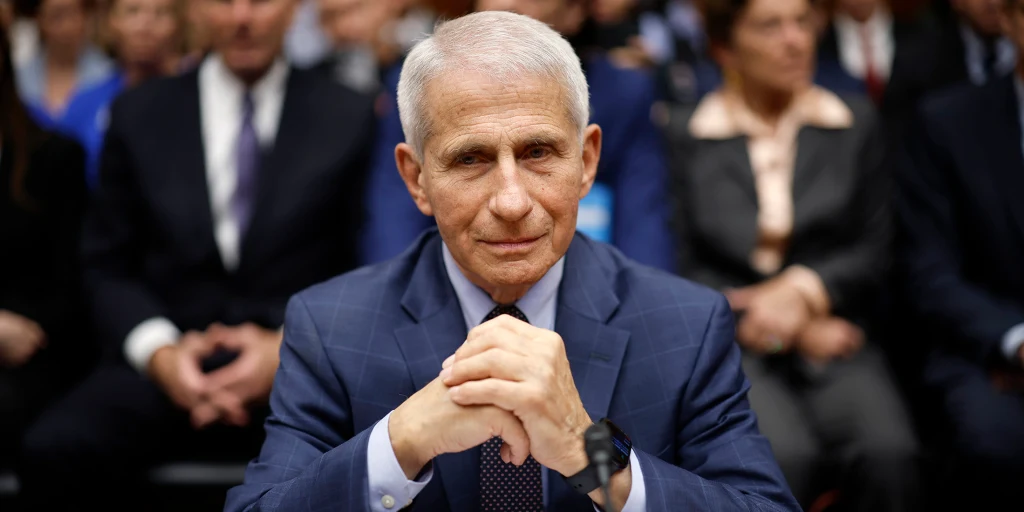
The Fauci diaries released by Rand Paul run to more than a thousand pages, and they arrived one day before the Kentucky Republican is set to question the country’s former top infectious disease official under subpoena. The timing was not accidental.
Paul chairs the Senate Homeland Security Committee, which is investigating how the COVID-19 pandemic began. He has argued for years that the virus escaped from a laboratory in Wuhan rather than passing naturally from animals to people, and he has accused Fauci and other officials of misleading Congress and the public about it.
The entries span three years, beginning in December 2019 — just before the United States declared a public health emergency — and ending in December 2022, when Fauci left his post as director of the National Institute of Allergy and Infectious Diseases after nearly four decades in the job.
Fauci declined to comment on the release. Paul’s office did not explain how the material was obtained. Health and Human Services Secretary Robert F. Kennedy Jr. told a television interviewer that the documents were pulled from government servers in recent months.
The Origins Question
The scientific picture remains contested. Many researchers hold that the virus most likely moved from bats into another species and then into humans handling animals at a Wuhan market, where the earliest known cases surfaced in late 2019. The FBI has reached a different conclusion, assessing that a laboratory incident was the more probable explanation. In January 2025 the CIA also came down on the side of a lab origin, while labeling its own confidence in that judgment low.
Several journal entries capture Fauci working through the uncertainty in real time. In January 2020 he wrote that the market functioned as an amplifier rather than the true source, while still assuming a jump from animals to humans had occurred somewhere. About a week later he noted a conference call during which several prominent infectious disease specialists raised the possibility that the virus had not emerged naturally at all.
Paul seized on that gap. He accused Fauci of confiding doubts privately while telling the public a lab origin was implausible and that wild animals at the market were almost certainly responsible, calling the discrepancy astonishing.
Fauci’s own account of that period reads differently. In a May 2021 entry, he described losing control of the narrative around accusations that he had reversed himself. His position, as he framed it, had always been that natural spillover was the likeliest explanation — but with speculation mounting, he had begun saying publicly that nobody could claim certainty, himself included, and that a full investigation was warranted.
An Unwelcome Kind of Fame
A large share of the journal is devoted to something else entirely: what it felt like to become one of the most recognized people on the planet almost overnight.
In May 2020 he described the scale of the attention as explosive and unimaginable, writing without hyperbole that he had become the most talked-about person in the country. He also noted that the president seemed taken with him despite the fact that Fauci was pulling attention away from the White House, describing the dynamic between them as unusual and evolving.
He kept track of the cultural spillover — a novelist telling him she had modeled a character on him, a movie star portraying him in a sketch comedy show, a comedian’s parody, an email from a legendary singer. He collected images of the masks, murals, portraits and bobbleheads bearing his likeness.
But the tone was not uniformly amused. Other entries record embarrassment at the attention and unease about what that level of visibility might mean for his personal safety.
The Trump Relationship, in His Own Words
Fauci’s notes on President Donald Trump swing between cordial and exasperated.
Early on he recorded genuinely positive exchanges and appeared frustrated by press coverage framing the two as adversaries. He addressed one widely circulated photograph that appeared to show him burying his face in his hand during a presidential press briefing, insisting that was never what he meant to convey.
Elsewhere the frustration is unmistakable. He described briefings as rambling and laborious, and recounted confrontations in which the president accused him of working against him.
One exchange stands out. Before a May 2020 event announcing the vaccine development initiative, Trump reportedly pulled him aside and told him he was costing the country trillions of dollars, then softened, saying the two of them were fine and that he respected Fauci. Trump then objected to officials wearing masks at the event, arguing it sent the wrong message. Fauci pushed back. The president asked once more whether they were good. Fauci wrote that he answered yes.
The relationship deteriorated by that August. Fauci described the president behaving erratically, expressed frustration at public criticism aimed his way, and at one point used a blunt insult after Trump shared inaccurate death figures.
Restrictions and Reopenings
Fauci held no authority to close anything, but his words carried enormous weight with officials who did.
In March 2020 he wrote of persuading New York City’s mayor to shut the school system, while acknowledging the mayor had largely made the call already based on Fauci’s public statements. He described a similar conversation with a member of the California governor’s staff regarding closures of schools and restaurants.
By August 2020 his position had shifted toward flexibility. He argued that no single approach fit every community, that local infection rates should drive decisions, and that reopening schools should be the starting assumption. At the same time, he objected to administration officials pressing for immediate reopening everywhere.
He also pushed for loosening guidance. In May 2021 he wrote that he could no longer defend the CDC’s stance on outdoor masking and worried the agency was damaging its own credibility. After the policy changed roughly a week later, he noted wryly that his loudest critics would never realize he had been the one who prompted it.
The Feud With Paul
The journals confirm that the animosity ran both ways.
In April 2021 Fauci wrote that Paul was among those pushing conspiracy theories linking him personally to the virus, and mentioned hearing that a coordinated effort existed to destroy him. Weeks later, after his early pandemic emails were made public, he expressed disbelief that critics were treating the release as vindication when the messages showed him consistently courteous toward the president.
Recounting a July 2021 hearing where the two clashed over gain-of-function funding, Fauci wrote that he looked Paul in the eye and told him that if anyone in the room was lying, it was the senator.
By that October, his summary was shorter: the assault continues.
Author
-
Lucienne Albrecht is Luxe Chronicle’s wealth and lifestyle editor, celebrated for her elegant perspective on finance, legacy, and global luxury culture. With a flair for blending sophistication with insight, she brings a distinctly feminine voice to the world of high society and wealth.