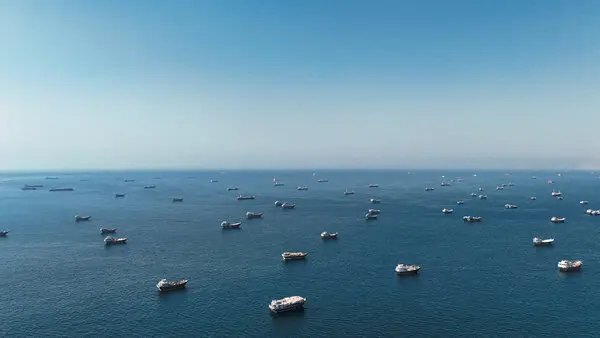
The attack on the MSC ship has sharpened fears over the safety of commercial vessels in the Persian Gulf, after a cargo ship owned by the world’s largest container shipping firm was struck by projectiles in an Iraqi port. The incident underscores how dangerous regional waters have become, even as the United States and Iran attempt to negotiate the reopening of the vital Strait of Hormuz.
What Happened at Umm Qasr
The vessel at the center of the incident, the Sariska V, is owned by the Geneva-based Mediterranean Shipping Company, or MSC. According to the company, the ship was struck by two projectiles on Monday as it departed the Port of Umm Qasr in Iraq.
Despite the violence of the strike, MSC confirmed on Tuesday that all crew members were safe and unharmed. The vessel had been bound for Qatar’s Hamad Port, located south of Doha, according to maritime data sources.
Iran Claims Responsibility
The Islamic Revolutionary Guards Corps claimed responsibility for the attack on the MSC ship. According to Tasnim, a semiofficial outlet affiliated with the Guards, Iran said it acted in retaliation for U.S. strikes on an Iranian vessel in the Gulf of Oman.
The Revolutionary Guards reportedly justified the strike by describing the ship as belonging to what they called the “American-Zionist enemy,” a characterization the shipping company firmly rejected.
MSC Pushes Back
MSC was quick to dispute Iran’s framing of the attack, insisting the strike was completely unjustified. The company stressed that it is a neutral commercial carrier with no ties to either the United States or Israel.
It also pointed to its ownership structure as evidence of its independence, noting that it is privately held and owned by the children of Gianluigi Aponte, who founded the company in 1970.
The company expressed deep concern over what it called unprovoked attacks, warning of the dangers they pose to innocent seafarers and to essential maritime trade across the region. With a fleet of 1,000 vessels and a workforce of 200,000 people worldwide, MSC’s alarm carries significant weight in the global shipping industry.
A Pattern of US Strikes
The attack did not occur in isolation. It came amid an escalating campaign by U.S. forces against vessels attempting to reach Iranian ports.
On Tuesday, U.S. Central Command said its forces attacked and disabled an oil tanker bound for an Iranian port, firing a missile directly into the ship’s engine room. Just days earlier, on Friday, the U.S. disabled another vessel, the Lian Star, as it tried to sail toward Iran from the Gulf of Oman.
In that case, a U.S. aircraft fired a Hellfire missile into the engine room after the crew ignored warnings that the ship was violating the American blockade. U.S. Central Command stated bluntly that the vessel was no longer heading to Iran.
The Strait of Hormuz at Stake
These confrontations are unfolding against the backdrop of high-stakes negotiations over the Strait of Hormuz. The strait is one of the world’s most critical energy corridors, with roughly a fifth of global oil and gas passing through it before the conflict in Iran began on February 28.
The U.S. blockade has had a sweeping impact on regional shipping. As of Monday, U.S. Central Command had disabled five commercial vessels and redirected 121 others as part of its effort to enforce the blockade against Iran.
A Region on Edge
The broader picture reveals just how perilous these waters have become. According to the United Kingdom Maritime Trade Operations Center, more than 25 vessels have been attacked in the region since late February.
The attack on the MSC ship adds to a growing list of incidents that threaten not only individual crews but the stability of global trade routes.
The key tensions now defining the crisis include:
- A tit-for-tat cycle of strikes between U.S. forces and Iran targeting commercial vessels
- The vulnerability of neutral shipping companies caught in a geopolitical conflict
- The economic stakes tied to the Strait of Hormuz and global energy supplies
- Ongoing yet fragile negotiations aimed at reopening the strait
What Comes Next
As diplomacy and military pressure unfold side by side, the attack on the Sariska V serves as a stark reminder of the risks facing maritime trade in one of the world’s most strategically important regions.
For shipping firms like MSC, the danger is no longer abstract. Neutral status offers little protection when vessels become targets in a wider struggle between the United States and Iran. Unless negotiations over the Strait of Hormuz produce a breakthrough, the threat to seafarers and global commerce is likely to persist, leaving an already volatile region on a knife’s edge.
Author