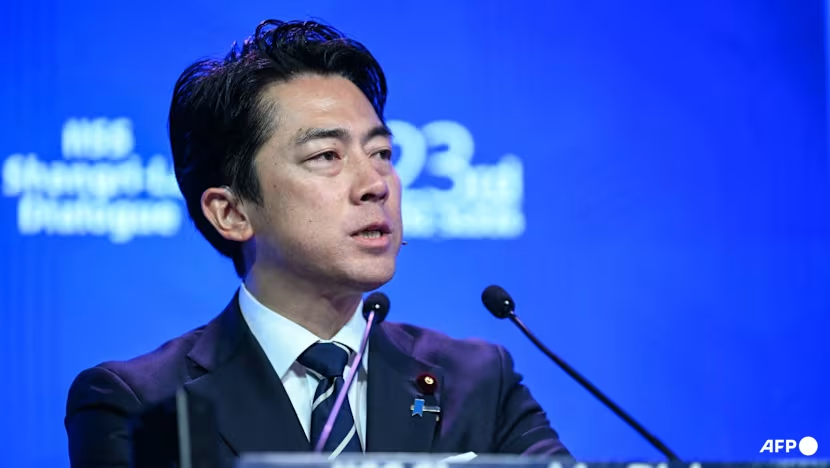
Amid rising friction with Beijing, Japan has pushed back firmly against accusations of neo-militarism, with Defense Minister Shinjiro Koizumi insisting that Tokyo remains committed to open dialogue even as it strengthens its defenses. His remarks, delivered at a major regional security forum, directly challenged China’s characterization of Japan and reframed questions of transparency and military buildup back toward Beijing.
An Open Door, Even Amid Change
Speaking at the IISS Shangri-La Dialogue, Koizumi made clear that Japan’s willingness to engage has not diminished despite its evolving defense posture. He declared that Japan’s door to dialogue is always open to the international community, even as the country increases defense spending and revises its guidelines on arms exports.
He grounded his argument in Japan’s record, stating that Tokyo has consistently respected international law. Koizumi emphasized that Japan’s path as a peace-loving nation has long been valued across the region and by the wider international community, adding that this reality could not be shaken by false claims because it is simply a fact.
Confronting the ‘Neo-Militarism’ Label
The defense minister responded directly to the charge that Japan is pursuing neo-militarism, saying nothing could be further from the truth. His comments came after China’s defense ministry, on May 28, called on the international community to jointly contain what it described as Japan’s neo-militarism, according to state media.
The accusation arrives as Japan has taken concrete steps to broaden its defense capabilities. Among the most significant moves are:
- Lifting its longstanding ban on lethal arms exports
- Weighing changes to Article 9 of its constitution, which renounces war and the maintenance of armed forces
Koizumi turned the criticism around with a pointed comparison. He invited his audience to consider that there exists a country with a vast arsenal of nuclear weapons and strategic bombers, while Japan possesses neither. He found it strange, he said, that Japan should nonetheless be the one branded neo-militarist.
A Notable Absence
Part of Koizumi’s frustration centered on who was, and was not, present at the forum. He highlighted the absence of a ministerial-level Chinese official, expressing sadness that he was unable to meet his counterpart, Dong Jun, at the gathering.
Beijing instead sent a lower-level delegation led by Major General Meng Xiangqing of the People’s Liberation Army National Defence University, after Dong skipped the Dialogue for a second consecutive year. Koizumi acknowledged that differences in perception and friction naturally arise between nations, but he argued that repeating unfounded claims in the other side’s absence was not the kind of engagement the moment required.
Meng, for his part, had already taken a swipe at Tokyo earlier in the forum. He noted that 2026 marks the 80th anniversary of the opening of the International Military Tribunal for the Far East, where Japanese leaders were tried in 1946 for crimes committed during World War II, a reminder clearly aimed at Japan’s wartime history.
Transparency as the Foundation
Beyond rebutting China’s claims, Koizumi laid out a broader vision for regional stability built on what he framed as “trust, transparency and talks.” He argued that transparency serves as the baseline for reducing tensions and preventing crises in the Asia-Pacific.
He pledged that Tokyo would build up its defense capabilities with a high level of transparency. Crucially, he tied this buildup to a changing security landscape, explaining that Japan is reinforcing its capabilities in response to emerging forms of warfare around the world, including artificial intelligence, cyber warfare, and the growing use of unmanned systems. Japan, he said, would make the necessary preparations with a sense of responsibility.
Turning the Spotlight on Beijing
Koizumi did not shy away from raising concerns about China’s own conduct. He pointed out that Beijing continues to increase its defense spending at a high level and is rapidly expanding its military capabilities across a wide range of areas without sufficient transparency.
He situated this concern within a broader international context, noting that worries about China’s rapid and opaque military buildup are not Japan’s alone. He stressed that this lack of transparency has caused serious concern both in Tokyo and across the international community.
The Case for Candid Dialogue
Despite the sharp exchanges, Koizumi’s central message returned repeatedly to the value of communication. He argued that Japan considers it essential to maintain persistent, candid dialogue without avoiding difficult issues.
In his view, disagreement is precisely the reason talks matter. He acknowledged that nations will inevitably hold different positions and perspectives, but contended that this divergence is exactly why dialogue is necessary rather than a reason to abandon it.
The Bottom Line
Japan’s rejection of the neo-militarism label reflects a delicate balancing act at the heart of Asia-Pacific security. Tokyo is simultaneously expanding its military capabilities, defending its peaceful postwar identity, and calling for greater openness, all while trading accusations with a far larger and more heavily armed neighbor.
Koizumi’s remarks captured this tension clearly. By emphasizing transparency, dialogue, and responsibility while questioning China’s own military opacity and absence from the forum, he sought to position Japan as both prepared and reasonable. As the region navigates new forms of warfare and deepening rivalries, the contrast between Japan’s call for candid talks and the war of words playing out in Beijing’s absence may shape the tone of Asia-Pacific security debates in the months ahead.
Author