Spirit Airlines Shutdown Marks the End of a Budget Travel Era
The Spirit Airlines shutdown brought a dramatic close to one of America’s most recognizable budget carriers, ending a 34-year run that transformed how millions of people traveled across the country, the Caribbean, and Latin America. At 3 a.m. Eastern Time on Saturday, the bright yellow jets that had become a fixture in American skies came to a permanent halt, leaving behind grounded planes, shocked employees, and stranded passengers scrambling for alternatives.
A First-Time Flyer on a Final-Day Flight
At Baltimore/Washington International Thurgood Marshall Airport on Friday afternoon, Jeremiah Burton was preparing for an experience he had never had before — boarding an airplane for the very first time. The 45-year-old HVAC technician was on his way to New Orleans to meet his daughter and her newborn twins.
He told CNBC he had simply searched online for the cheapest available ticket and ended up paying around $500 for the round trip. What he didn’t know as he waited at the gate was that the airline he had chosen was just hours away from disappearing entirely.
A Bailout That Fell Apart at the Last Minute
Spirit’s collapse came after a final attempt to secure financial rescue from the Trump administration unraveled. Bondholders rejected an eleventh-hour deal that could have injected up to $500 million into the struggling airline. The proposed agreement would have placed the federal government ahead of other creditors and given it as much as a 90 percent stake in the company.
According to a source familiar with the discussions, Commerce Secretary Howard Lutnick personally called Spirit CEO Dave Davis to deliver the news that no agreement could be reached. Bondholders quickly followed up with a letter to Spirit’s board confirming what insiders had been fearing — the airline was finished.
Empty Terminals and Silent Gates
By the early hours of Saturday morning, Spirit’s website and mobile app displayed only a single message — all flights had been canceled and customer service was no longer available. The note thanked travelers for 34 years of bringing families and friends together.
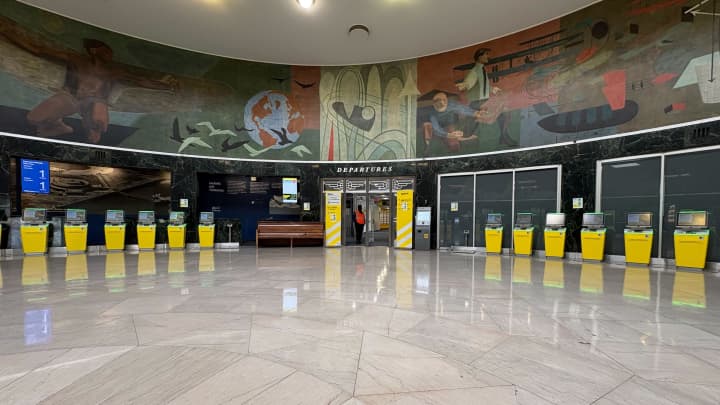
Inside LaGuardia Airport’s historic Marine Air Terminal, which had served as Spirit’s New York hub, the silence was striking. By midday, even the Cibo Express café had shut down, with no customers left to serve. The bright yellow check-in kiosks displayed a final farewell, while the last TSA officer on duty was sent home early.
Major airlines including United, American, Frontier, Southwest, and JetBlue stepped up immediately, capping ticket prices to help stranded travelers find their way home. United alone reported that around 14,000 former Spirit passengers booked flights with the carrier on Saturday. JetBlue announced new routes from Fort Lauderdale to destinations as varied as Cali, Colombia, and Nashville, Tennessee.
A Captain’s Bittersweet Final Flight
Some of the most emotional moments unfolded among Spirit’s own crew. Captain Jon Jackson had been scheduled to fly his retirement flight on Saturday — but his airline shut down before he ever got the chance.
Instead, he hopped aboard a Southwest flight to get from Fort Lauderdale back to Baltimore. When his fellow passengers and the Southwest crew learned what had happened, they organized a heartfelt tribute. The aircraft was greeted with a water cannon salute upon arrival, and Jackson walked off the jet bridge to applause and a small reception.
Years of Mounting Trouble
While the final blow came suddenly, Spirit’s troubles had been building for years. The airline last turned a profit back in 2019. After thriving throughout the 2010s by filling planes with cost-conscious travelers, it found itself increasingly squeezed by larger, better-funded competitors like Delta, United, and American.
Several factors stacked against Spirit:
- Major airlines began offering their own basic-economy fares, eroding Spirit’s pricing edge
- A failed merger with JetBlue, blocked by the Biden Justice Department, derailed the carrier’s recovery plans
- An engine defect grounded a significant portion of its fleet
- The travel industry shifted toward premium cabin customers willing to pay thousands for upgraded experiences
- Surging jet fuel prices, driven by the recent war in Iran, became the final unmanageable burden
In August of last year, Spirit filed for bankruptcy protection for the second time in under twelve months. Industry analysts said the airline had failed to make tough decisions during its first filing, leaving it vulnerable when fuel costs spiked again.
17,000 Jobs Lost in a Single Stroke
The collapse wiped out roughly 17,000 direct and indirect jobs. Jason Ambrosi, international president of the Air Line Pilots Association, said the real impact of the shutdown wouldn’t be felt in corporate boardrooms but in the homes of pilots, flight attendants, mechanics, dispatchers, and ground crew workers.
Sara Nelson, president of the Association of Flight Attendants-CWA, which represents Spirit’s roughly 5,000 flight attendants, sent a letter to Transportation Secretary Sean Duffy and acting Labor Secretary Keith Sonderling. She urged them to ensure flight attendants receive their earned wages, vacation pay, and per diems through the bankruptcy process. She also requested a $600 weekly federal supplement on top of state unemployment to help affected families stay afloat.
The Airline America “Loved to Hate”
Despite holding only about 4 percent of US market share, Spirit had a cultural footprint far larger than its size. Aviation analyst Henry Harteveldt called Spirit a true pioneer of discount travel, even though it earned a reputation as the carrier Americans loved to mock — thanks to its no-frills cabins, occasional customer service mishaps, and spotty reliability in earlier years.
Late-night comedians frequently made the airline a target. Jimmy Fallon recently joked that with $500 million from the Trump administration, Spirit’s planes could have had two wings again.
Yet for all the jokes, Spirit had a loyal fan base. Travelers like Kara Snyder, a 30-year-old health insurance sales worker, said that for a short two-hour flight, she could easily put up with cramped seats and minimal perks in exchange for a low fare.
The Last Hours Inside Spirit’s War Room
At Spirit’s headquarters in Dania Beach, Florida, the executive team gathered Friday evening to watch the airline’s final flights touch down. News had already broken that operations would cease at 3 a.m. on Saturday.
Air traffic controllers and rival airline crews offered emotional farewells. An American Airlines employee was heard wishing a Spirit flight crew good luck, expressing sorrow over what had happened.
The very last Spirit flight, NK1833 from Detroit to Dallas Fort Worth International, carried 175 passengers. Just before touching down past midnight, one of the pilots asked the tower if any other Spirit flights were still inbound. The controller checked and confirmed they were likely the last. He thanked the crew for their work and wished them the best.
A Final Goodbye From the Cockpit
Wes Egan, a Spirit dispatcher with 23 years of service, was working in the airline’s Orlando operations center late Friday night when senior managers informed staff at around 11:30 p.m. that the end was hours away. One pilot reached out asking for confirmation about the airline’s fate.
Egan sent back a brief message through the cockpit alert system. It read that unofficially, all flying would stop at 3 a.m. on May 2 — and ended with a simple, heartfelt farewell wishing his fellow aviator godspeed.
The End of an Era
The Spirit Airlines shutdown closes a remarkable chapter in American aviation. For more than three decades, the carrier opened up affordable travel to people who had never flown before, connected families across borders, and challenged the dominance of legacy airlines.
Now, with its planes grounded and thousands of workers searching for what comes next, the bright yellow jets that once defined budget travel in America have made their final descent.
Author