Judge Blocks Trump’s Mail Voting Order Again as Midterm Ballots Start Going Out
The Trump mail voting executive order hit another wall on Friday, when a federal judge extended her ruling barring the U.S. Postal Service from carrying it out. The timing matters enormously: the first mail ballots of the midterm cycle are already in the mail, and the administration is running short on runway to change how tens of millions of Americans vote.
What the Judge Actually Did
U.S. District Court Judge Indira Talwani issued a preliminary injunction, which supersedes the temporary order she had put in place earlier. The practical effect is the same for now — the Postal Service cannot move forward with the plan it drew up to implement the president’s directive — but a preliminary injunction carries more weight and typically stays in force while litigation continues.
Talwani, appointed to the bench by President Barack Obama, leaned heavily on the calendar in explaining her decision. With ballots already going out, there is simply no realistic window for election offices across the country to rebuild their procedures around a new federal directive.
The Administration Is Fighting on Two Fronts
The Justice Department had already gone to the Supreme Court asking the justices to dissolve Talwani’s earlier temporary order. On Friday, it notified her that it also intends to challenge the new injunction at the U.S. 1st Circuit Court of Appeals.
That leaves the dispute moving through two appellate tracks at once, with the clock working against the government in both.
Ballots Are Already in Voters’ Hands
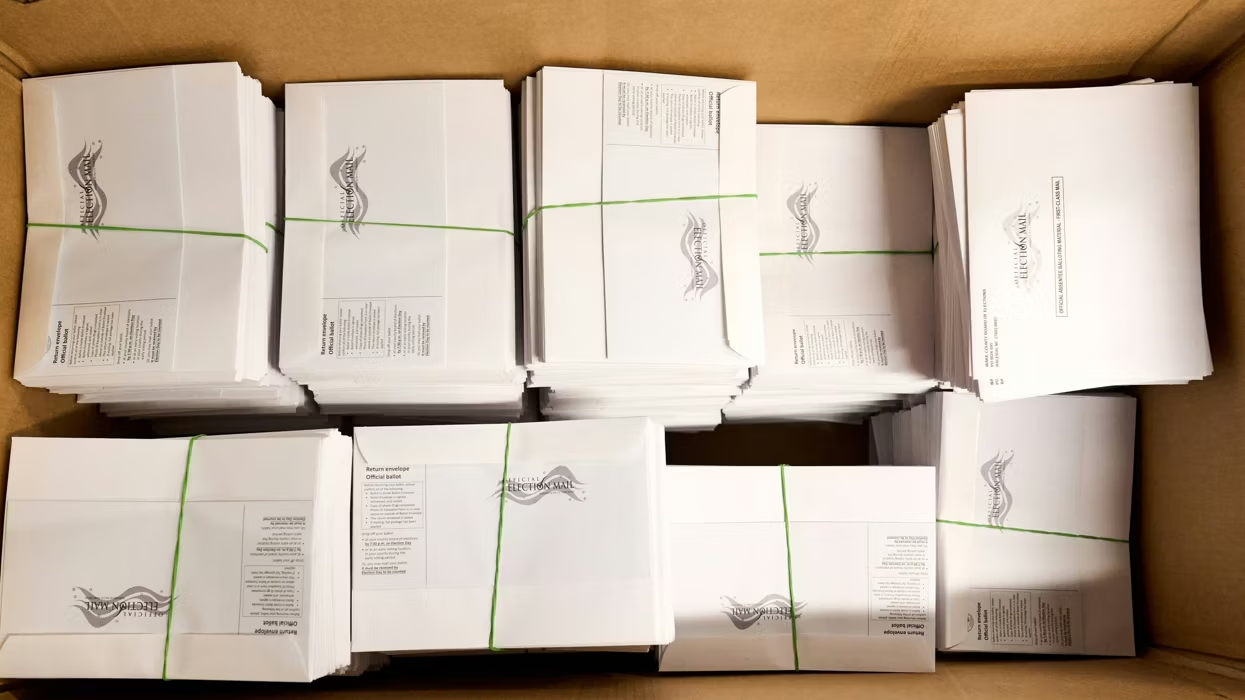
North Carolina started mailing ballots to voters on Friday, and other states are close behind. Once ballots are physically in circulation, the argument for a sudden procedural overhaul becomes much harder to sustain.
This is not a niche issue. Close to a third of the American electorate votes by mail. Election administrators have said repeatedly that reprogramming their systems, retraining staff, and updating voter instructions to satisfy new Postal Service requirements is not something that can be done in weeks.
With control of both chambers of Congress on the line this November, the stakes attached to those logistics are considerable.
Trump’s Long Campaign Against Mail Ballots
The president has spent years attacking voting by mail, despite having repeatedly used it to cast his own ballot. He has blamed the practice for his 2020 defeat and promoted fraud allegations that have not held up under scrutiny — and, so far, he has been unable to dislodge a voting method that predates his political career by generations.
This is not his first attempt to reshape election rules by executive action. An earlier order, issued last year, included a demand that prospective voters produce documentary proof of citizenship when registering. Federal judges stopped it, reasoning that the Constitution assigns authority over election procedures to the states, and in certain areas to Congress — but not to the White House.
How This Case Reached Its Current Point
The mail voting order came out in March. Democrats and voting rights organizations responded with a wave of lawsuits, two of which landed in Talwani’s courtroom. In June, she froze the order, ruling that it could not take effect before November.
Then the case took a turn. Late last month, the Supreme Court threw out that ruling. Notably, the conservative majority did not endorse the legality of the order itself. Instead, the justices concluded the lawsuits had arrived too early — filed before the Postal Service had actually published a rule spelling out how the directive would work in practice.
That rule surfaced just ahead of the Supreme Court’s decision. The plaintiffs promptly filed again, this time with a concrete policy to challenge rather than a general presidential instruction. Friday’s injunction is the result.
Why the Procedural Detail Matters
The Supreme Court’s earlier reasoning is worth dwelling on, because it shapes everything that follows.
- The justices did not bless the order. They sidestepped the substance entirely.
- Their objection was about ripeness — whether the challenge came before there was anything concrete to challenge.
- The Postal Service rule removed that obstacle. Plaintiffs now point to a specific set of directives with specific operational consequences.
In other words, the government won a round on timing, not on the merits. The underlying constitutional question — whether a president can direct changes to how ballots are handled — remains open.
What Happens Next
Several things are worth watching in the coming weeks:
The 1st Circuit appeal. The appeals court could uphold Talwani’s injunction, narrow it, or set it aside. Any of those outcomes would likely trigger another emergency application to the Supreme Court.
The Supreme Court’s posture. The justices have already shown a willingness to intervene in this dispute once. Whether they treat the re-filed suits differently now that a formal rule exists is the central unknown.
The calendar itself. Every day that passes with ballots in circulation strengthens the argument that a mid-election change would cause more disruption than any policy benefit could justify. Courts are historically reluctant to alter voting rules close to an election, a principle that has cut in different directions in different cases but generally favors stability.
The Bigger Picture
Strip away the procedural layers and this case comes down to a straightforward question about who sets the rules of American elections. States have run their own voting systems since the founding, with Congress holding limited authority to intervene in federal contests. The executive branch has never had a clear role.
For now, mail voting proceeds as it has for years. Ballots are moving, deadlines are fixed, and the administration’s order sits blocked. Whether that holds through November will be decided in appellate courtrooms — likely within weeks, and possibly by the Supreme Court a second time.
Author