London Stabbing Attempted Murder Charges Filed in Antisemitic Terror Case
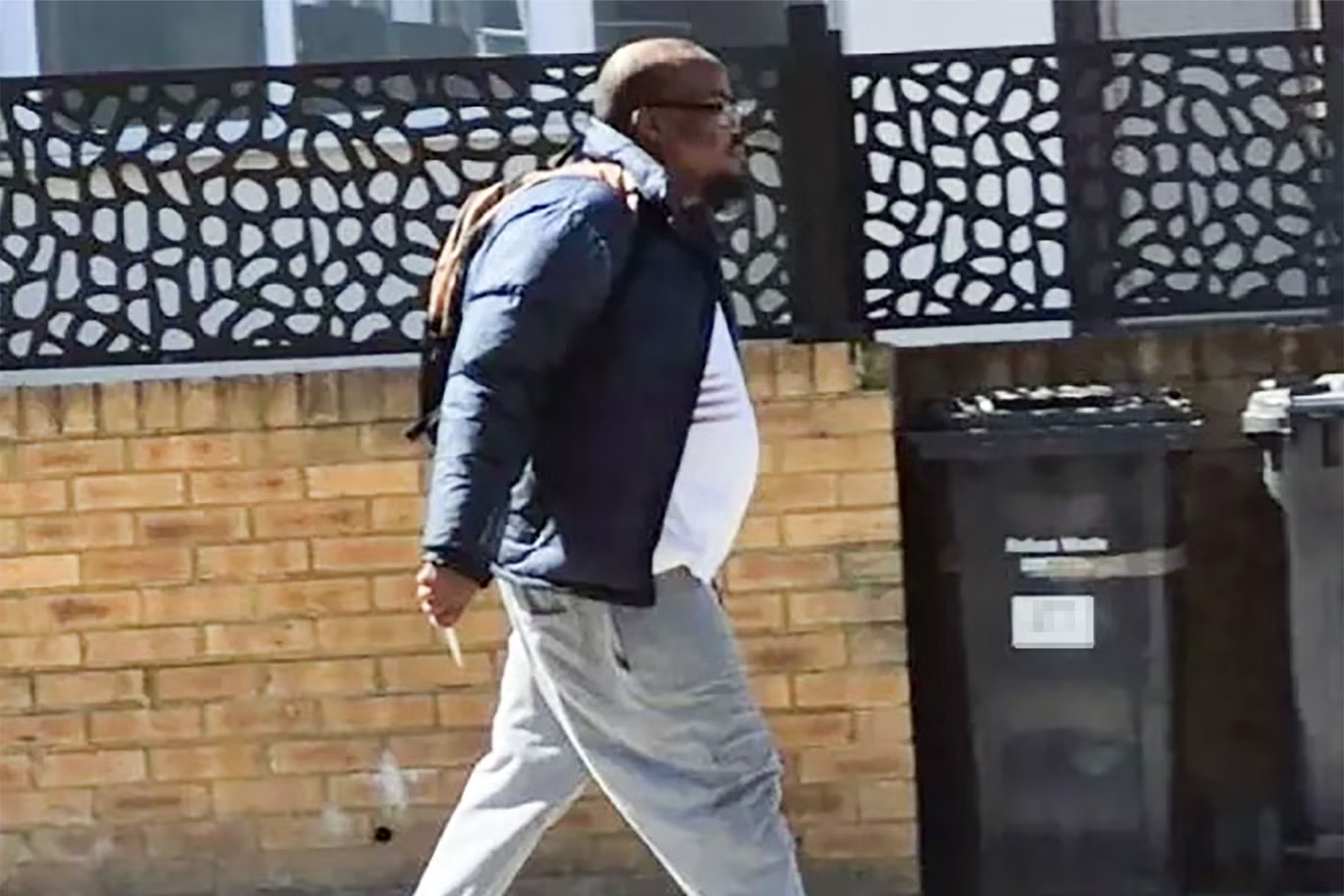
The London stabbing attempted murder case is now moving forward in the courts, after the Metropolitan Police announced Friday that 45-year-old Essa Suleiman has been charged following a Counter Terrorism Policing investigation. The charges relate to a violent antisemitic attack in which two Jewish men were stabbed on Wednesday in north London, as well as a separate incident on the same day in south London.
The case has shaken Britain’s Jewish community, intensified scrutiny of the country’s counter-radicalization programs, and reignited debate over how effectively the British government is protecting Jewish citizens at a time of rising antisemitic violence.
What Suleiman Has Been Charged With
According to the Metropolitan Police, Suleiman, a Somalia-born British citizen, faces several serious charges connected to two separate incidents on the same day.
The charges include:
- Two counts of attempted murder in connection with the Golders Green attack.
- One count of possession of a bladed article in a public place.
- An additional count of attempted murder relating to a separate incident in south London.
He has been remanded in custody and was due to appear at Westminster Magistrates’ Court later on Friday. The combination of charges signals just how serious authorities consider the case — and how broad the alleged pattern of violence appears to be.
What Happened in Golders Green
The most high-profile portion of the case involves the stabbing of two Jewish men in Golders Green, a heavily Jewish neighborhood in north London. The attack took place on Wednesday and immediately drew comparisons to other recent antisemitic incidents across the UK and Europe.
Key facts about the Golders Green attack:
- The two victims have been identified as Shloime Rand, 34, and Moshe Shine, 76.
- Both men were taken to the hospital in serious condition.
- Rand has since been discharged.
- Shine remains hospitalized in stable condition.
- The attack happened in one of the UK’s most prominent Jewish neighborhoods.
For a community already on edge after a series of antisemitic incidents, the location of the attack carried symbolic weight. Golders Green is widely considered a center of Jewish life in London, home to kosher restaurants, several Jewish schools, and dozens of synagogues.
A Second Attack the Same Day
Investigators have also linked Suleiman to another violent incident in south London earlier the same day. While details remain limited, the additional attempted murder charge tied to that incident suggests authorities believe the events may be connected as part of a broader pattern of violence.
For police, charging Suleiman in two separate incidents on the same day reinforces the urgency of the case and the seriousness of the alleged conduct.
A Disturbing Criminal History Resurfaces
One of the most striking elements of the case is what reporting has uncovered about Suleiman’s past. According to The Telegraph, he was previously jailed in 2008 for stabbing a police officer.
Details reported about that earlier case include:
- Suleiman was 27 years old at the time of the 2008 incident.
- He stabbed Police Constable Neil Sampson in the head, face, and leg with a bread knife during a violent confrontation.
- According to The Daily Mail, he also stabbed Sampson’s German Shepherd, Anya, in the stomach as she tried to protect the officer.
- Anya was later awarded the PDSA Gold Medal for animal bravery.
- Suleiman received an indefinite sentence of imprisonment for public protection, with no set release date.
The judge in that case had recommended Suleiman remain incarcerated unless he was no longer considered a risk to the public. It is not yet clear when he was released, or whether that judicial recommendation was fully considered as part of the decision.
That history is now drawing intense public attention as questions mount over how someone with this background was able to allegedly commit such serious offenses again.
Counter-Radicalization Concerns Rise Again
The case has also reopened a difficult debate over Britain’s counter-radicalization efforts. Police confirmed on Thursday that Suleiman was referred to the government’s Prevent program in 2020, but his case was closed within six weeks.
Prevent has been under increased scrutiny in recent years, particularly after another high-profile case:
- Axel Rudakubana, who murdered three children in Southport in July 2024, had been referred to Prevent three times in three years.
- Each time, the case was closed without long-term intervention.
- Critics argue that the program is too quick to dismiss serious warning signs.
- Supporters say the system is overwhelmed and underfunded.
The new revelations regarding Suleiman are likely to fuel even more public and political pressure to overhaul how the UK identifies, monitors, and intervenes with individuals at risk of radicalization.
Government Response and Heightened Threat Level
In the wake of Wednesday’s attack, the UK national terrorism threat level has been raised to its second-highest level. That designation indicates that another terrorist attack within the next six months is considered highly likely.
Prime Minister Keir Starmer responded with strong public statements, vowing more aggressive action to protect Jewish citizens. The community has been repeatedly targeted in recent months, and the latest attack has only intensified the sense that the government must do more.
Starmer’s response has included:
- Pledging stronger measures to protect Jewish people in the UK.
- Promising to seek tougher powers to combat foreign-state threats, particularly from Iran.
- Calling for greater accountability for those who incite or glorify violence.
The political stakes of the response are clear: continuing public concern about antisemitism, combined with a complex security environment, is shaping how the government talks about extremism and protest in real time.
A Foreign-Linked Terror Group Claims Responsibility
In a particularly alarming development, a newly formed terror group calling itself Harakat Ashab al-Yamin al-Islamiya (HAYI) has claimed responsibility for the attack. The group is believed to have links to Iran and has been associated with several recent antisemitic incidents in the UK and elsewhere in Europe.
In response, Starmer signaled a tougher stance, declaring that his government would seek stronger powers to confront the threat from states like Iran, which he said are working to target British Jews.
This adds another dimension to the case:
- The attack is no longer being treated as an isolated incident.
- It’s part of a broader concern about state-linked antisemitic violence.
- It elevates the case to international and geopolitical importance.
- It highlights the need for cross-border intelligence cooperation.
For the UK, navigating these external threats while managing domestic tensions has become a complex, high-stakes challenge.
Tensions Around Protests and Free Speech
The Prime Minister’s remarks went beyond the immediate attack, touching on broader debates about free speech, protests, and incitement.
Starmer specifically addressed:
- The chant “globalize the intifada,” which he described as a call for “terrorism against Jews.”
- People marching alongside imagery glorifying terror attacks, such as paraglider depictions linked to the October 7, 2023, Hamas-led attack on Israel.
- The need to balance free speech protections with limits on incitement to violence.
He suggested that those using phrases like “globalize the intifada” should be prosecuted, framing such language as crossing the line from political speech into outright support for terrorism.
Meanwhile, Interior Minister Shabana Mahmood acknowledged that ongoing pro-Palestinian protests have added to pressure on the Jewish community and suggested the government would consider further restrictions on those demonstrations.
Why More Restrictions May Be Hard to Pass
Despite strong rhetoric from the prime minister and home office, real change may be more difficult than it sounds. According to The Daily Mail, ministers in the House of Lords recently rejected proposals to ban pro-Palestine marches outright. Instead, the government has had to settle for more limited restrictions that can curtail demonstrations but not stop them altogether.
That political reality adds a layer of frustration to the moment:
- Calls for tougher action are growing.
- Legal and parliamentary constraints make sweeping changes harder.
- The government is balancing security with civil liberties concerns.
- Public opinion is divided, even as outrage over violence is widespread.
For the Jewish community, the gap between political promises and meaningful, enforceable change is one of the most pressing concerns of all.
A Community Under Siege
For Britain’s roughly 280,000 Jews, the latest attack lands amid a wider feeling of being under siege. Just before this incident, an arson attack targeted four ambulances owned by the Jewish emergency charity Hatzola — vehicles parked outside a synagogue only 300 yards from where Wednesday’s stabbing occurred.
Britain’s chief rabbi has openly described the situation as a campaign of violence and intimidation against UK Jews.
Statistics from the Community Security Trust (CST) reflect that reality:
- 3,700 antisemitic incidents were recorded across the UK in 2025.
- That’s a sharp rise from 1,662 incidents in 2022.
- The increase has been driven in part by the war in Gaza following the October 7, 2023, Hamas attack on Israel.
- Incidents have ranged from harassment and graffiti to violent assaults.
Earlier in October 2025, a terror attack outside a Manchester synagogue on Yom Kippur saw an attacker drive a car into worshippers and stab one person to death. Another individual died during the response after being inadvertently shot by police. That incident, like the latest one in Golders Green, became a defining moment in the community’s growing fear.
A Politically Charged Visit From the Prime Minister
Starmer’s visit to Golders Green on Thursday underscored just how politically charged the situation has become. As he arrived, he was met by protesters chanting hostile slogans, including “Keir Starmer, Jew Harmer.”
The scene reflected several pressures:
- Frustration within parts of the Jewish community over what they see as inadequate protection.
- Backlash from groups who oppose the government’s wider stance.
- The challenge of making symbolic visits while real concerns remain unresolved.
- The polarization of public discourse around Israel, Gaza, and antisemitism.
For the prime minister, the visit was both a gesture of solidarity and a stark reminder of the political and social tensions surrounding the case.
What Comes Next
Several major questions and decisions now lie ahead.
Likely developments to watch include:
- The progression of Suleiman’s case through the UK courts.
- Any updates on how he was released after his 2008 indefinite sentence.
- Reviews and possible reforms of the Prevent program.
- New government measures targeting state-linked terror threats, especially from Iran.
- Possible legislative debate on tighter controls around incitement and protest activity.
- Ongoing security upgrades for Jewish communities, schools, and places of worship.
For UK Jews, the coming weeks and months will be critical in determining whether the political response translates into real, sustained protection on the ground.
Final Thoughts: A Defining Moment for British Security and Jewish Life
The London stabbing attempted murder case is far more than a single act of violence. It’s a moment that has exposed deep weaknesses in counter-radicalization efforts, reignited concerns about foreign-linked terror networks, and intensified questions about how much the British government can — and will — do to protect its Jewish community.
For Britain’s roughly 280,000 Jews, especially those in places like Golders Green, the impact is deeply personal. They’ve lived through rising threats, increased security measures, and a string of frightening incidents. Now, with a high-profile suspect facing serious charges and a foreign-linked terror group claiming credit, the question is no longer whether the threat is real, but whether the response will finally match the severity of the moment.
Author