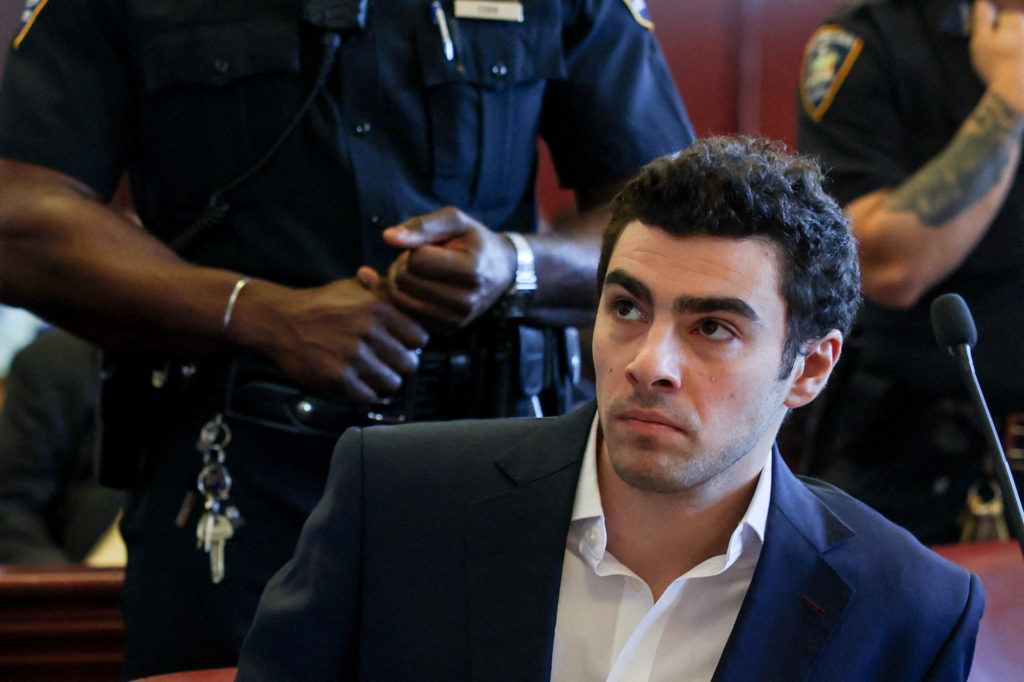
The Luigi Mangione guilty plea landed as a genuine surprise in a case that had already dominated headlines for well over a year. Standing in a federal courtroom, the 28-year-old admitted to tracking and fatally shooting UnitedHealthcare chief executive Brian Thompson outside a Manhattan hotel in 2024 — and, for the first time, explained in his own words what led him there.
A Short Admission That Left the Room Silent
Mangione’s statement was brief and delivered without emotion. He acknowledged firing on Thompson, said plainly that the man died as a result, and added that he understood at the time that his actions broke the law.
There was no apology. No expression of regret. Nothing offered to the family seated directly in front of him.
Cameras are not permitted in federal court, but journalists present described an atmosphere thick with tension. Thompson’s relatives occupied the front row, and reporters noted that several of them broke down in tears as Mangione walked through how he had prepared for and carried out the shooting.
What He Actually Pleaded To
An important distinction got some attention afterward: Mangione did not plead guilty to murder in this proceeding. He admitted to two counts of stalking that resulted in Thompson’s death.
That framing is not a legal loophole so much as a reflection of how federal jurisdiction works. Murder charges at the federal level are unusual and apply only in narrowly defined circumstances. Killings are ordinarily prosecuted by states. The homicide charge in this case exists — it simply lives in a separate proceeding in New York.
The plea exposes Mangione to a potential sentence of life imprisonment.
Why He May Have Chosen to Plead
The evidence stacked against him was substantial. Prosecutors had video capturing the shooting itself, the firearm, and a personal notebook in which Mangione had reportedly sketched out elements of his plan. Avoiding a trial he was unlikely to win is one plausible motivation.
But observers see a second, more strategic calculation underneath it.
The Double Jeopardy Argument
Mangione’s legal team has long contended that running federal and state prosecutions simultaneously over the same killing amounts to trying him twice for one act — a violation of constitutional protection against double jeopardy.
New York’s version of that protection is tighter than the federal baseline. State law bars separately prosecuting a defendant for two offenses that stem from a single course of conduct. Here, that single act would be Thompson’s killing.
Following that logic, the defense argues that once Mangione admitted guilt federally, the state can no longer pursue its own charges arising from the same event. His attorneys wasted no time acting on it: on the same day as the plea, they filed a motion asking that the New York case be thrown out.
That trial is currently scheduled to open in early September. Whether it proceeds now rests with the court.
The Motive He Described
Perhaps the most revealing part of the hearing came when Mangione explained why he did it.
He pointed to years of chronic back pain and a conviction that the health insurance system had been structured against people like him. That grievance, by his account, hardened over time into something targeted.
He then described the mechanics of getting close to Thompson:
- He learned that UnitedHealthcare was hosting an investor summit in Manhattan.
- He contacted company leadership by email, presenting himself as an investor.
- Using that pretense, he obtained details about when and where the event would take place.
- That information allowed him to be in position outside the venue.
One Detail That Clearly Stayed With Him
Mangione shared a small observation with the judge that appeared to carry real weight for him.
While posing as a wealthy prospective investor, he received a reply from company leadership within an hour. He contrasted that speed against his own experience trying to get responses from insurers as an ordinary patient.
He offered it almost as an explanation of his worldview — a data point, in his mind, proving who the system moves quickly for and who it does not.
Why the Case Struck Such a Nerve
The killing generated a reaction unlike most homicide cases, and not only because the victim ran one of the largest health insurers in the United States. In the weeks after the shooting, a disturbing amount of online commentary treated Mangione as a folk figure rather than a defendant, reflecting deep and widespread frustration with claim denials, coverage disputes and medical debt.
That reaction was itself widely condemned. A man was killed on a public street in front of a hotel. Frustration with an industry does not translate into justification for that, and Thompson’s family has been forced to grieve amid a public conversation that frequently sidelined him as a person.
Still, the case has become a lens through which arguments about American health coverage are refracted — a reality that legal proceedings alone cannot resolve.
What Happens Next
Two questions now hang over the case.
The first is whether New York’s prosecution survives. If the court accepts the defense’s double jeopardy reasoning, the state murder charge could vanish, leaving only the federal conviction on the record. If it does not, Mangione faces a second trial within weeks.
The second is sentencing. With guilt now admitted at the federal level, attention turns to the term he will receive, with life imprisonment on the table.
For Thompson’s family, none of the legal maneuvering changes what was described in that courtroom. They listened to a detailed account of how a man was hunted and killed, delivered by the person who did it, without a single word of regret attached.
Author
-
Lucienne Albrecht is Luxe Chronicle’s wealth and lifestyle editor, celebrated for her elegant perspective on finance, legacy, and global luxury culture. With a flair for blending sophistication with insight, she brings a distinctly feminine voice to the world of high society and wealth.