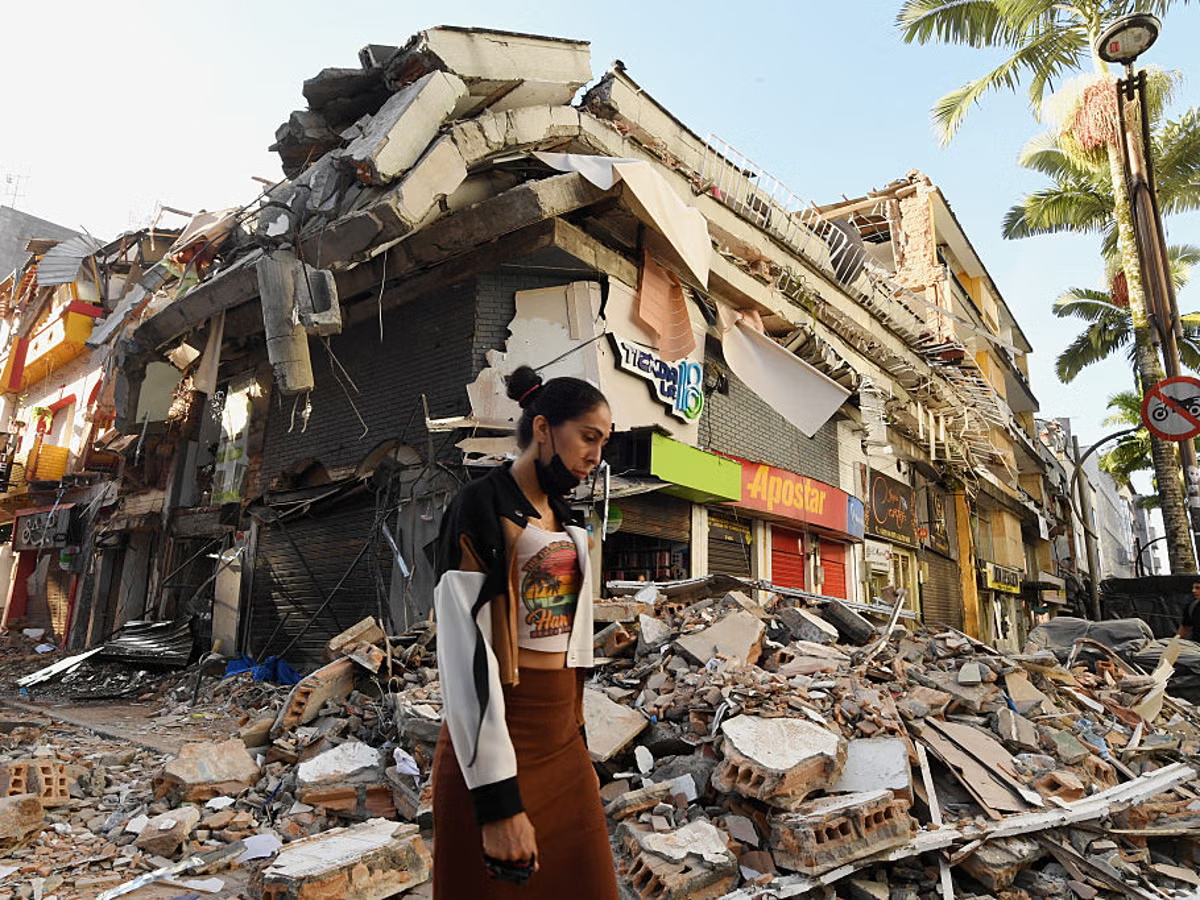
Colombia earthquake response has become the first major controversy facing the country’s new administration, after the government initially declined or restricted offers of foreign rescue assistance during the hours when such help matters most.
The 7.4 magnitude quake struck Monday. By Wednesday, international teams were finally arriving, but the delay had already consumed a substantial portion of the window in which survivors are typically found alive.
Why the Timing Matters So Much
Rescue specialists work against a widely recognized threshold of roughly 72 hours.
Beyond that point, the likelihood of pulling someone alive from collapsed structures drops sharply. Dehydration, crush injuries, exposure, and the physical toll of confinement compound rapidly.
That is why offers of assistance flood in immediately after major quakes, and why the speed of acceptance is often as consequential as the capability offered.
A Contrast With Venezuela
The comparison being drawn across the region is with Venezuela, which experienced two powerful tremors in June.
Leaders across the Americas offered support in both cases. Venezuela accepted dozens of international rescue groups without hesitation. Colombia either declined some offers outright or placed limits on how the arriving teams could contribute.
That divergence has fuelled much of the criticism.
A Government Barely a Week Old
President Abelardo de la Espriella took office on Friday. The earthquake struck three days later.
Political scientist Sandra Borda of Universidad de los Andes attributes much of the confusion to that timing, and specifically to a transition between administrations that included no formal handover.
A telling detail supports her reading. David Tamayo Roldán was only appointed director of the National Unit for Disaster Risk Management on Wednesday, two days after the quake. That agency holds primary responsibility for disaster preparedness and response.
Borda described the resulting breakdowns as entirely predictable given the absence of transition and the scale of personnel change.
Countries Left Waiting for a Request
Tuesday brought an unusual situation in which multiple governments and organizations reported they were ready but had received no formal request from Colombian authorities.
The United Nations was among them. Jens Laerke, spokesperson for the UN Office for the Coordination of Humanitarian Affairs, said the UN system and humanitarian actors stood prepared to provide whatever support they could if asked.
Mexico had assembled tons of supplies and a contingent of 255 military personnel, but said deployment depended on receiving a request.
Chinese ambassador Zhu Jingyang made an urgent public appeal for Colombia to establish an official coordination channel, asking that the government immediately name an official and provide contact details so international assistance could be organized.
That kind of public prompting from a diplomatic mission is unusual and signals genuine frustration.
Coordination Slowly Emerged
By Tuesday afternoon movement began.
Salvadoran President Nayib Bukele announced humanitarian aid would be sent, while noting that Colombia had requested supplies only. He said his government had been informed that Colombian rescue teams, medical staff, and emergency services were already deployed and that personnel support was not required at that stage.
Peru confirmed Wednesday it would send volunteers for search and rescue work.
Colombia’s Foreign Ministry later said it was compiling a list of specific needs and had approached the United Nations Development Programme for support.
The Certification Explanation
The newly appointed disaster management chief offered a rationale for the selective approach.
He said the government had requested rescue teams from four countries specifically: the United States, El Salvador, Ecuador, and Israel. The stated reason was that those teams hold the international and national certifications Colombia considers necessary.
Foreign Minister Omar Bula pushed back on suggestions of exclusion, saying no country had been ruled out from among those offering help, and that Colombia works with nations without ideological or political considerations.
The United States confirmed Wednesday that it had mobilized search and rescue teams from Virginia and California following a request from the Colombian government.
Criticism of the Approach
Borda was unconvinced by the explanations.
She described the new government as displaying deep distrust toward parts of the international community, a stance she found difficult to understand. She also said there was no clarity about what procedure foreign rescuers were supposed to follow.
Her sharpest point concerned consistency. The eventual acceptance of foreign experts, she argued, undermines the earlier position that they were not needed.
She noted that the assumption of sufficient domestic capacity was never accompanied by any published technical assessment confirming that Colombian teams could handle the full extent of the damage.
The Picture on the Ground Is Mixed
Complicating the criticism, some local officials have indicated that additional personnel are not helpful at every site.
The emergency chief of the fire department in Cali, one of the hardest-hit cities, advised volunteers to stay away from collapsed structures, saying sufficient specialized personnel were already conducting rescue work without complications.
The Topos Tlatelolco Rescue Brigade, a Mexican organization with extensive disaster experience, said Wednesday that Colombian authorities would not permit external rescue groups to enter because national teams were handling operations.
Untrained volunteers at collapse sites genuinely can create hazards, both for themselves and for structured search operations. Whether that concern justified the broader restrictions is the contested question.
Aid Beginning to Flow
In Pereira, another severely affected city, the Foreign Ministry marked the arrival of 19.5 tons of aid from Mexico, saying further flights were expected and that Colombia was not alone.
Mexican President Claudia Sheinbaum confirmed her government had finally coordinated with Colombian counterparts, who requested specific items. She said the flight also carried members of the Mexican Army to assist.
The Underlying Lesson
Disaster response depends on infrastructure built long before disasters occur: designated officials, established channels, pre-agreed certification standards, and clear procedures for accepting foreign teams.
Colombia was three days into a new administration with no completed handover when the ground moved. Whatever the merits of individual decisions, the machinery for making them quickly was not fully in place.
For families still waiting beside collapsed buildings, that distinction offers little comfort.
Author
-
Lucienne Albrecht is Luxe Chronicle’s wealth and lifestyle editor, celebrated for her elegant perspective on finance, legacy, and global luxury culture. With a flair for blending sophistication with insight, she brings a distinctly feminine voice to the world of high society and wealth.