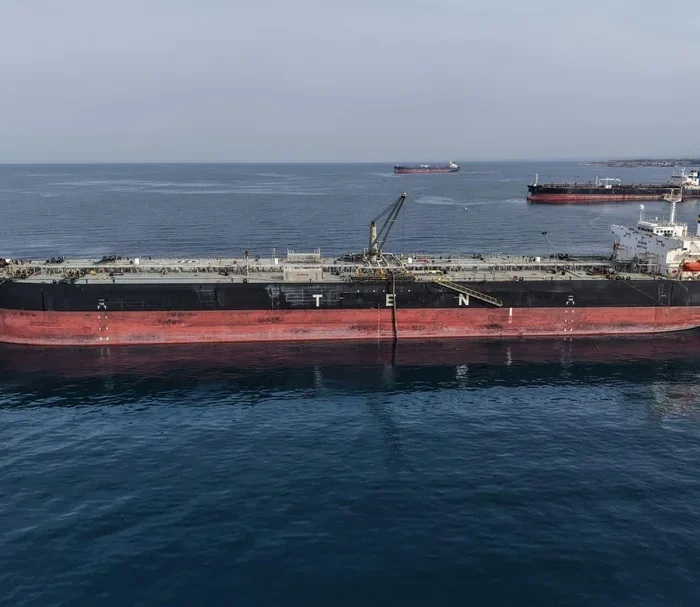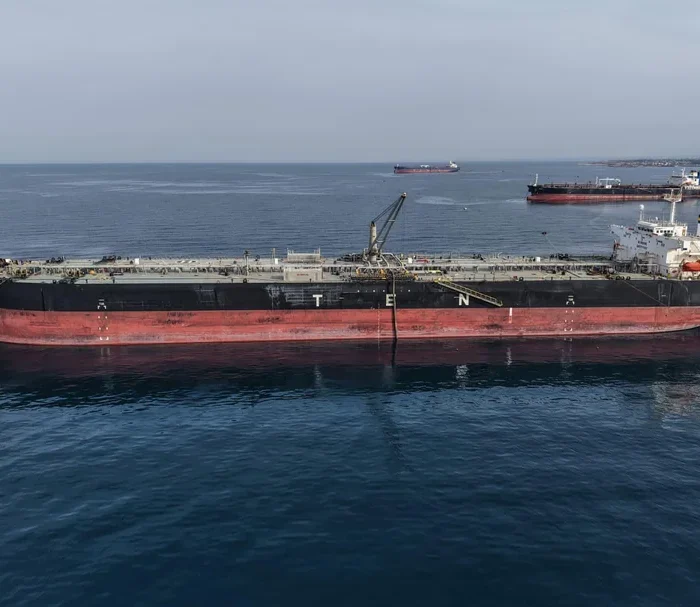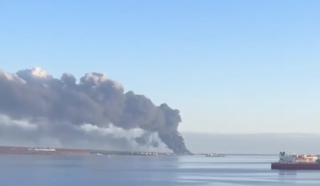
A Ukrainian drone attack on Ust-Luga port overnight on 14 August sent 54 aircraft against Russia’s largest Baltic Sea oil facility, starting a fire and disrupting operations. It was at least the sixth strike on the same target this year, and it fits a pattern that has become central to Kyiv’s war effort.
What Happened Overnight
Leningrad Oblast Governor Alexander Drozdenko confirmed the attack on Telegram, reporting that damage had been recorded and that a fire had broken out at the port. Emergency crews were deployed to bring the blaze under control.
He made no mention of casualties.
The assault ran roughly four hours, concluding at 6:48 a.m. Moscow time.
Why Ust-Luga Matters
The port is not an incidental target. It is Russia’s largest facility on the Baltic Sea and one of the primary arteries through which Moscow moves oil and refined fuel to international markets.
Its terminals handle a range of products: crude oil, fuel oil, jet fuel and gasoil.
The throughput figures explain the attention. Ust-Luga shipped around 700,000 barrels per day during 2025, placing it second only to Primorsk among Russia’s Baltic export terminals. Between them, those two ports account for roughly 40 percent of Russia’s seaborne oil exports.
Damage at either facility therefore reaches well beyond a local disruption.
A Year of Repeated Attacks
The August strike continues a sustained campaign that intensified sharply in spring.
Late March saw Ust-Luga hit almost continuously. On 25 March, Ukrainian drones struck oil tankers and storage facilities, igniting a substantial fire. That attack also interfered with operations at a Novatek facility and briefly halted some petroleum product exports.
Two days later, reports indicated that three oil tankers, five fuel storage tanks, three ship berths and additional port infrastructure had been hit.
By 30-31 March, the port had absorbed its fourth strike inside a single week, with the cumulative disruption affecting a facility handling roughly 700,000 barrels daily.
Further attacks followed. Drones targeted the oil terminal again on 7 April as part of a wider push against Baltic energy infrastructure, and Ust-Luga featured among the Russian Baltic facilities struck during a major drone assault on 6 July.
Counting the Cost
The economic effect has been measurable rather than merely symbolic.
The Financial Times reported in April, citing analysis from the Kyiv School of Economics, that five Ukrainian strikes on Ust-Luga and Primorsk cost Russian energy exporters an estimated $970 million in lost revenue during the week ending 29 March.
That figure captures something important about the strategy. Physical damage to a terminal can be repaired in weeks. Revenue not earned during those weeks cannot be recovered.
Part of a Broader Effort
The Ust-Luga strike arrived only two days after Ukraine hit the Sheskharis oil terminal at Novorossiysk, Russia’s largest oil facility on the Black Sea.
That terminal moves an estimated 600,000 to 700,000 barrels per day. Novorossiysk’s terminals collectively exported 19.8 million tons of petroleum products during 2025.
Taken together, the two attacks touched Russia’s principal export outlets on two separate seas within 48 hours.
The Logic Behind the Targeting
Ukraine has steadily expanded its focus on Russian refineries, oil terminals, pipelines and tankers. The reasoning behind that emphasis is straightforward, if slow-acting.
Energy exports fund the Russian budget. Reducing export capacity reduces revenue, and reduced revenue constrains military spending over time.
Beyond the fiscal effect, disrupting terminals complicates the logistics that sustain operations. Fuel that cannot be moved efficiently is fuel that arrives late or not at all.
There is also a psychological dimension. Repeated strikes on the same facility signal that no depth of territory offers reliable protection, and force Russia to distribute air defence resources across a wider area than it might prefer.
Why Ports Are Difficult to Defend
Oil terminals present an awkward defensive problem.
They are large, fixed and impossible to conceal. Storage tanks and berths cannot be hardened in the way military installations can. The infrastructure that makes them commercially efficient — concentrated loading points, dense tank farms — also concentrates vulnerability.
Drones are comparatively cheap. The assets they threaten are not. That asymmetry is precisely what makes this campaign viable for Ukraine and expensive for Russia.
What to Watch
Three questions will determine whether these strikes shift anything structurally.
The first is repair speed. If damage is patched within days, the revenue effect stays modest.
The second is insurance and shipping behaviour. Repeated attacks can deter carriers and raise premiums, imposing costs no repair crew can address.
The third is whether the frequency holds. Six strikes on one port in a year is a campaign. The question is whether it becomes a permanent condition of Russian export operations.
Author