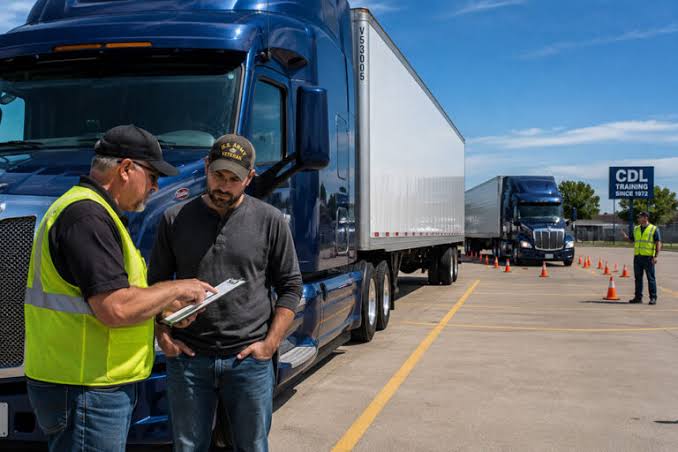
Skip the Road Test, Start in Weeks: What the Freedom Haulers Initiative Actually Changes
President Donald Trump launched the Freedom Haulers Initiative at the White House on Thursday, standing beside a parked semi truck with Transportation Secretary Sean Duffy, Veterans Affairs Secretary Doug Collins, acting Labor Secretary Keith Sonderling and executives from the trucking industry.
The programme has two halves that the administration presents as a single policy: an accelerated route for military veterans into commercial driving, and a continued campaign to remove drivers it says are improperly licensed or cannot meet federal English-language requirements.
Trump framed it directly, saying the goal is to take unauthorised drivers off American roads and replace them with veterans.
The Licensing Mechanics
The substantive changes concern how a veteran gets a commercial driver’s licence.
- Veterans with heavy-vehicle experience gained in service can apply to waive the CDL road-skills test, avoiding a repeat of training the military already provided
- In participating states, some veterans may also qualify to waive the written knowledge test
- The window to use these waivers has been extended from 12 months to 24 months after active duty ends
- Veterans without truck-driving experience can enter expedited training that officials say can be completed in a matter of weeks
- The GI Bill can cover up to 100 percent of CDL tuition at programmes approved by a state approving agency, and the VA says it will accelerate enrolment
Duffy put the logic in plain terms, noting that service members who drove heavy vehicles in uniform have been required to spend months repeating skills and knowledge testing on discharge — and arguing that if the Defense Department trusted them with those vehicles, the licensing system should too.
Trump said 34 states have joined or are moving to implement the associated Even Exchange Program, naming Indiana, Wyoming, Louisiana, Arkansas, Alabama, Florida and Maryland, and called on the rest to participate. Details are being published through a Transportation Department site.
It is worth noting this builds on existing policy rather than starting from nothing. Federal regulators have permitted states to waive skills testing for qualifying military drivers for over a decade; the changes here widen eligibility, lengthen the window and add funding and outreach.
The Enforcement Half
The initiative follows an executive order signed in April directing federal officials to enforce English-language proficiency standards for commercial drivers and to review domestic and foreign-issued licences for authenticity and validity.
Trump said more than 24,000 commercial drivers have been removed from the road after failing to demonstrate they could read or understand English-language traffic signage, and that states have cancelled more than 28,000 licences determined to have been improperly issued to people in the country unlawfully. He cited several fatal crashes he attributed to unauthorised drivers.
There is a regulatory wrinkle here that explains part of the friction. All states are required to administer the CDL test in English without interpreters, but few have converted their written knowledge exams to English-only, and some continue to offer that portion in multiple languages. The Federal Motor Carrier Safety Administration has said it will examine training and licensing practices and hold states, schools and carriers accountable.
Where the Evidence Is Thin
The administration presents the enforcement campaign primarily as a safety measure. That framing is contested, and readers should know why.
Peer-reviewed research specifically linking driver English proficiency to crash rates is limited. Federal crash data does not routinely record language ability or immigration status, which makes causal claims difficult to substantiate in either direction. Individual crashes cited at the event are real, but individual cases do not establish a rate.
Supporters counter that the requirement is longstanding federal law and that enforcing an existing safety standard does not require new research to justify it — a reasonable position on its own terms.
The Jobs Case
Duffy described trucking as offering strong pay, citing figures from roughly $80,000 to more than $100,000 a year.
Those numbers are achievable, but they sit toward the upper end of the range. Federal wage data has generally put median annual pay for heavy tractor-trailer drivers meaningfully lower, with substantial variation by segment — specialised freight, tanker and flatbed work pays better than entry-level long-haul, and owner-operators carry costs that gross figures obscure.
That distinction matters for anyone considering the career on the strength of the announcement.
Collins framed the programme as expanding stable employment options for former service members and noted that roughly one in ten truck drivers nationally are already veterans.
Werner Enterprises, which employs about 14,000 drivers, announced it will hire 1,400 veterans over the coming year. Company president Nathan Meisgeier called veterans a natural fit and said around 15 percent of the firm’s current drivers have served.
Army veteran Ricky Washington, who moved into commercial driving after three decades in the Army and Army National Guard, described the industry as the backbone of American commerce and a place where veterans and military spouses can find purpose and community.
The Shortage Debate
One assumption running underneath all of this deserves scrutiny.
Industry groups have argued for years that the country faces a driver shortage. A substantial body of analysis, including work by federal labour economists, has questioned that framing — arguing the problem is retention rather than recruitment, with long-haul turnover historically running near or above 90 percent annually at large carriers because of pay structures, time away from home and working conditions.
If that analysis is right, adding entrants to the pipeline addresses the visible symptom without touching the cause. If the industry’s framing is right, expanding the pipeline is exactly what is needed.
The programme itself does not resolve that argument, and its success will be measurable largely by how many veterans are still driving two or three years from now rather than how many obtain licences this year.
What Is Uncontroversial
Setting aside the immigration and safety disputes, the licensing reform has a straightforward logic that has drawn support across the political spectrum in the past.
Requiring someone who operated heavy military vehicles to repeat a road-skills test on civilian discharge is a genuine bureaucratic redundancy. Removing it, extending the eligibility window and letting GI Bill funds cover training are the kinds of transition-support measures veterans’ organisations have long requested.
Whether the broader package achieves what the administration claims will depend on state participation, employer follow-through and data that does not yet exist.
Author
-
Lucienne Albrecht is Luxe Chronicle’s wealth and lifestyle editor, celebrated for her elegant perspective on finance, legacy, and global luxury culture. With a flair for blending sophistication with insight, she brings a distinctly feminine voice to the world of high society and wealth.