The Taliban’s EU talks on deportations marked a notable diplomatic moment Tuesday, as a delegation from the Afghan Taliban met with European Union staff in Brussels for closed-door discussions. The talks centered on diplomatic services and what a Taliban official described as the “dignified returns” of Afghans to their isolated and war-ravaged homeland.
Why the Talks Are Happening
The meeting reflects mounting pressure across Europe to address migration. Afghans make up one of the largest groups of migrants seeking asylum in the EU, but a growing number of governments within the 27-nation bloc want to speed up and increase deportations, particularly for those whose claims are rejected or who commit crimes in their host countries.
Abdul Qahar Balkhi, a spokesperson for the Taliban Ministry of Foreign Affairs, hailed the visit as “historic.” He noted it was the first time a delegation from the Islamic Emirate had held talks with the EU and EU nations in Brussels.
Balkhi, who led the five-member delegation, said the discussions focused on several areas:
- “Trust-building measures”
- The Taliban’s diplomatic presence in the EU
- A “dignified return process”
The meeting took place at an undisclosed location in the Belgian capital, home to both the EU and NATO. The European Commission said it co-chaired the session with Sweden, with representatives from 15 of the EU’s 27 nations participating in talks focused on easing the deportation of criminals and security threats.
Rights Groups Sound the Alarm
The meeting drew swift condemnation from human rights advocates, who warned it could endanger Afghans both in Europe and back home.
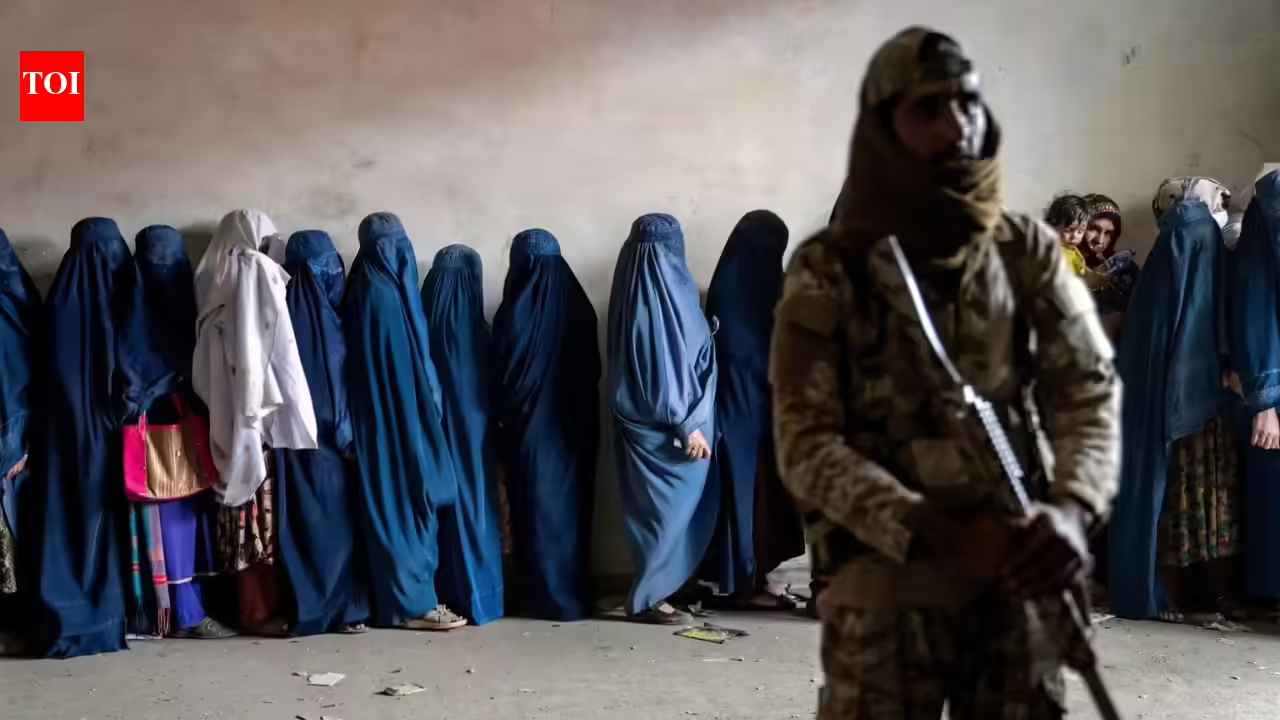
Their concerns stem from the Taliban’s record since seizing power in 2021, in the wake of the chaotic withdrawal of U.S.-led forces. The group has imposed draconian restrictions on rights, especially for women and girls.
Fereshta Abbasi, a researcher at Human Rights Watch, argued that any engagement with the Taliban must prioritize protecting human rights and accountability rather than deporting people into danger. She said EU countries were undermining their own credibility by condemning Taliban abuses on one hand while cooperating to forcibly return Afghans on the other.
Nobel Peace Prize laureate Malala Yousafzai voiced similar dismay, writing that she was “deeply shaken” that the EU was talking with the Taliban. She insisted Europe must not legitimize a regime responsible for one of the world’s worst human rights crises, adding that any engagement must begin and end with the rights of Afghan women and girls.
A Crack in Diplomatic Isolation
Although no EU nation recognizes the Taliban, the Brussels meeting symbolizes a small crack in the group’s diplomatic isolation since it took power five years ago.
At the time of the takeover, most nations around the world, including the entire EU, cut off diplomatic relations. The Taliban has been quietly working to expand its access to diplomatic missions in Europe ever since.
European officials were careful to stress that the meeting did not signal a shift in that stance. Members of the Taliban delegation received visas only after security screening, with limited territorial validity that granted them just 24 hours in Belgium and no access to other countries in the Schengen zone.
Belgian Foreign Minister Maxime Prévot said Belgium complied with EU requests to grant the visas but emphasized that hosting the meeting did not amount to recognition, legitimacy, or an invitation from the Belgian government. Because neither Belgium nor the EU officially recognizes the Taliban, the meeting was deliberately held away from official sites belonging to either.
The Push for More Deportations
A European Commission spokesperson said the meeting responded to pressure from a clear majority of EU member states. In October, 20 of the 27 nations signed a letter calling for stronger migration policies, including a ramp-up of deportations.
Commission spokesperson Markus Lammert said the body had been asked to coordinate “technical talks” on returns, stressing that this did not mean recognition. While Tuesday marked the Taliban’s first meeting inside the EU, the two sides first met in Afghanistan in January, when the Commission sent a mission to Kabul, where it also maintains staff.
The October letter was drafted in part by Belgian Migration Minister Anneleen Van Bossuyt, who argued that Europe could no longer afford a standstill and needed a firm, joint approach to regain control over migration and security. She noted that across the EU, only 2 percent of the 22,870 Afghans told to return had actually done so.
A Worsening Crisis in Afghanistan
The push to deport comes as Afghanistan grapples with a deepening humanitarian disaster. Over the past year alone, the country has absorbed the return of about 3 million Afghans from Pakistan and Iran, nearly all of them forcibly repatriated.
That influx has compounded existing food and economic crises, made worse by biting sanctions. Meanwhile, the Taliban’s restrictions on women and girls remain severe, including bans on education beyond primary school, prohibitions on working in all but a few professions, and strict rules governing what women may wear in public.
Critics find the timing especially troubling. Eve Geddie, director of Amnesty International’s European Institutions Office, recalled the desperate scenes of people, including EU staff, fleeing Afghanistan, calling it unconscionable that the EU would now try to deport people to a country that has only grown more dangerous.
The Bigger Picture
The Taliban’s EU talks on deportations sit at the intersection of two powerful pressures: Europe’s political drive to toughen migration policy and Afghanistan’s desperate need for aid and reduced isolation.
Facing political demands across the bloc, the EU has recently passed deep reforms to its collective rules aimed at ramping up deportations, including provisions for so-called “return hubs,” increased domestic surveillance, tighter border controls, and engagement with the Taliban government. For the Taliban, which is in dire need of humanitarian aid, the talks offer a chance to ease its economic and political isolation.
The result is a fraught balancing act, one in which Europe’s migration goals and its stated human rights commitments appear increasingly difficult to reconcile. As both sides cautiously engage, the central question remains whether cooperation on deportations can proceed without legitimizing a regime that much of the world continues to condemn.
Author