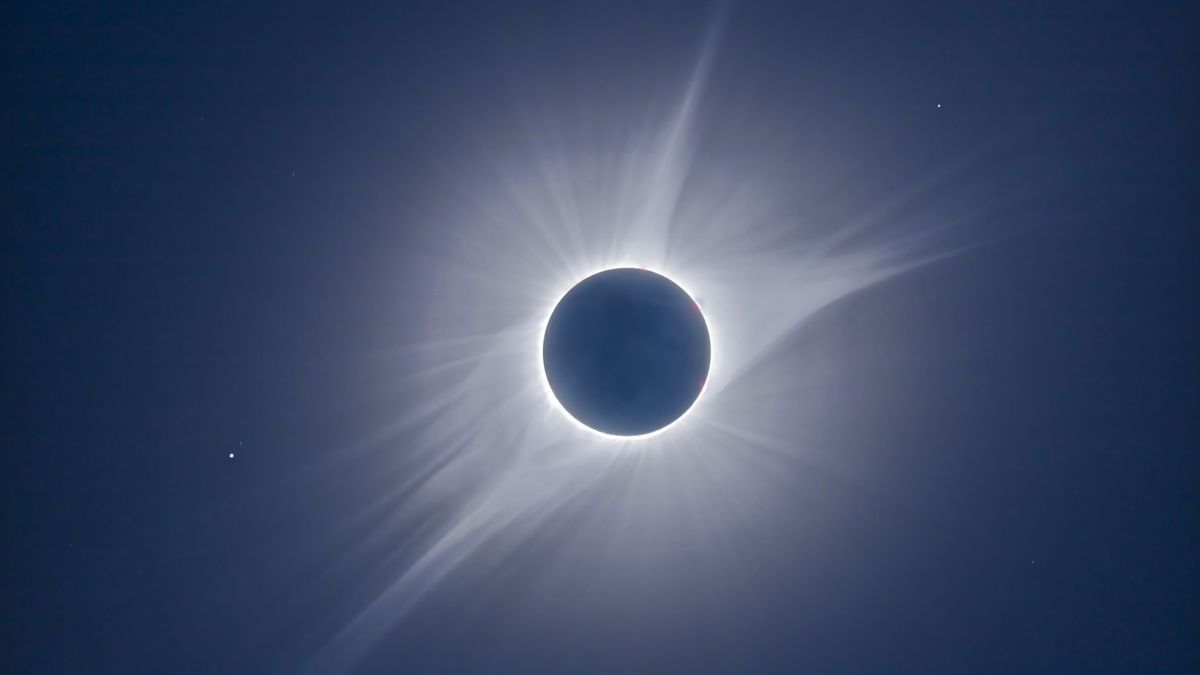
The August 12 solar eclipse will hand roughly 15 million people something mainland Europe has not seen since 1999: the sun disappearing completely in the middle of the day.
Beginning at 15:34 GMT, the moon’s shadow will sweep from the Arctic down across Greenland, Iceland and into Spain, holding the sun fully covered for as long as two minutes and 18 seconds at its longest point.
Well beyond that narrow band, about 980 million people, close to one in eight humans alive, will see the sun at least partially obscured.
Which leaves seven in eight of us with an entirely ordinary Wednesday sky.
Who Gets Totality
The path of totality on Wednesday crosses Spain, Iceland, and portions of Greenland, Russia and Portugal.
Northern and eastern Spain draw the best viewing conditions. Leon, Valladolid, Zaragoza, Teruel and Valencia all sit inside the band. Totality begins around 18:27 GMT in western Spain, which is 8:27 p.m. local time, and lasts up to 110 seconds depending on exactly where you are standing.
Madrid and Barcelona fall just outside the line. Frustratingly close, since observers in both cities will still see more than 99 percent coverage.
That last one percent, though, is the entire difference. Partial eclipse and total eclipse are not the same experience at different intensities. Only during totality does the sun’s corona become visible and the sky genuinely darken.
Where a Partial Eclipse Will Be Visible
Much of Europe gets a deep partial eclipse in the evening, and in many places the sun will still be partly covered as it sets.
Paris will see roughly 92 percent coverage. London reaches 91 percent, Berlin 85 percent.
Further east, there is a complication. In many cities the sun sets before the eclipse reaches maximum, meaning the deepest phase never appears above the horizon at all. North Africa runs into the same problem. Algiers reaches about 98 percent coverage and Casablanca about 87 percent, with the sun going down before the event finishes in both cases.
North America avoids the sunset issue entirely, since the eclipse falls during morning and afternoon hours there. But the continent sits far from the path, and the result is modest.
In Canada, St John’s in the northeast sees around 53 percent, dropping to 18 percent in Montreal and just 8 percent in Toronto.
In the United States, parts of Alaska get the deepest view at roughly 37 percent. Elsewhere it thins out fast: about 28 percent in northeastern Maine, 10 percent in New York, and effectively nothing across the Midwest.
What Is Actually Happening Up There
An eclipse occurs when one body moves into another’s shadow.
During a lunar eclipse, Earth’s shadow falls on the moon. During a solar eclipse, the moon slides between Earth and the sun and blocks the light. That blocking takes four forms.
A partial eclipse means the moon clips the sun’s edge, covering only a portion of it.
A total eclipse means full coverage, turning day into something like dusk and exposing the corona, the sun’s faint outer atmosphere.
An annular eclipse happens when the moon sits too far from Earth to cover the sun completely, leaving a bright ring around the edge.
A hybrid eclipse is the rarest, shifting between total and annular at different points along its own track.
The coincidence that makes any of this possible is remarkable. The sun is roughly 400 times wider than the moon and also roughly 400 times more distant, so from Earth the two discs appear nearly identical in size.
How Rare Is This
NASA counts two to five solar eclipses observed on Earth annually, across all four categories.
Total eclipses are considerably scarcer, averaging about 66 per century, or roughly one every eighteen months.
Breaking down all solar eclipses, roughly a third are partial, a third annular, a bit over a quarter total, and about five percent hybrid.
The catch is that any given location waits far longer, since totality traces a narrow strip across the surface. Europe’s 27-year gap since 1999 illustrates the point.
Viewing Safely
This part is not optional.
Looking directly at a partially eclipsed sun damages the retina, and the damage is painless as it occurs. Sunglasses do not work. Neither does exposed film, smoked glass, or a phone screen.
Use eclipse glasses certified to the ISO 12312-2 standard, or a handheld solar viewer. Inspect them for scratches or pinholes before use and discard anything damaged.
Never look through binoculars, a telescope or a camera lens while wearing eclipse glasses. The concentrated light burns straight through the filter.
Pinhole projection is a safe and satisfying alternative: punch a small hole in card, let sunlight pass through onto a second surface, and watch the crescent shape appear.
Only inside the path of totality, and only during the seconds of complete coverage, is it safe to look with unaided eyes. The moment any sliver of sun returns, the glasses go back on.
If You Miss This One
The next total solar eclipse arrives on August 2, 2027, crossing southern Spain, North Africa and Yemen.
That one runs notably longer than Wednesday’s, which is why some eclipse chasers are already planning around it.
Author
-
Lucienne Albrecht is Luxe Chronicle’s wealth and lifestyle editor, celebrated for her elegant perspective on finance, legacy, and global luxury culture. With a flair for blending sophistication with insight, she brings a distinctly feminine voice to the world of high society and wealth.