Trump Says Qatari-Gifted Air Force One Heading Back for Security Upgrades
The Qatari Air Force One upgrades that President Donald Trump described on Sunday will take the donated jumbo jet out of service for roughly a month, following persistent questions about whether the aircraft carries the defensive systems a presidential plane requires.
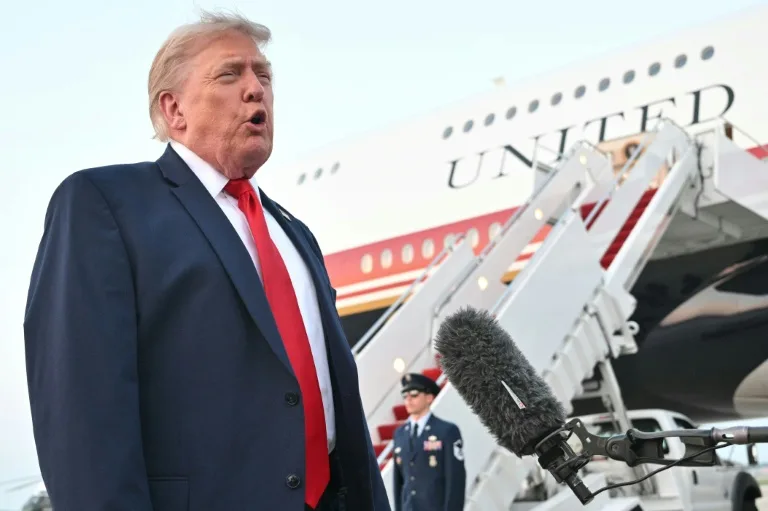
Speaking to reporters at Joint Base Andrews after returning from the FIFA World Cup final in New Jersey, Trump was asked directly whether the refitted aircraft lacked missile-defense capability.
He said the plane already has considerable capability, but that his understanding was it would be sent out in about a month to be, as he put it, maxed out — a process he estimated would take roughly another month.
The Air Force did not immediately respond to a request for comment.
How the Plane Got Here
Trump accepted the Boeing 747 as a gift from Qatar last year, prompting an accelerated conversion effort to make it suitable for presidential travel. Defense contractor L3Harris Technologies handled the refit.
He began flying aboard it on July 1. The aircraft carries a livery of his own choosing — red, white, dark blue and gold — replacing the pale blue scheme that has identified American presidential aircraft for decades.
The plane was never intended as a permanent solution. It exists to fill a gap.
The Boeing Delay Behind It All
The underlying problem is a contract that has gone badly wrong.
Boeing agreed in 2018 to deliver two purpose-built 747-8 aircraft for presidential use under a fixed-price contract worth $3.9 billion. That programme is now four years behind schedule and over budget, with delivery not expected until sometime in 2028.
Fixed-price defense contracts were meant to shift risk from taxpayers onto contractors. In practice, they have produced repeated cost overruns and delays across multiple programmes, with Boeing absorbing losses while the government waits.
The result is that the current fleet of presidential aircraft, now decades old, has had to keep flying far longer than planned — creating the opening the Qatari jet was brought in to fill.
Why the Security Questions Persist
Air Force One is not simply a modified airliner. The designation refers to a flying command post built to keep functioning under extreme circumstances.
Purpose-built presidential aircraft typically include hardened communications, electromagnetic pulse shielding, in-flight refuelling capability, medical facilities, and defensive countermeasures against missile threats. Those systems are integrated during construction, not bolted on afterward.
The concern raised by aviation and defense specialists is one of timeline. Converting a commercial 747 to that standard normally takes years. This conversion was completed in months. Whether an accelerated schedule could deliver equivalent protection is precisely the question critics have been asking.
Trump’s comment on Sunday — that the plane will be sent away to be “maxed out” — suggests the initial refit was not complete.
The Turkey-to-London Detour
One episode gave those questions added weight.
On July 8, Trump unexpectedly chose not to use the new aircraft for a flight from Turkey to the United Kingdom, travelling instead aboard an older Air Force One. He characterised the decision as being for old time’s sake.
The context was hard to ignore. Tensions with Iran were escalating sharply, and the route crossed a region where threat levels had risen considerably. He later flew home aboard the new plane, on a transatlantic route with far less exposure.
Whether the switch reflected a security assessment or simple preference is unclear. But the pattern — older aircraft over contested airspace, newer aircraft over the Atlantic — invited exactly the interpretation critics offered.
Cost, Propriety and the Press
Beyond the technical concerns, the arrangement has drawn criticism on other grounds.
Accepting a substantial gift from a foreign government for presidential use raises questions that critics have pressed on both ethical and constitutional lines. Others have focused on the conversion cost, arguing that a donated airframe requiring an expensive military-grade refit may not represent the savings it appears to.
The dispute has also touched the press. New York Times journalists who reported on the aircraft’s security features were subpoenaed earlier this month. The newspaper has asked a court to block the orders requiring reporters to appear before a grand jury in Manhattan federal court.
That development carries implications beyond this story. Subpoenaing reporters over national security coverage is a step administrations have generally approached cautiously, given the press freedom questions it raises.
What Comes Next
The immediate sequence is straightforward enough:
- The aircraft is expected to go in for additional work in about a month
- The upgrade work is projected to take roughly another month
- Older presidential aircraft will presumably cover travel during that period
- Boeing’s purpose-built replacements remain scheduled for 2028
What remains unaddressed is the substance. Neither the president nor the Air Force has specified what capabilities the plane currently lacks or what will be added. Given the classification surrounding presidential aircraft systems, that detail may never be public.
Which leaves the situation roughly where it started: a donated jet flying the president around, questions about its protection unanswered, and a replacement programme still years from delivering what was ordered in 2018.
Author