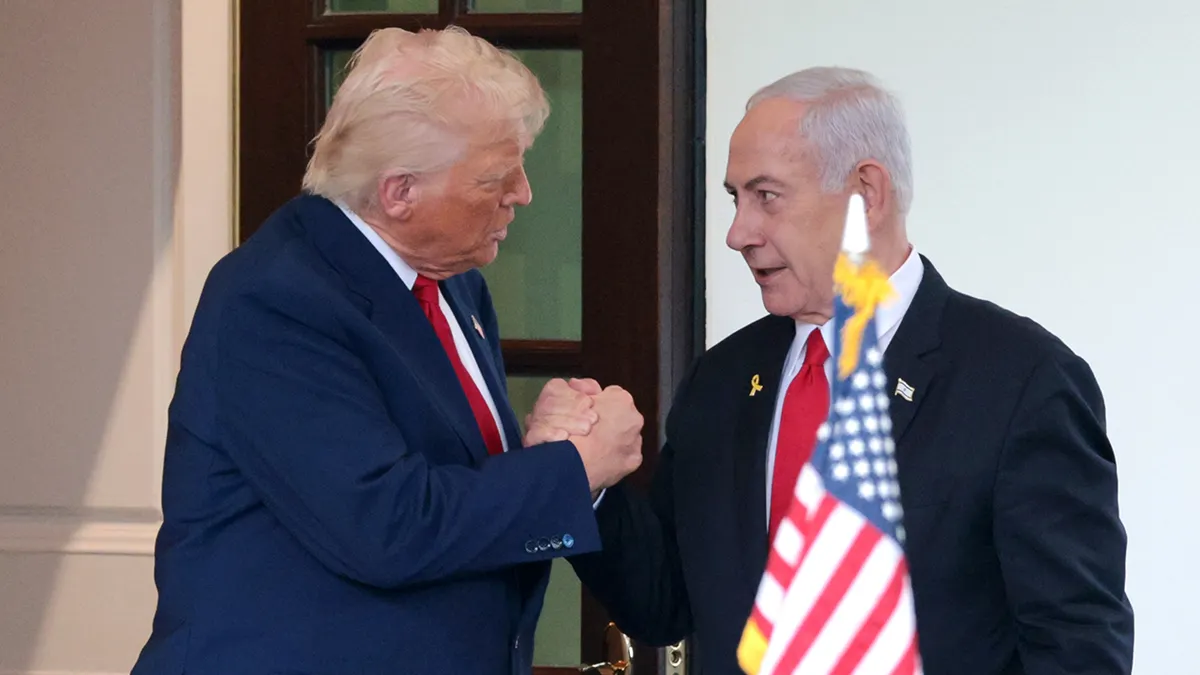
The Trump Netanyahu relationship, long celebrated as one of the warmest between an American president and an Israeli leader, is now showing real strain. As President Donald Trump races to close a deal ending the war with Iran, he has turned on Prime Minister Benjamin Netanyahu with language no other U.S. president has been willing to use in public.
The shift is striking. Just last year, Netanyahu was calling Trump the “greatest friend Israel ever had in the White House.” Today, that friendship is being tested in full view.
Sharp Words From an Unlikely Critic
Trump hasn’t held back. In recent interviews, he claimed personal credit for Israel’s very survival, declaring that without him, there would be no Israel. He questioned Netanyahu’s judgment outright and at one point even described the Israeli leader as “crazy.”
For a politician who has positioned himself as Israel’s staunchest defender, the rhetoric marks a dramatic departure. Netanyahu has now served alongside four U.S. presidents and managed to frustrate each of them at some point — but none have aired that frustration as bluntly as Trump, who launched this very conflict in coordination with the Israeli leader.
Why the Tension Now
The friction comes at a pivotal moment. Trump has grown openly critical of recent Israeli military operations in Lebanon, which he fears could derail the delicate negotiations between Washington and Tehran.
There’s also a domestic dimension. The war has proven unpopular at home and has pushed gasoline prices higher, generating political blowback for the president. That pressure helps explain his urgency to reach an agreement — and his willingness to lean on an ally to get there.
As Aaron David Miller, a longtime Middle East adviser to both Democratic and Republican administrations, put it: if Netanyahu stands between Trump and something he badly wants — namely, an exit from this war — Trump is ready to use whatever leverage he has.
A Deal on the Horizon
The stakes are concrete. An agreement is set to be signed Friday at the Bürgenstock resort near Luzern. Speaking Tuesday at the annual G7 summit in France, Trump made clear he had voiced his displeasure directly to Netanyahu.
“Without the U.S., there would be no Israel. Without me, there would be no Israel because no other president was willing to do what I did,” Trump said. He added that while he and “Bibi” have enjoyed a strong relationship, the prime minister now needs to act more responsibly regarding Lebanon.
A Fraying Consensus
Trump’s comments land against a backdrop of shifting attitudes toward Israel in American politics. The longstanding bipartisan consensus supporting Israel has weakened considerably in recent years.
The cracks run in multiple directions:
- On the left, many liberals have grown outraged over Israel’s treatment of Palestinians, particularly during the war in Gaza.
- On the right, some conservatives have begun questioning the value of America’s traditional support for Israel.
- Concerns about antisemitism have surfaced on both ends of the political spectrum.
Reaction Splits Across the Spectrum
The president’s remarks drew immediate pushback from left-leaning Jewish groups. Halie Soifer, who leads the Jewish Democratic Council of America, criticized Trump for framing Israel’s existence as dependent on him personally, calling the framing deeply offensive to the many Jews invested in Israel’s future.
Notably, Trump’s predecessors handled their own disagreements with Netanyahu more cautiously. President Joe Biden and Vice President Kamala Harris frequently clashed with him over the Gaza war and sometimes criticized him publicly, but they stayed measured to avoid accusations of being anti-Israel.
Within conservative, pro-Israel circles, opinions diverged on how seriously to take Trump’s broadside:
- Matt Brooks, president of the Republican Jewish Coalition, brushed off the criticism as the kind of disagreement that naturally happens “among family members.” He argued that Trump’s reliable support for Israel — including moving the U.S. embassy to Jerusalem and securing the return of Israeli hostages from Gaza — gives him a reservoir of goodwill that Biden and Harris never had.
- Mort Klein, president of the Zionist Organization of America, took a more critical view. He felt Trump should have kept his complaints private, especially given the president’s history of publicly praising authoritarian leaders in Turkey, North Korea, and China.
Klein went further, voicing concern that Trump may be making these remarks publicly to court Israel’s critics, sensing that Americans have grown more hostile toward Israel than ever before.
A Friendship Under Pressure
What emerges is a portrait of an alliance being recalibrated in real time. Trump’s defenders insist his criticism carries a fundamentally different weight than that of past Democratic leaders, rooted in a track record of strong support rather than skepticism. His critics worry it signals something more troubling about the durability of U.S.-Israel ties.
For now, the friendship endures, but the dynamic has clearly changed. With a major agreement just days away and political currents shifting beneath both leaders, the coming days will reveal just how much pressure this once-unshakable partnership can withstand — and whether Trump’s pursuit of an Iran deal will ultimately reshape one of Washington’s most consequential relationships.
Author