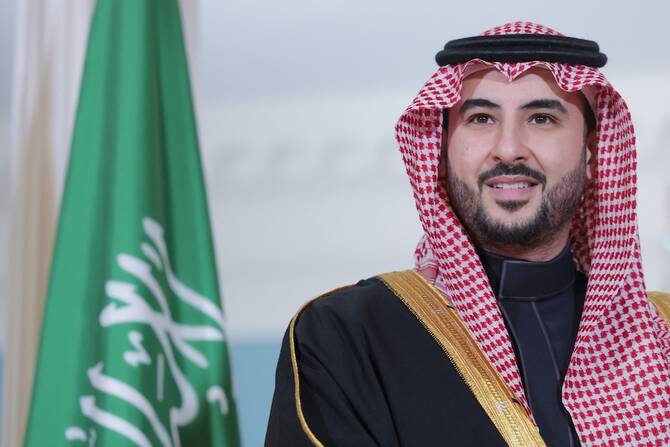
Two Messages in One Day: The Saudi Defense Minister’s Quiet Case Against Escalation
The Saudi defense minister flew to Washington this week carrying a message that sounds contradictory on its face: hours after his air force helped bomb Iran-aligned militias in Iraq alongside American jets, Prince Khalid bin Salman sat down at the White House to argue for de-escalation.
He met Vice President JD Vance on Wednesday in a session that had been on the calendar. A separate meeting with President Donald Trump was reportedly added afterward — an indication, according to sources familiar with the visit, that what he said in the first meeting warranted a second one.
Everything known about the substance comes from anonymous sources rather than official readouts. The vice president’s office declined to comment.
Who Was Delivering It
Prince Khalid is the brother of Crown Prince Mohammed bin Salman and among his closest confidants. When he travels, he travels as an extension of the crown prince rather than as a technical defense official, and the stated purpose of this trip was to convey a personal message about the war with Iran and the wider regional picture.
He had originally planned the visit for last week and postponed it because of the strikes in Iraq.
What Happened in Iraq
On Tuesday night, Saudi and American fighter aircraft struck what Central Command described as multiple militia logistics and weapons sites across eastern Iraq.
CENTCOM framed it as a response to more than 30 aerial drone attacks over the preceding 72 hours, directed by the Islamic Revolutionary Guard Corps and executed by aligned militias against American forces and Saudi energy infrastructure.
Saudi Arabia’s Defense Ministry subsequently confirmed its participation and said the operation had been coordinated with CENTCOM. Riyadh justified the action as self-defence under Article 51 of the UN Charter, citing attacks launched from Iraqi territory against its petroleum facilities, and warned it would strike again if the attacks continued.
The Popular Mobilisation Forces, the largely Iran-aligned coalition of Shiite armed groups, said several of its headquarters were hit, reporting at least 20 members killed and 32 wounded along with extensive property damage. Iran condemned the strikes as a violation of Iraqi sovereignty.
The Argument Prince Khalid Made
According to sources describing the meeting, the message had two parts held in deliberate tension.
The first was that the militia attacks on Saudi infrastructure and energy facilities crossed a red line, and that the kingdom had no choice but to answer. The second was that answering does not signal an appetite for a wider war.
One source characterised the crown prince’s intent as wanting Vance to understand that the Iraq strikes do not make Saudi Arabia pro-escalation — only that it is prepared to defend itself when required.
Prince Khalid also reportedly told Vance that Saudi Arabia will not tolerate attacks on its energy infrastructure or civilian targets, while restating Riyadh’s longstanding preference for reducing regional tensions.
The Comparison to Netanyahu
The most pointed element of the reporting concerns a contrast the Saudis apparently drew explicitly.
Prince Khalid arrived one day after Israeli Prime Minister Benjamin Netanyahu met Trump. According to a source familiar with the Saudi meeting, the defense minister told Vance that Netanyahu is pushing for escalation with Iran while Saudi Arabia wants de-escalation because it considers that the more productive path.
An Israeli official said Netanyahu had discussed the situation in Saudi Arabia in the context of regional challenges.
Two of Washington’s most important regional partners, in other words, made their cases in the same building 24 hours apart and reportedly argued for different directions. That is worth stating plainly, while noting that characterisations of a rival’s position delivered through unnamed sources are inherently self-serving.
The Yemen Dimension
Running underneath all of this is a second conflict.
Roughly two weeks ago, Trump gave the crown prince his backing for an unusual Saudi military operation against the Iran-backed Houthis in Yemen. The Houthis responded by threatening a naval blockade of Saudi ports and conducting several attacks on Saudi vessels in the Red Sea.
One source suggested the Iraq strikes were partly aimed at Yemen — a demonstration intended to deter the Houthis from further attacks on the kingdom.
Prince Khalid also reportedly told Vance that Saudi Arabia can manage the Houthi situation itself and does not need American involvement at this stage. The kingdom is negotiating with the Houthis in parallel.
That combination — striking hard while talking — is essentially the same dual-track posture Washington has maintained throughout the conflict. Secretary of State Marco Rubio said at the ASEAN foreign ministers meeting in Manila last week that the United States remains open to negotiations with Iran while accusing Tehran of not being serious at the table.
The Saudi assessment, as described by sources, is somewhat bleaker: that Iran will keep pursuing leverage through escalation using militias in Iraq and the Houthis in Yemen, regardless of what diplomatic openings exist.
Why Riyadh’s Voice Carries
Saudi Arabia is among the most consequential American partners in the region, and its influence on this administration’s Iran policy has been real. Over roughly five months of war — through periods of visible friction — the Saudis have shifted Trump’s approach more than once.
Part of that leverage is geographic. Saudi energy infrastructure is within reach of Iranian-aligned forces, and the kingdom absorbs the consequences of escalation more directly than most parties urging it on. Part is economic: with the Strait of Hormuz constricted and global fuel prices elevated, Riyadh’s assessment of what the market can withstand carries weight in Washington for domestic political reasons as much as strategic ones.
The Bind
The position Prince Khalid brought to the White House is coherent but uncomfortable. Retaliate visibly enough to deter, restrain enough to avoid a wider war, and negotiate with the same actors you are bombing.
Whether that balance holds depends largely on choices made in Tehran rather than Riyadh. If the drone attacks resume, Saudi Arabia has already committed publicly to responding — which would produce another round of strikes, another set of casualty claims, and another argument in Washington about which ally to listen to.
The meetings this week suggest the crown prince wanted to make sure his side of that argument was heard directly, at the top, before the next escalation forced the question.
Author
-
Lucienne Albrecht is Luxe Chronicle’s wealth and lifestyle editor, celebrated for her elegant perspective on finance, legacy, and global luxury culture. With a flair for blending sophistication with insight, she brings a distinctly feminine voice to the world of high society and wealth.