US-Poland Troop Deployment Sparks Diplomatic Shock After Conflicting Messages
The US-Poland troop deployment saga has stirred up serious tensions between Washington and Warsaw, leaving Polish leaders feeling blindsided and questioning the reliability of their strongest ally. According to a confidential U.S. diplomatic cable obtained by POLITICO, mixed signals coming out of the United States contributed heavily to what officials described as a “major political and psychological shock” in Poland this past week.
A Sudden Reversal That Shook Warsaw
President Donald Trump eventually walked back the decision to halt the troop deployment, but not before significant damage had already been done. The cable, dated Wednesday and signed by U.S. Ambassador to Poland Tom Rose, makes it clear that Polish officials viewed the original cancellation as a serious breach of trust.
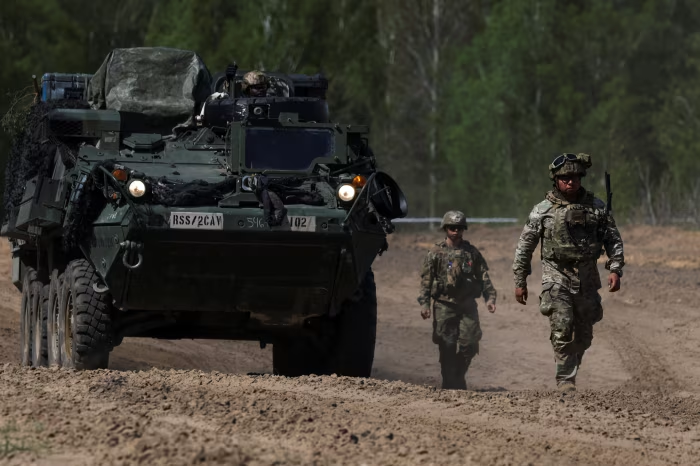
Originally, around 4,000 American troops had been slated to deploy, most of them heading to Poland and a smaller number to nearby countries. That plan was suddenly stopped by the Pentagon on May 13. By late Thursday, Trump had changed his mind, announcing instead that 5,000 troops would head to Poland, though where exactly those forces would come from remains unclear.
Polish Officials Felt Betrayed
The brief window between the cancellation and the reversal triggered emotional reactions across Polish political circles. Officials voiced “disappointment,” “bewilderment,” and even “genuine alarm,” according to the document, which is marked sensitive but unclassified.
The cable noted that the strongest emotional response was a sense of betrayal. This was especially painful given that Trump had repeatedly praised Poland as America’s most loyal and dependable ally in Europe. Among those who received the cable was the office of Secretary of State Marco Rubio.
Long-Standing Communication Issues
The miscommunication didn’t start with Trump. The cable points out that inconsistent messaging dating back to the administration of former President Joe Biden also played a role. Biden originally approved the troop rotations in response to Russia’s full-scale invasion of Ukraine in 2022.
According to the document, those deployments were never officially meant to be permanent. However, that point was never clearly explained to the Polish public. Over time, the rotational presence began to feel like a semipermanent security commitment, and U.S. officials did little to push back against that perception.
The White House Defends Trump’s Strategy
White House spokesperson Anna Kelly defended Trump’s eventual decision to send troops, framing it as part of a broader regional strategy. She emphasized that the president has been pushing European allies to take more responsibility for their own defense while still maintaining peace through strength.
The State Department declined to comment on the leaked cable, while the Pentagon redirected all questions to the White House.
Poland’s Heavy Investment in the Alliance
Poland has consistently stood out among NATO allies for its commitment to defense spending. The country has spent tens of billions of dollars on American-made military equipment and currently pays to host roughly 10,000 U.S. troops on its territory. This is exactly the kind of dedication Trump has demanded from NATO members, which is why he has frequently praised Warsaw, even as he clashes with other major allies like Germany.
Political Damage at Home
The troop cancellation also hit one of Trump’s key political allies hard. Polish President Karol Nawrocki, a conservative leader closely aligned with the U.S. president, found himself in an awkward position. His senior aide, Marcin Przydacz, told POLITICO that the situation was caused by “chaotic communication” coming out of Washington, leaving allies in the dark.
Przydacz also expressed his belief that the cancellation didn’t reflect the White House’s actual intentions, suggesting that it was largely the result of internal confusion inside the Pentagon.
Why the Deployment Was Paused
Behind the scenes, the Trump administration had been looking for ways to scale back the troop rotations that started under Biden. Several U.S. Army brigades have been increasingly tied up at the southern border, which has placed pressure on the military’s resources. This made the rotational system in Europe harder to sustain.
However, the cable warns that the recent confusion could push European nations to rethink their reliance on American military support. It cautions about growing momentum behind EU defense integration, potential reductions in purchases of American weapons, and rising anti-American sentiment across the region.
Top US Generals Rush to Calm Allies
In response to the panic, top American military officials quickly traveled across Europe to reassure nervous allies. The Chair of the Joint Chiefs of Staff, Gen. Dan Caine, met with NATO defense ministers in Brussels. Meanwhile, Vice Chair Gen. Christopher Mahoney held meetings with Polish military and civilian leaders in Warsaw.
Polish officials also rushed to Washington for clarity. Polish Defense Minister Władysław Kosiniak-Kamysz held a direct conversation with U.S. Defense Secretary Pete Hegseth earlier in the week.
A Possible Way Forward
The U.S. Embassy in Warsaw offered several recommendations to repair the damage. One key suggestion was to reduce the large rotational armored presence while creating a smaller but more permanent American troop role in Poland.
This new model could focus on areas like command and control, surveillance, logistics, prepositioned equipment, air defense, and rapid reinforcement. An added benefit, according to the cable, is that this approach could save millions of dollars by ending the need to rotate out an armored brigade every nine months.
What This Means for US-Poland Relations
The US-Poland troop deployment controversy has revealed serious cracks in the way Washington communicates with even its closest allies. While Trump’s reversal may have stopped the immediate fallout, the trust between the two nations has taken a hit. Polish leaders now want clearer, more consistent commitments from the United States, especially in a region that continues to feel the pressure of ongoing conflict in Ukraine.
How both sides handle the next steps will likely shape not just the future of Polish-American relations but also the broader stability of NATO’s eastern flank.
Author