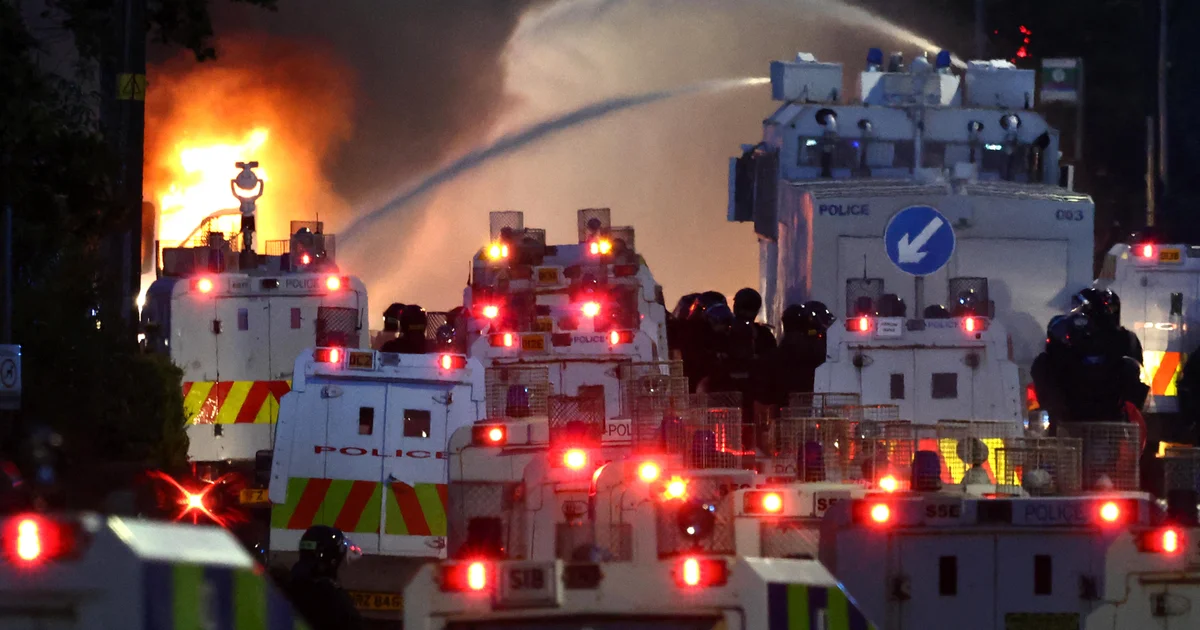
The Belfast anti-immigrant violence intensified Wednesday as police blasted water cannons at protesters who set small fires and hurled bricks, rocks, and bottles, marking a second consecutive night of unrest sparked by a brutal stabbing on a city street. The escalating clashes have left Northern Ireland grappling with a wave of racially charged disorder that politicians across the spectrum have condemned.
Chaos on the Streets
The scenes in Belfast were striking in their intensity. Masked demonstrators tore bricks from the walls outside homes and smashed sidewalks with sledgehammers to fashion projectiles for riot police. In one area, the crowd used sections of a dismantled picket fence as makeshift cover while confronting officers.
The violence broke out just hours after the suspect in the stabbing appeared in court, fueling tensions that had already been building since the attack.
The Suspect in Court
A 30-year-old man from Sudan appeared before a Belfast court charged with attempted murder in the knife attack that left a man seriously injured. Hadi Alodid was ordered held in jail after appearing by video in Belfast Magistrates’ Court.
A detective testified that Alodid blinded the victim, Stephen Ogilvie, in the left eye during the assault. He also faces charges of possessing a knife and threatening to kill a radiographer while being treated for a hand injury following the attack.
According to the detective, police arrived to find Alodid on top of the victim, armed with a kitchen knife. Alodid reportedly told hospital staff that he had killed someone, saying he didn’t know whether they were dead, and later threatened, “I will kill you.” Speaking through an Arabic interpreter, he refused legal representation and entered no plea.
A Night of Burning Homes
Authorities had braced for further violence after a harrowing first night. On Tuesday, masked men set fire to several homes they believed housed immigrants, burned trash bins, torched a Belfast bus, and pelted police with objects.
The human toll was significant. Firefighters rescued several people from burning houses, and more than two dozen people were left homeless. Among those rescued were families, including one with a baby, who were taken to police stations for safety.
Fear Among Residents
For longtime residents, the unrest shattered a sense of community. Anselme Shima, a Belfast resident originally from Congo, described seeing smoke rising from burning vehicles near his home. He said he had lived on his street for nearly a decade and maintained good relationships with his neighbors, but called the night horrific. Frightened and uncertain, he said he found himself wondering if he might be next.
Police and Officials Respond
Police Service of Northern Ireland Chief Constable Jon Boutcher emphasized that the violence touched people across the community, not only ethnic minorities. He told the BBC that the families caught up in what he called vile behavior came from across communities, insisting there was absolutely no excuse for it.
Boutcher announced that 200 additional officers would be deployed Wednesday, with the PSNI calling in support from other forces. In anticipation of further protests, bus and train operators in Belfast said they would halt services early.
A Family’s Plea for Peace
In a powerful gesture, the family of the stabbing victim appealed for an end to the violence and spoke out in defense of migrants, saying they make a deeply valuable contribution to the country. The family urged that the tragedy not be exploited to divide people or fuel hostility.
Political Condemnation
Leaders from both sides of Northern Ireland’s power-sharing government denounced the disorder. First Minister Michelle O’Neill of Sinn Fein labeled it thuggery, describing groups of masked men burning families out of their homes as disgusting cowardice. Deputy First Minister Emma Little-Pengelly of the Democratic Unionist Party agreed, saying it was utterly wrong to take frustration over one person’s actions out on those who had no part in them.
The Attack That Sparked It All
The original assault, which occurred Monday, was captured on video that spread rapidly across social media and was quickly seized upon by anti-immigration activists. Ogilvie, a man in his 40s, was hospitalized with deep cuts to his head, face, and back.
Police said Alodid had entered Northern Ireland from the neighboring Republic of Ireland in 2023, applied for asylum, and received a five-year permit to remain. The PSNI stated there was no information suggesting the attack was terrorism-related.
Despite repeated calls for calm from politicians, far-right activists encouraged the protests online, and the street violence erupted regardless.
National Leaders Weigh In
Prime Minister Keir Starmer condemned the stabbing as sickening but made clear that violence targeting people based on their background would not be tolerated. He called the scenes in Belfast shocking and completely unacceptable, stressing there was no justification for the disorder or for those who encouraged it online or elsewhere.
Northern Ireland Justice Minister Naomi Long offered a sharp rebuke of outside agitators, saying social media provocateurs who would have struggled to locate Belfast on a map were weaponizing local fears. She characterized the act of driving people from their homes based on the color of their skin as plain racism, urging those bad-faith actors to step back.
Questions Over the Border
The stabbing has reignited a politically sensitive debate. Some politicians argued it should prompt a review of the open border between Northern Ireland, part of the U.K., and the Republic of Ireland.
That border remains a delicate issue. The free movement of people is a central pillar of the peace process that largely ended decades of conflict known as “The Troubles,” a period of violence involving Irish Republican and British Loyalist militants and U.K. security forces that left nearly 3,600 people dead before the 1998 peace accord. Much of Tuesday’s violence unfolded in working-class areas where former paramilitary groups still wield considerable influence over the streets.
A Broader Pattern
The Belfast unrest echoes recent events elsewhere. Last week, a separate case involving a university student stabbed to death in Southampton, England, in December was similarly exploited by activists, including U.S. Vice President JD Vance, who blamed immigration for the violence, a claim rejected by Starmer and other British politicians.
In that case, the victim, Henry Nowak, who was white, was killed by Vickrum Digwa, a Sikh who falsely told police he had been the victim of a racist assault by Nowak. Officers initially treated the wounded Nowak as a suspect before recognizing his injuries and attempting to resuscitate him. Digwa was convicted of murder and sentenced last week to life in prison with a minimum 21-year term. A protest over Nowak’s death also turned violent, with some attacking police and several people charged with violent disorder.
An Uneasy Outlook
As Belfast braces for the possibility of further unrest, the city finds itself at a difficult crossroads. A single act of violence has exposed deep tensions around immigration, identity, and community, amplified by online agitators and the long shadow of Northern Ireland’s troubled past.
With additional police on the streets and community leaders, victims’ families, and politicians all pleading for calm, the coming days will test whether Belfast can step back from the brink. For now, residents like Shima are left fearful in their own neighborhoods, hoping that reason prevails over the violence that has gripped their city
Author