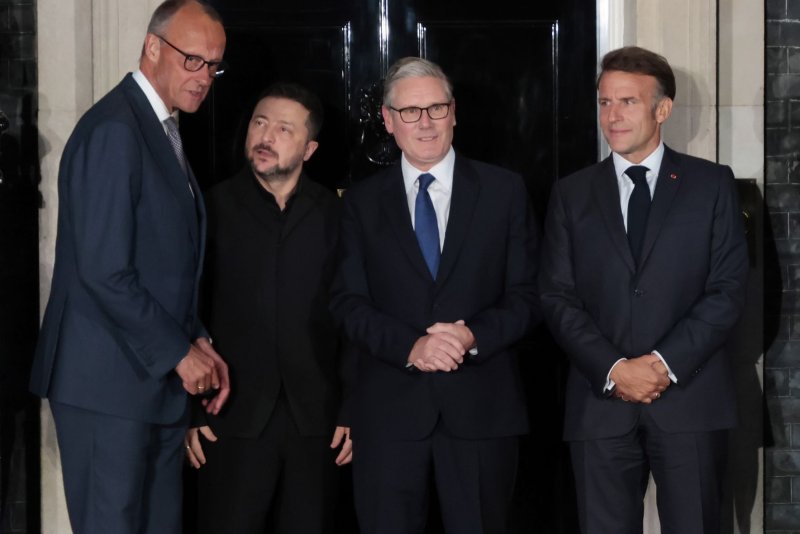
The Zelensky E3 peace conditions took center stage on June 7, as the leaders of the United Kingdom, France, Germany, and Ukraine issued a joint statement outlining five key conditions that must be met between Kyiv and Moscow to bring an end to Russia’s war in Ukraine.
Aligning With Zelensky’s Open Letter
The statement closely mirrors an open letter that President Volodymyr Zelensky had sent to Russian President Vladimir Putin just days earlier, in which he urged the two leaders to move forward with direct bilateral peace talks.
The joint declaration followed Zelensky’s visit to London, where he held bilateral talks with U.K. Prime Minister Keir Starmer and participated in E3-format discussions with the leaders of the U.K., France, and Germany.
Praise for Ukraine’s Battlefield Gains
Before laying out the conditions, the leaders welcomed Ukraine’s recent battlefield advancements, including what they described as the “ground-breaking use of drone technology.” This was partly a reference to Ukraine’s recent progress in medium-range strikes targeting Russian logistics behind the front line.
The leaders also discussed how best to coordinate further support for Ukraine based on its prioritized needs, with an eye toward several upcoming international gatherings, including the G7 Leaders’ Summit.
The Five Conditions for Peace
At the heart of the statement are five conditions the leaders say “would need to be in place for a just and lasting peace”:
- An immediate and complete ceasefire — a direct call for Putin to halt hostilities.
- Negotiations beginning at the current line of contact — directly mirroring Zelensky’s open letter.
- Robust, legally binding security guarantees for Ukraine once a ceasefire takes effect, including the deployment of a multinational force to enforce it.
- Compensation for war damages, with leaders vowing that Russian assets will remain immobilized until Moscow ends the war and provides restitution.
- Safeguarding European security interests, with the statement specifying that any negotiation elements related to the EU and NATO would require the consent of the EU and its member states, as well as NATO allies, respectively.
Putin’s Resistance
Despite months of U.S.-brokered peace negotiations, Putin has repeatedly refused to implement a ceasefire in Ukraine. Notably, the Russian president dismissed Zelensky’s open letter just one day after it was issued, underscoring the steep diplomatic challenges that remain.
Europe’s Central Role
A recurring theme throughout the talks was the insistence that Europe play a meaningful part in any peace process. Ahead of the discussions, Zelensky said that “Europe should be (included) in the negotiations and should be strong.”
In his open letter, Zelensky proposed that Russia and Ukraine begin direct talks, while noting that “other specific participants may join the bilateral track that has been started between us.” He emphasized the importance of involving “those who really have the ability to influence the situation,” writing that “Europe needs to participate.”
Freezing the Front Lines
In an interview with U.K. outlet Sky News on June 7, Zelensky reiterated his call to begin a ceasefire by freezing the battlefield along current positions. He stressed that the goal was a durable resolution rather than a temporary pause.
“We want to stop the war in a way where the war will not come back,” he told Sky News. He added, “It’s not the idea just to freeze, but the quickest way to is to freeze and to move it to a diplomatic setting.”
What Comes Next
Zelensky’s diplomatic engagements in the U.K. are set to continue, with a planned meeting with King Charles III on June 8. As the war grinds on and upcoming summits like the G7 loom, the joint statement represents a unified European-Ukrainian front on the terms for ending the conflict — even as Moscow’s continued resistance leaves the path to peace deeply uncertain.
Author