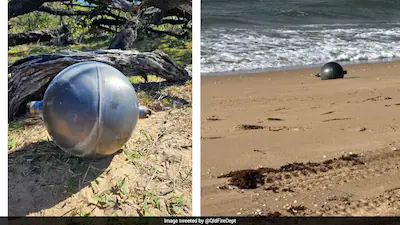
The discovery of mysterious metal spheres has sparked intrigue after several objects washed up on an Australian beach, with experts now identifying them as likely space debris Australia from a recent rocket reentry. Before anyone jumps to conclusions, officials are fairly confident about one thing: this is not the work of aliens.
What the Objects Actually Are
The Australian Space Agency has identified the metal spheres as potential space debris tied to a recent rocket reentry. According to the agency, the recovered objects appear to be pressure vessels from a space launch vehicle. Their location and physical characteristics, officials said, are consistent with debris from a foreign rocket body that recently reentered the atmosphere from orbit.
In short, what looked at first like something out of science fiction turns out to have a far more grounded, if still remarkable, explanation.
The Shiny Space Balls
Six solid objects were discovered on Forrest Beach in Queensland, Australia. Each one is a shiny metal sphere with bolts protruding from either side, and they may represent a key component from a launch vehicle.
These are likely rocket pressure vessels, which are engineered to safely store propellant or oxidizers during a launch. Typically, such components are constructed from durable materials like aluminum or titanium, which helps explain how they survived the intense heat and stress of atmospheric reentry.
A Cautious Response
While the origin of the debris was being investigated, authorities took no chances. The Australian Space Agency began working with international partners to confirm the source of the objects and issued a clear warning to local residents.
Officials urged anyone who might come across additional debris not to touch, move, or attempt to recover it. Instead, they advised treating any suspected space debris as hazardous until told otherwise.
That caution was visible on the ground. Following the initial discovery, crews wearing protective suits were seen placing the spheres into hazmat barrels, a precaution taken over concerns that the objects might still contain residual amounts of flammable or reactive substances.
The agency later confirmed that Queensland emergency responders had assessed and recovered the objects and determined them to be safe, while noting that efforts continued to formally identify the launch vehicle and the country responsible for it.
A Growing Trend of Falling Space Junk
The Australian discovery is far from an isolated event. As the global space industry continues to expand, incidents involving fallen debris after rocket reentries have become increasingly common.
Several notable cases in recent years illustrate the pattern:
- In December 2024, a large metal ring crashed onto a village in Kenya. Early analysis suggested it was a separation ring, a part used to connect payloads to rockets during launch before falling back to Earth.
- In July 2022, pieces of space debris landed in the Snowy Mountains of southern New South Wales, Australia. Experts later identified them as belonging to a SpaceX Crew Dragon spacecraft that had carried four astronauts to the International Space Station in November 2020.
- Around the same time, fragments of a Chinese rocket fell over parts of Indonesia and Malaysia after its core stage returned to Earth on July 30, 2022.
Together, these incidents highlight just how frequently remnants of humanity’s space activities end up scattered across the planet.
Should We Be Worried?
So far, none of these debris events have caused reported injuries. However, the risk is not entirely negligible. A 2022 study suggested that the likelihood of space debris causing casualties on the ground is increasing as more objects are launched into orbit.
While the odds of being struck remain low, experts caution that they are not exactly zero, a sobering reminder as launch activity around the world continues to accelerate.
The Bigger Picture
The metal spheres on Forrest Beach serve as a striking, tangible example of a broader challenge facing the modern space age. As more rockets take flight, more of their components will inevitably return to Earth, sometimes in unexpected places.
For now, the Australian Space Agency continues to work with international authorities to trace the origin of the debris and identify the responsible launching state. And while the sight of shiny metal orbs on a quiet beach may spark visions of the extraterrestrial, the reality points to something closer to home, the growing footprint of human activity in space, quite literally washing back onto our shores.
Author