Deadly Floods Devastate Southern China as 39 Die and a New Typhoon Threatens the Coast
Southern China flooding has turned deadly, with authorities confirming on Thursday that 39 people lost their lives after a tropical storm unleashed torrential rain across the region. As rescue crews continue searching for survivors, the country’s east coast and neighboring Taiwan are bracing for yet another powerful storm expected to strike in the coming days.
A Reservoir Collapse Turns Tragic
The heaviest toll came from Hengzhou, where the partial failure of a reservoir dam sent a violent surge of water rushing into the city. That single disaster claimed 26 lives, according to Ding Wei, vice mayor of Nanning city, which oversees the affected area. Across the wider Guangxi region, nine people remained unaccounted for.
The devastation was triggered by Tropical Storm Maysak, which began pounding Guangxi with record-breaking rainfall on Saturday. The relentless downpours breached reservoirs and left residents stranded in their homes and other buildings for days. Just two days earlier, on Tuesday, the reported death toll had stood at only six, a stark reminder of how quickly the situation deteriorated.
A Second Storm Looms
Even as southern China reels from one disaster, another is approaching. Typhoon Bavi was tracking northwest over open water, on a path expected to carry it across remote Japanese islands, past the northern edge of Taiwan, and eventually onto China’s Fujian or Zhejiang province by Saturday.
In northern Taiwan, fishing boats were seen packed tightly into ports on Thursday as residents prepared for heavy rain to reach the island of 23 million people. Although Bavi had been downgraded from super-typhoon strength earlier that day, it remained dangerous, with maximum sustained winds of 114 miles per hour, according to Taiwan’s Central Weather Administration.
The storm’s reach extended well beyond China and Taiwan. Bavi had already battered Saipan and other U.S. territories earlier in the week. In response to its advance:
- Classes were suspended across several cities and towns in the Philippines
- Ships were barred from leaving northern ports
- Coastal communities braced as the typhoon passed east of Luzon
Thousands Rescued From Rising Waters
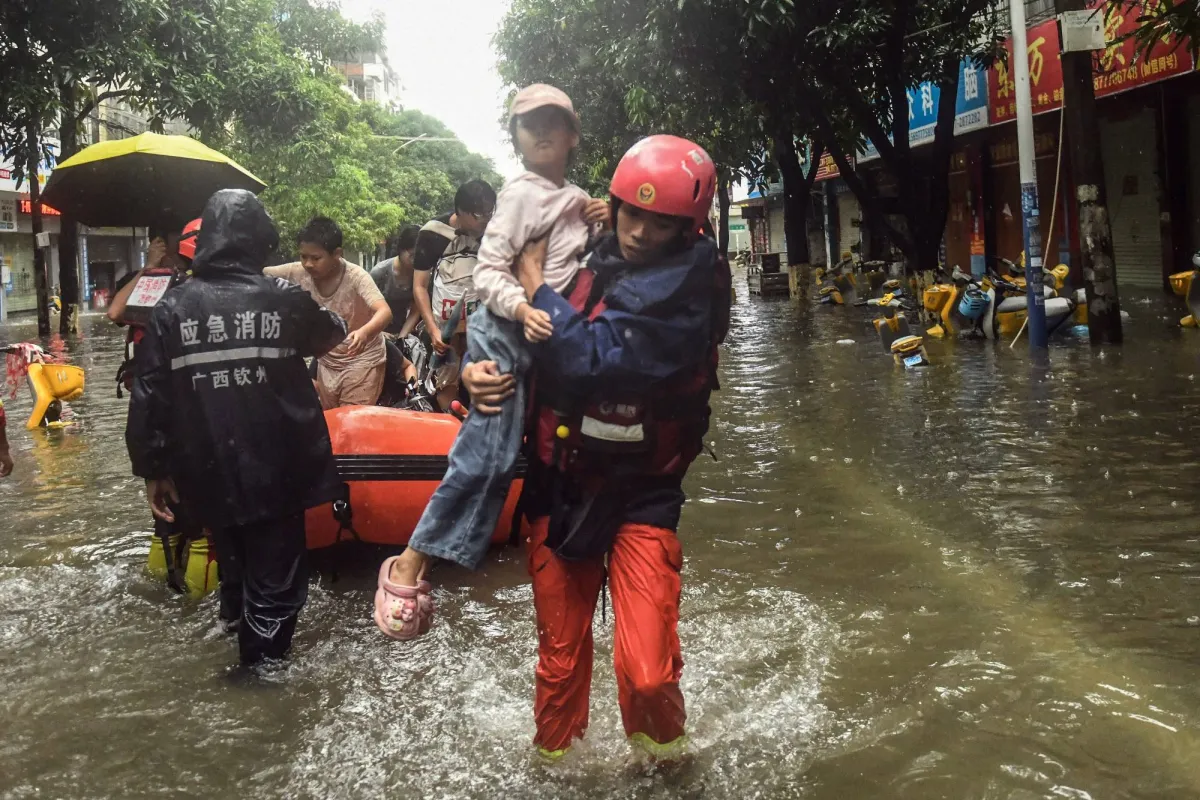
Amid the crisis, rescue efforts unfolded on a massive scale. Military teams in Guigang city, located about 40 miles northeast of Hengzhou, managed to evacuate more than 10,000 trapped students and teachers from a cluster of flooded schools.
Footage aired by state broadcaster CCTV captured a surreal and haunting scene: students in bright orange life vests climbing onto boats as school buildings rose from a vast expanse of muddy water. The images underscored both the severity of the flooding and the urgency of the response.
A Crisis for Animals, Too
The floods spared no one, including the region’s animals. Many were stranded or swept away as the waters rose.
A zoo in Guigang reported that more than 100 animals had gone missing, among them two zebras, four porcupines, and dozens of tropical birds. In Hengzhou, the situation grew even more dangerous when snakes reportedly escaped from a nearby farm. Fearing bites, authorities stocked up on antivenom and issued guidance to residents on how to respond if attacked.
The rescue of domestic animals proved equally challenging. In Binyang county, roughly 50 miles northwest of Hengzhou, an animal shelter operator worked frantically to save around 200 cats and a number of dogs. The dogs were carried out two at a time through deep water, while the cats scrambled up into the rafters as the flood levels climbed.
A Massive Relief Operation
The scale of the emergency response has been enormous. Drones and roughly 5,700 boats have been mobilized to deliver drinking water and essential supplies while ferrying trapped residents to safety. In total, about 130,000 people have been evacuated from the disaster zones.
According to Ding, floodwaters have begun to recede, though more rain is expected in some areas over the next two days. Recovery crews have been deployed to clear away mud and debris and to disinfect several towns in Hengzhou. Road repairs are underway, and electricity has already been restored to more than 60,000 homes.
The numbers behind the disaster reveal just how extreme the weather was. Southern Guangxi endured days of heavier-than-expected rain, with cumulative totals ranging from 4 to 16 inches in many areas and surpassing 35 inches in the hardest-hit locations, the national meteorological center reported.
Severe Weather Strikes Across Asia
Southern China was not the only region facing nature’s fury. Central China also suffered this week, as thunderstorms and tornadoes tore through Hubei province on Monday night, killing 11 people and leaving many others without homes.
The turmoil extended beyond China’s borders as well. In Bangladesh, landslides triggered by monsoon rains killed at least 13 Rohingya refugees living in camps. By Thursday, authorities had begun relocating vulnerable refugees to safer areas.
Looking Ahead
As southern China works to recover from one of its deadliest flooding events in recent memory, the looming arrival of Typhoon Bavi adds a heavy layer of uncertainty. With more rain forecast and a powerful storm bearing down on the coast, rescue teams, officials, and residents alike remain on high alert, hoping to prevent further loss in a region already pushed to its limits.
Author