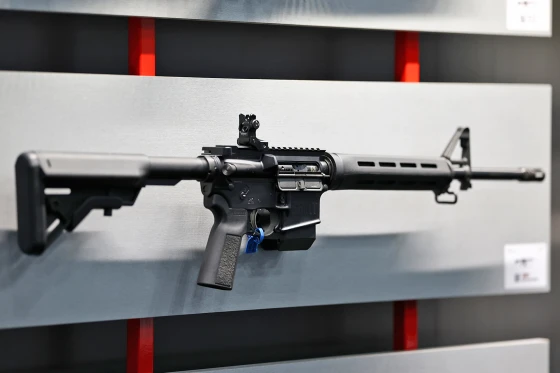
The New Jersey assault weapons ban was declared unconstitutional Friday by a federal appeals court, marking the first time any federal appellate court has struck down a state’s assault-weapons law on Second Amendment grounds.
The Philadelphia-based 3rd U.S. Circuit Court of Appeals held that New Jersey’s prohibitions on possessing semiautomatic rifles such as AR-15s and on magazines holding more than 10 rounds cannot stand.
A Ruling Broader Than the One Below It
The case reached the appeals court after a mixed outcome at the district level.
In 2024, a lower-court judge split the difference — finding New Jersey’s 1990 ban on AR-15 rifles unconstitutional while permitting the large-capacity magazine restriction to survive.
The appeals court went considerably further. Voting 10 to 5, the panel concluded that the ban on all categories of semiautomatic rifles violates the Second Amendment, not merely the portion covering AR-15s. It reached the same conclusion about the magazine limit.
The court also sent an additional question back down, instructing a lower-court judge to evaluate whether the assault weapons ban is constitutional as applied to other firearm types — including semiautomatic pistols and shotguns.
That directive means the ruling’s ultimate reach may extend beyond what Friday’s decision itself addressed.
The Legal Reasoning
Writing for the majority, U.S. Circuit Judge Arianna Freeman grounded the decision in recent Supreme Court precedent.
Her core conclusion was that recent Second Amendment rulings establish that broad prohibitions on possessing or carrying a class of weapons commonly used for lawful purposes lack support in the nation’s tradition of firearm regulation.
She added a point that goes to the heart of the dispute: that holds true even when such regulations are enacted specifically to reduce gun violence.
In other words, the stated purpose of a restriction doesn’t rescue it if the historical tradition test isn’t satisfied.
Freeman was one of two Biden appointees in the majority. The remainder of the majority consisted of judges appointed by Republican presidents — a composition that complicates any purely partisan reading of the outcome.
The Precedent Driving It
The challenge came from gun rights organizations arguing that New Jersey’s law could not survive a 2022 Supreme Court decision that substantially expanded gun rights.
That case, New York State Rifle & Pistol Association v. Bruen, established that modern firearm restrictions must be consistent with the nation’s historical tradition of firearm regulation.
Bruen replaced the balancing approach many courts had previously used — weighing public safety interests against constitutional burdens — with a historical analogue test. Under it, a state defending a gun law must point to comparable regulations from the founding era or shortly after.
That shift is what made Friday’s outcome possible.
New Jersey’s Argument
Attorneys for the Democratic-led state defended the law by emphasizing what the banned weapons can do.
They characterized assault weapons as military-style firearms capable of causing wholesale destruction and contributing to mass shootings, noting that New Jersey is one of 11 states with similar restrictions on the books.
That argument had prevailed in other circuits. It did not prevail here.
The Dissent
U.S. Circuit Judge Patty Shwartz, an Obama appointee, argued that states retain authority to ban certain categories of weapons.
She placed semiautomatic rifles in the “dangerous and unusual” category that falls outside Second Amendment protection, pointing specifically to their continued use by shooters committing crimes and mass shootings.
The disagreement between Freeman and Shwartz reflects the central unresolved question in post-Bruen litigation: whether a weapon in widespread civilian ownership can simultaneously be classified as dangerous and unusual.
Reaction From Both Sides
The Firearms Policy Coalition was among the groups challenging the law. Its president, Brandon Combs, characterized the ruling as another significant setback for what he described as an authoritarian campaign against gun owners.
New Jersey Attorney General Jennifer Davenport called the decision unfortunate and said her office is weighing its options.
She defended the underlying law, arguing that assault weapons and large-capacity magazines play a dangerous role in the current pattern of mass shootings, and that New Jersey acted both reasonably and lawfully in restricting them.
The Supreme Court Is Already Watching
The timing here matters enormously.
Last month, the Supreme Court agreed to review rulings that upheld comparable bans in Cook County, Illinois, and in Connecticut. That case is already on the docket.
The 3rd Circuit’s decision now creates a direct split among federal appeals courts — some upholding these laws, one striking them down. Circuit splits are among the strongest reasons the Supreme Court takes cases, and here the Court has already committed to resolving the question.
The Court holds a 6-3 conservative majority, and it authored Bruen. Friday’s ruling applies that precedent aggressively rather than narrowly.
What Happens Next
Several paths remain open.
New Jersey could seek Supreme Court review, though the Court’s existing case may effectively resolve the issue regardless. The state could also pursue further proceedings on the questions remanded to the district court.
The practical effect within New Jersey depends on whether any stay is issued. Appeals courts frequently pause enforcement of rulings like this while further review is sought, meaning the law may or may not be immediately unenforceable.
The broader answer arrives when the Supreme Court rules in the Illinois and Connecticut cases. Whatever standard it announces will govern assault weapons bans in all 11 states that have them — either validating the 3rd Circuit’s approach or overriding it.
For now, one federal appeals court has said such bans cannot survive the Second Amendment. Whether that becomes the national rule is a question with a decision date already on the calendar.
Author