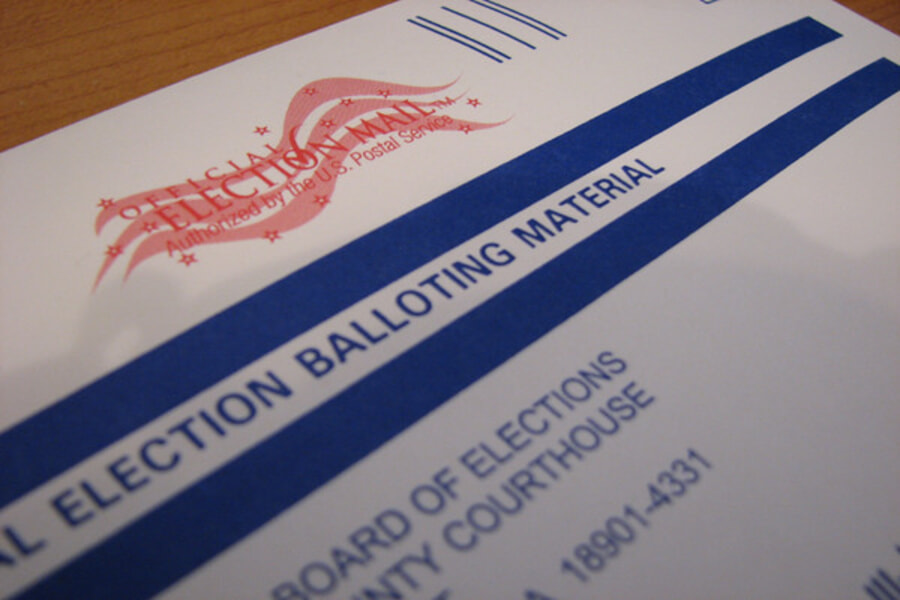
The USPS election-mail rule cleared a significant legal hurdle Friday when a federal appeals court allowed it to move forward while litigation continues — a decision with particular weight for California, where mail voting is the default rather than the exception.
The DC Circuit Court of Appeals granted the Postal Service a temporary stay, permitting the proposed rule to proceed as the case works its way through the courts.
What the Rule Would Require
The proposal places two conditions on states before federal ballots can be mailed.
States would need to provide voter lists to the Postal Service. They would also need to supply serialized barcodes for ballots — unique identifiers attached to individual pieces of election mail.
Supporters describe both requirements as safeguards that would strengthen the security of the election-mail system. Critics see the voter list provision as the more consequential piece, since it routes state-held voter registration data to a federal agency.
Why California Is at the Center
California functions as the primary test case for a straightforward reason: nearly every voter in the state receives a ballot by mail.
That makes any change to election-mail handling far more consequential there than in states where mail voting remains a minority practice. A rule that adds prerequisites before ballots go out affects essentially the entire California electorate.
The state has also been at the center of an ongoing dispute over election confidence, driven by complaints about the pace of vote counting and by unsubstantiated claims of widespread fraud.
The Federal Argument
First Assistant U.S. Attorney Bill Essayli framed the ruling as a victory for election integrity.
He specifically pointed to states that have declined to hand over their voter rolls for verification against federal election law requirements, saying the decision carries significant implications for jurisdictions in that position — California among them.
That framing makes the underlying dispute clear. The rule’s practical effect would be pressure on states to release voter data they have so far withheld.
How California Officials See It
Election administrators in the state have defended their system as both safe and secure while acknowledging the reality that drives most of the criticism: counting millions of ballots takes time.
The scale involved is easy to underestimate. Los Angeles County alone has more than 10 million residents — a population exceeding that of many entire states. Processing ballots for a jurisdiction that size is a logistical undertaking that simply cannot be compressed indefinitely.
Speed and thoroughness pull against each other. Signature verification, cure processes for ballots with issues, and reconciliation procedures all consume time, and skipping them would introduce exactly the vulnerabilities critics claim to be worried about.
California officials have also directly rejected Trump’s assertions about voter fraud in the state.
What the Ruling Does and Doesn’t Settle
This is important: the decision resolves nothing permanently.
The court did not rule on whether the Postal Service rule is lawful, nor did it address the broader election order it connects to. It granted a stay pending appeal — a procedural determination that the Postal Service satisfied the legal threshold required to keep the rule operative while the case proceeds.
The three-judge panel issued its conclusion in a two-page order, finding the standard for a stay had been met.
The underlying litigation continues, and the rule could still be struck down.
The Case Itself
Court records identify the matter as National Association for the Advancement of Colored People v. United States Postal Service and Louis DeJoy, docketed as No. 26-5257 before the U.S. Court of Appeals for the District of Columbia Circuit.
The NAACP’s involvement signals the nature of the opposition. Civil rights organizations have historically challenged election administration changes on grounds that added requirements can disproportionately burden certain voters.
The Larger Fight Underneath
This case sits inside a broader contest over who controls election administration.
The Constitution assigns responsibility for organizing elections to the states. Federal efforts to condition election operations — whether through funding requirements, data demands, or mail-handling rules — consistently generate constitutional objections on that basis.
Requests for state voter roll data have been particularly contentious. Multiple courts have previously blocked attempts to assemble federal voter databases from state-supplied records.
The USPS rule approaches the same objective through a different door. Rather than demanding data directly, it makes the delivery of election mail contingent on providing it.
What to Watch
Several developments will determine where this lands.
The first is whether California and other states comply, refuse, or seek further emergency relief. A refusal would force the question of what actually happens when a state declines and ballots are scheduled to go out.
The second is the timeline. With elections approaching, the practical impact depends heavily on whether the litigation resolves before or after ballots need to be mailed.
The third is the merits ruling itself. A stay pending appeal indicates the court thought the Postal Service had a reasonable argument worth preserving — not that the argument will ultimately prevail.
For now, the rule stands. Whether it survives, and what states do in the interim, remains unsettled.
Author