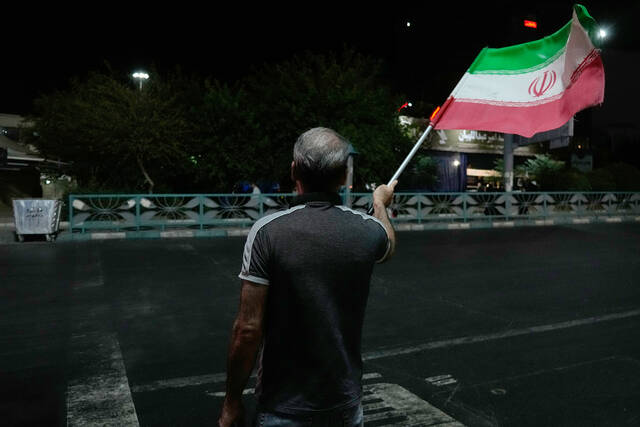
The latest Iran war updates mark a milestone that carries its own weight: the U.S. military confirmed Friday it had completed a seventh consecutive night of strikes against Iranian targets.
One full week of nightly attacks, with hostilities intensifying rather than winding down. Meanwhile, commercial traffic through the Strait of Hormuz has effectively frozen.
Competing Claims Over Regional Strikes
Iran’s Revolutionary Guards announced Friday that they had launched a new wave of attacks on American military facilities spread across the Middle East.
Their claimed targets spanned five countries: Syria, Kuwait, Oman, Bahrain, and Jordan.
The U.S. military rejected those claims the same day.
That denial doesn’t cover everything, however. Multiple U.S. officials told CBS News that Iran did strike at least two Jordanian bases earlier in the week, and that several American service members were injured when their facility was hit.
The gap between what Iran claims and what the U.S. acknowledges has become a recurring feature of this conflict — with the Jordan strikes serving as a reminder that denials of specific claims don’t mean nothing happened.
Gulf States Escalate Their Language
The Gulf Cooperation Council issued its sharpest condemnation yet on Saturday.
Secretary General Jasem Mohamed Albudaiwi described Iranian attacks on member states as war crimes requiring international accountability and prosecution.
His statement characterized Iran’s conduct as an extremely dangerous escalation and a serious breach of both international law and the United Nations Charter. He grounded the war crimes accusation in the deliberate targeting of infrastructure and civilian facilities, which he called a flagrant violation of international norms, and pointed to what he described as a sustained effort to destabilize regional security.
The GCC comprises Bahrain, Kuwait, Oman, Qatar, Saudi Arabia, and the United Arab Emirates. All six maintain alliances with the United States, and Secretary of State Marco Rubio attended a meeting of the bloc several weeks ago.
Iran has struck all six member states at various points during the war, framing the attacks as retaliation for U.S. and Israeli operations.
Kuwait absorbed particularly heavy fire overnight. Albudaiwi extended support to Bahrain, Kuwait, and Jordan following the overnight attacks, and offered wishes for the recovery of those wounded in Kuwait.
Why the GCC Statement Matters
The language here represents a shift worth noting.
Gulf states have historically calibrated their public positions carefully, balancing security ties to Washington against geographic proximity to Tehran. Formally accusing Iran of war crimes and calling for prosecution moves well beyond diplomatic expressions of concern.
It also signals that these countries increasingly view themselves as direct participants rather than bystanders to a U.S.-Iran confrontation.
Lebanon’s President Heads to Washington
On a separate but connected front, Lebanese President Joseph Aoun departed for the United States on Saturday alongside first lady Nehmat Aoun.
The trip centers on a summit with President Trump at the White House, scheduled for July 21, focused on the conflict between Israel and Hezbollah — the Iran-backed militia based in Lebanon.
According to a readout from Aoun’s office, the visit will also include meetings with a range of U.S. officials. The stated agenda covers reinforcing the ceasefire, restoring security and stability throughout the country with particular attention to the south, securing an Israeli withdrawal from occupied Lebanese territory, and extending the Lebanese state’s authority across all of its territory.
Trump has repeatedly spoken favorably of Aoun and previously extended the White House invitation.
A Death on the Day of Departure
Aoun left the country the same day a Lebanese soldier was killed and two others wounded.
A device exploded near an army vehicle in Al-Mansouri, a town in southern Lebanon, according to the Lebanese army. The army described the object as suspicious, and responsibility remains unestablished.
The timing underscores the difficulty of the position Aoun carries into Washington.
The Impasse in Southern Lebanon
The arrangement being negotiated has a circular problem at its center.
The Lebanese army is meant to deploy into southern Lebanon and provide security once Israel withdraws from the security zone it holds. But Israel has stated it will not leave until Hezbollah is disarmed and removed from the territory — an outcome that appears distant.
So the Lebanese army waits for an Israeli withdrawal that depends on a Hezbollah disarmament that hasn’t occurred, while the territory remains contested.
The cost of that stalemate is measurable. At least 33 Lebanese soldiers have died since Israel expanded operations in the south on March 2, according to a July 15 release from the U.N. Security Council.
The Hormuz Dimension
The freeze in Strait of Hormuz traffic deserves attention beyond the immediate military exchanges.
The strait is among the most consequential maritime chokepoints in the world, carrying a substantial share of global oil shipments. When commercial vessels stop moving through it, the effects reach far past the region — into energy markets, shipping insurance rates, and supply chains that have nothing to do with the Middle East.
A halt in traffic also removes a pressure valve. Shipping continuing under difficult conditions suggests operators believe risk is manageable. Shipping stopping entirely suggests they don’t.
What to Watch
Several threads will determine whether this stabilizes or worsens.
The strike tempo is the first — whether an eighth, ninth, and tenth night follow, establishing a sustained campaign rather than a defined operation.
The July 21 summit is the second. Whether it produces anything concrete on Lebanon, or serves mainly as a display of alignment, will say something about available diplomatic room.
The Gulf states are the third. Having accused Iran of war crimes, their next steps — whether toward international legal action, expanded military posture, or renewed de-escalation efforts — will shape the conflict’s boundaries.
And Hormuz remains the wild card. Extended closure converts a regional war into a global economic event, which changes the calculations of governments currently watching from a distance.
Author