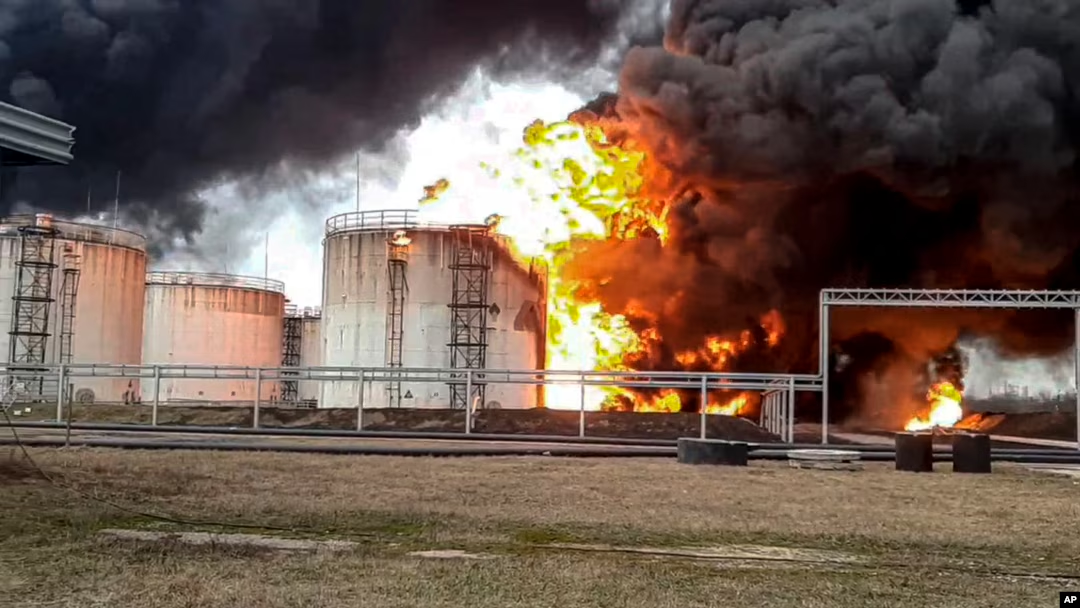
Ukrainian drone attacks struck multiple locations across Russia overnight, killing seven warehouse workers, injuring dozens more, and setting off a fire at an oil depot in the wider Moscow region, according to regional governors speaking Saturday.
The strikes hit facilities belonging to Russia’s largest online retailer as well as energy infrastructure, in a night that produced the highest civilian toll from a single wave of attacks in some time.
Seven Killed on a Night Shift
The deadliest strike landed in Kotovsk, a city in the Tambov region roughly 475 kilometers — about 295 miles — southeast of Moscow.
Governor Evgeniy Pervyshov said drones struck a warehouse operated by Wildberries, injuring 25 people. Seven workers on the night shift were killed at the scene.
Pervyshov said air defenses shot down 28 additional drones as they approached, arguing that civilian casualties could have been substantially higher had those drones reached their targets.
The timing matters to the death toll. A warehouse operating overnight has fewer people inside than during daytime hours, but those present are concentrated in specific work areas rather than dispersed across a large floor.
A Second Warehouse Hit East of Moscow
The Kotovsk strike wasn’t isolated.
Andrei Vorobyov, governor of the Moscow region, reported that 24 people were injured in a drone attack on another Wildberries facility, this one in Elektrostal, a city east of the capital.
Two warehouses belonging to the same company, struck the same night, hundreds of kilometers apart. That pattern points to deliberate targeting rather than coincidence.
Fire at the Noginsk Oil Depot
In Noginsk, also within the Moscow region, falling drone debris ignited a fire at an oil depot.
Vorobyov did not detail the extent of damage to the facility. He did say two people were injured in Noginsk and that a nearby maternity hospital was evacuated as a precaution.
The evacuation detail illustrates a hazard that often goes unmentioned in these accounts. Even drones intercepted or brought down short of their targets can cause significant harm through debris and secondary fires — particularly near fuel storage.
Kyiv’s Account of the Targets
Ukrainian President Volodymyr Zelenskiy offered a different characterization of what was hit.
Writing on X, he said Kyiv had struck two logistics facilities that Russia uses to supply components for drone production and navigation equipment. He also confirmed that an oil facility was targeted.
That framing casts the warehouses not as civilian retail infrastructure but as nodes in a military supply chain — a claim that, if accurate, would change the legal and strategic assessment of the strikes considerably.
No independent verification of the facilities’ contents or uses has been offered publicly.
The Company Responds
Tatyana Kim, co-founder and chief executive of Wildberries, described it as a terrible night for both Russia and the company, and extended condolences to the families of those killed.
Wildberries operates as Russia’s dominant e-commerce platform, with warehouse infrastructure distributed across the country. Its facilities are large, numerous, and — from a targeting perspective — identifiable.
The Underlying Dispute
The core disagreement in this incident is about what the warehouses actually were.
Russian officials describe civilian workers killed at a retail facility. Ukrainian officials describe strikes on logistics sites feeding drone manufacturing and navigation systems.
Both descriptions can be partly true. Dual-use infrastructure — commercial facilities that also handle or store militarily relevant goods — has been a persistent feature of this war and a persistent source of dispute over targeting decisions.
What isn’t in dispute is that seven people working a night shift are dead, and roughly 50 others were injured across the two warehouse sites.
Why Logistics and Fuel Keep Getting Hit
The target selection reflects a consistent Ukrainian approach over recent months.
Strikes on oil depots, refineries, and distribution infrastructure aim at the fuel supply that sustains military operations. Strikes on logistics facilities aim at the movement of components and equipment.
Neither category produces immediate battlefield results. Both are designed to accumulate — degrading capacity over weeks and months rather than days, and forcing Russia to allocate air defense resources across an enormous geographic area.
The reach involved is itself part of the message. Facilities in the Moscow region and hundreds of kilometers into Russian territory being struck simultaneously demonstrates capability that extends well beyond the front lines.
The Air Defense Picture
Pervyshov’s figure of 28 drones intercepted near Kotovsk alone suggests a large coordinated wave rather than a handful of individual strikes.
That ratio — dozens intercepted, a smaller number reaching targets — reflects the arithmetic of saturation attacks. Defending against them requires stopping nearly everything. Attacking requires only that some fraction gets through.
It also explains the debris damage in Noginsk. Intercepted drones don’t disappear; they fall, and where they fall matters.
What Comes Next
Expect Russian retaliation claims and likely reciprocal strikes on Ukrainian infrastructure in the coming days, following the pattern established throughout this phase of the war.
The more consequential question is whether Ukraine can sustain this tempo and reach. Repeated deep strikes on facilities near Moscow impose real costs on Russian air defense allocation and on the industrial base supporting drone production.
For the families in Kotovsk, those strategic considerations are beside the point. Seven people went to work a night shift and did not come home.
Author