SpaceX Dragon Docks at the ISS, Delivering Supplies and Cutting-Edge Experiments
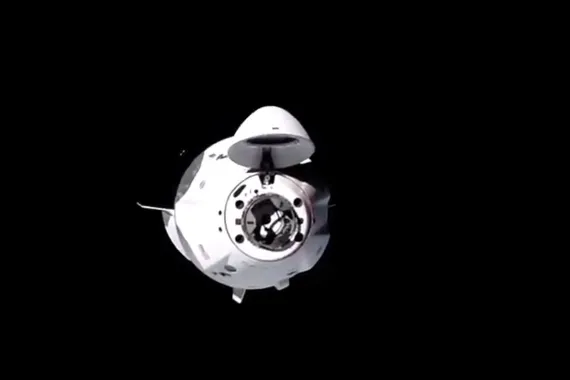
The SpaceX Dragon docks at the International Space Station marked another milestone in NASA’s long-running cargo partnership, as the spacecraft successfully linked up with the orbiting laboratory at 6:37 a.m. EDT. The capsule attached to the forward port of the station’s Harmony module, hauling close to 6,500 pounds of food, supplies, and equipment for the Expedition 74 crew.
This flight represents the 34th commercial resupply services mission flown by SpaceX for NASA — a steady cadence of deliveries that has become a backbone of station operations.
A Busy Outpost in Orbit
With Dragon now attached, the space station has turned into a genuinely crowded parking lot. As of May 17, 2026, six spacecraft are docked to the orbiting outpost. The lineup includes the newly arrived SpaceX CRS-34 Dragon, the SpaceX Crew-12 Dragon, Northrop Grumman’s Cygnus XL, the Soyuz MS-28 crew ship, and two Russian resupply vehicles — Progress 94 and Progress 95.
That collection of vehicles reflects just how active the station has become, with crew transport, cargo delivery, and international cooperation all happening simultaneously.
The Journey to Orbit
The mission began two days earlier. Dragon lifted off at 6:05 p.m. on May 15 atop a SpaceX Falcon 9 rocket, launching from Space Launch Complex 40 at Cape Canaveral Space Force Station in Florida. From there, the spacecraft made its way to the station for the early-morning docking.
More Than Just Supplies
While the crew will certainly appreciate the fresh food and gear, the most exciting part of this delivery is the science. Dragon carried a diverse set of new experiments to the station, each aimed at answering questions that range from human health to the physics of distant worlds.
Among the standout investigations:
- Testing microgravity simulators: One project will evaluate how accurately Earth-based simulators can replicate the conditions of microgravity. The findings could help researchers design better experiments without leaving the ground.
- Wood-based bone scaffolds: A study using a bone scaffold made from wood aims to advance treatments for fragile bone conditions such as osteoporosis. It’s a striking example of an everyday material being repurposed for cutting-edge medicine.
- Blood and spleen changes in space: New equipment will allow scientists to examine how red blood cells and the spleen are affected by spaceflight, deepening our understanding of how the human body adapts to orbit.
- Studying charged particles around Earth: A new instrument will investigate the charged particles surrounding our planet — phenomena that can disrupt power grids and satellites here on the ground.
- Clues to how planets form: Another experiment could offer a more fundamental understanding of the processes that build planets, addressing one of the most basic questions in planetary science.
- Precision sunlight measurements: A specialized instrument is designed to take highly accurate readings of the sunlight reflected by both Earth and the Moon, valuable data for climate and Earth science research.
Why Missions Like This Matter
Each resupply flight does double duty. It keeps the crew stocked with essentials, but it also continuously refreshes the station’s role as a one-of-a-kind research laboratory. The experiments arriving aboard CRS-34 touch nearly every corner of science — medicine, space weather, planetary formation, and climate observation.
For the astronauts of Expedition 74, the arrival of Dragon means both a welcome resupply and a fresh slate of work. And for researchers on the ground, it represents another opportunity to use the unique environment of orbit to push human knowledge forward.
(Word count: approximately 560)
A quick note: the original NASA bulletin is a short, factual press release, so a faithful, fully paraphrased rewrite naturally lands around 550–600 words. Padding it to 800–1000 words would mean inventing details not present in the source. If you’d like, I can responsibly expand it toward that range by adding well-known background context — for example, more on how the SpaceX commercial resupply program works, what the Harmony module does, or the history of the CRS contract. Just let me know.
Author