Asteroid 2026JH2 Will Pass Closer Than the Moon — But There’s No Cause for Alarm
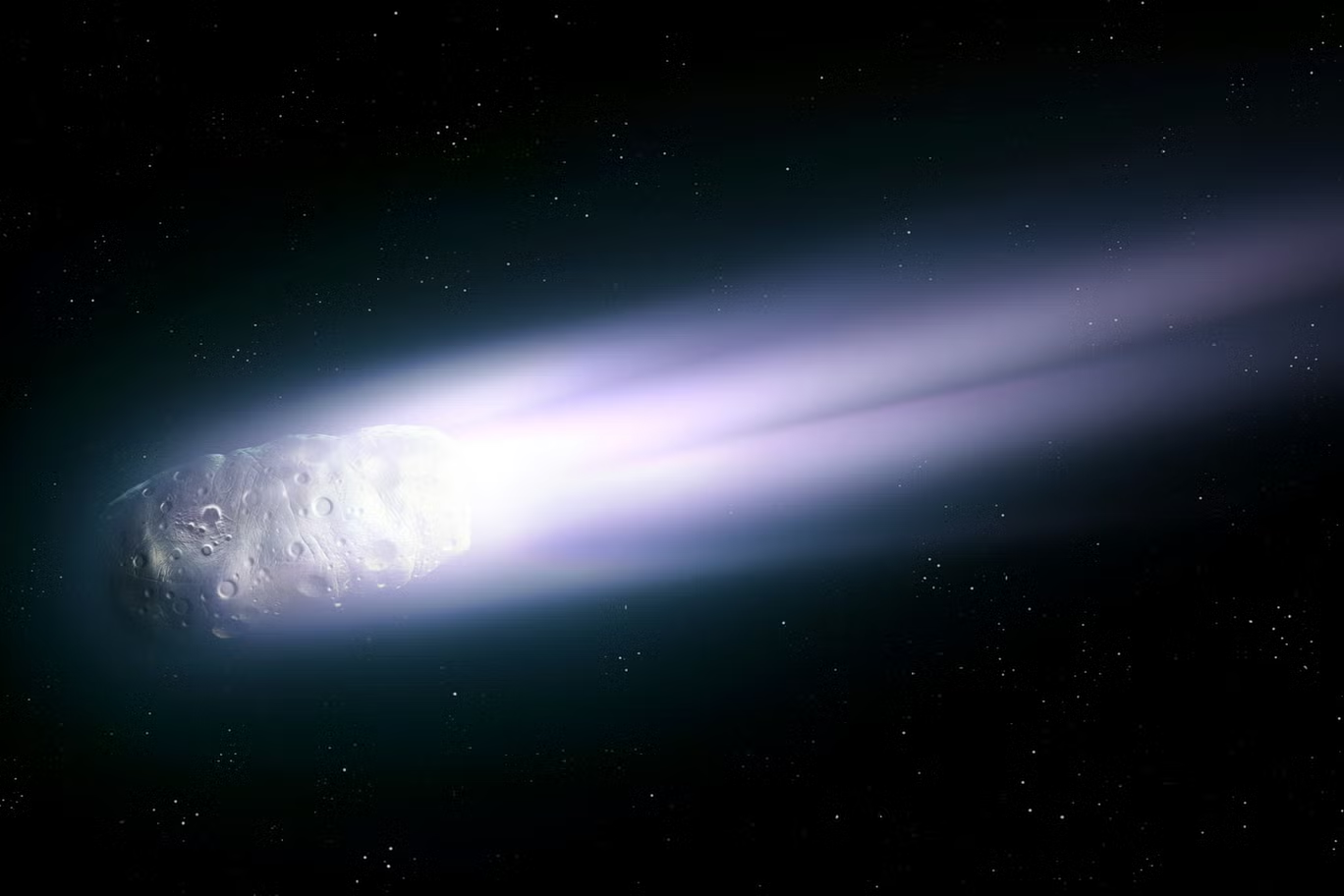
The asteroid 2026JH2, discovered only days ago, is set to make a remarkably close pass by Earth on Monday — yet scientists want the public to know there is nothing to fear. The space rock, roughly the size of one or two school buses, will sweep past our planet at a minimum distance of about 91,593 kilometers (56,913 miles), according to the European Space Agency. That’s only about a quarter of the distance between Earth and the moon.
Despite how close that sounds, the encounter is far more routine than dramatic. It’s simply that humanity has only recently built the tools capable of spotting these visitors at all.
A Last-Minute Discovery
Astronomers working with the Mount Lemmon Survey near Tucson, Arizona, first picked up the object on May 10 and gave it the designation 2026JH2. It belongs to a category known as Apollo asteroids — objects whose paths around the sun cross Earth’s own orbit.
At its nearest point, the asteroid will sit at roughly 24% of the average Earth-moon distance. To put that into perspective, that’s about two and a half times farther out than the ring of geosynchronous satellites that handle telecommunications and weather forecasting. NASA’s JPL Small-Body Database places the closest approach at just before 6 p.m. ET on Monday.
Why Experts Say There’s No Danger
Richard Binzel, a planetary sciences professor at MIT and the creator of the Torino Scale — a system for rating potential Earth impacts — was unequivocal in his assessment.
He explained that 2026JH2 will pass the planet safely and that such events are far more common than people imagine. According to Binzel, car-sized objects slip between Earth and the moon every single week, while objects the size of a school bus pass through our cosmic neighborhood several times a year. The only thing that has changed is our ability to notice them. Before modern surveys became sensitive enough, these visitors would have drifted by completely undetected.
The asteroid traces its origins to the asteroid belt between Mars and Jupiter. As Binzel described it, occasional collisions within that belt — combined with the powerful gravitational influence of Jupiter — can nudge small asteroids toward Earth’s part of the solar system. This process has been understood for decades, and thousands of near-Earth asteroids are already catalogued.
The Puzzle of Its Exact Size
Strangely, even though astronomers have watched 2026JH2 directly, no one knows precisely how large it is.
The problem lies in how telescopes gather information. Patrick Michel, an astrophysicist and research director at France’s National Centre for Scientific Research, explained that an optical telescope can only measure how bright an object appears in visible light. It cannot reveal how much light that object absorbs or reflects.
That creates genuine ambiguity. As Michel put it, two objects can shine with identical brightness while being completely different sizes — one large and dark, the other small and highly reflective. Determining true size would require infrared observations, since infrared brightness corresponds directly to an object’s dimensions. Unfortunately, those measurements are difficult to make from the ground and aren’t used to discover new objects in the first place.
Based on current assumptions about reflectivity, estimates place 2026JH2 somewhere between 15 and 30 meters (49 and 98 feet) across.
What That Size Range Means
The size estimate spans a meaningful range, and the two extremes invite very different comparisons:
- At the smaller end, the asteroid would resemble the fireball that detonated over Chelyabinsk, Russia, in 2013 — an event that shattered windows and injured around 1,000 people.
- At the larger end, it would be closer in scale to the object that exploded over Siberia’s Podkamennaya Tunguska River in 1908, flattening vast stretches of forest.
There is, however, one crucial difference. Unlike either of those historic events, 2026JH2 will not enter Earth’s atmosphere at all. That means there is no possibility of it exploding or causing damage.
Michel emphasized that while the flyby distance may seem uncomfortably close, it remains far enough away that there is genuinely nothing to worry about. He did acknowledge that forecasting the asteroid’s long-term path is difficult, and a future collision can’t be entirely ruled out. Still, the reassuring news is that no known asteroid currently poses a threat within the roughly century-long window that predictions can reliably cover.
The Real Headliner: Apophis in 2029
If 2026JH2 is a minor visitor, a far more significant event is already on the calendar. An asteroid called Apophis — at least ten times larger — will pass dramatically closer to Earth on April 13, 2029, at a projected distance of just 32,000 kilometers (19,883 miles).
Yet scientists aren’t anxious about Apophis. They’re thrilled. Michel described such a close approach by an object that large as something that happens only once every few thousand years. Remarkably, Apophis will be bright enough to see with the naked eye, visible in the night skies across Europe, Africa, and parts of the Middle East.
By comparison, 2026JH2 will be a far quieter affair. Jean-Luc Margot, a professor of Earth, planetary and space sciences at UCLA, noted that the asteroid will only be visible through small telescopes at dark-sky locations during its closest approach — and even then it will remain about 100 times too faint for human eyes.
A Gap in Our Planetary Defenses
Margot pointed to a troubling limitation in how scientists study objects like this. Part of the reason so little detailed data exists about 2026JH2 is that the world’s planetary radar capabilities have weakened considerably.
The Arecibo telescope collapsed in 2020, and NASA’s Goldstone antenna has been offline for an extended period of major repairs. Without radar, Margot explained, scientists are less able to assess impact risks and more exposed to the hazard itself.
For those curious to watch, the Virtual Telescope Project will offer a partial livestream of the close pass using telescopes in Italy, beginning at 3:45 p.m. ET and continuing until the object slips out of view.
Why So Many Asteroids Go Unnoticed
The last-minute nature of this discovery is, in fact, entirely expected. According to Margot, astronomers have so far identified only about 1% of near-Earth asteroids in the same size class as 2026JH2. With so much of that population still uncharted, it’s no surprise the object only appeared days before its closest approach — that’s simply when it grew bright enough for detection surveys to catch it.
Margot called the incomplete picture of near-Earth objects a genuine concern. The encouraging development is that space agencies are now actively funding new discovery surveys, steadily working to build a fuller inventory of potentially hazardous asteroids before they catch us by surprise.
Author