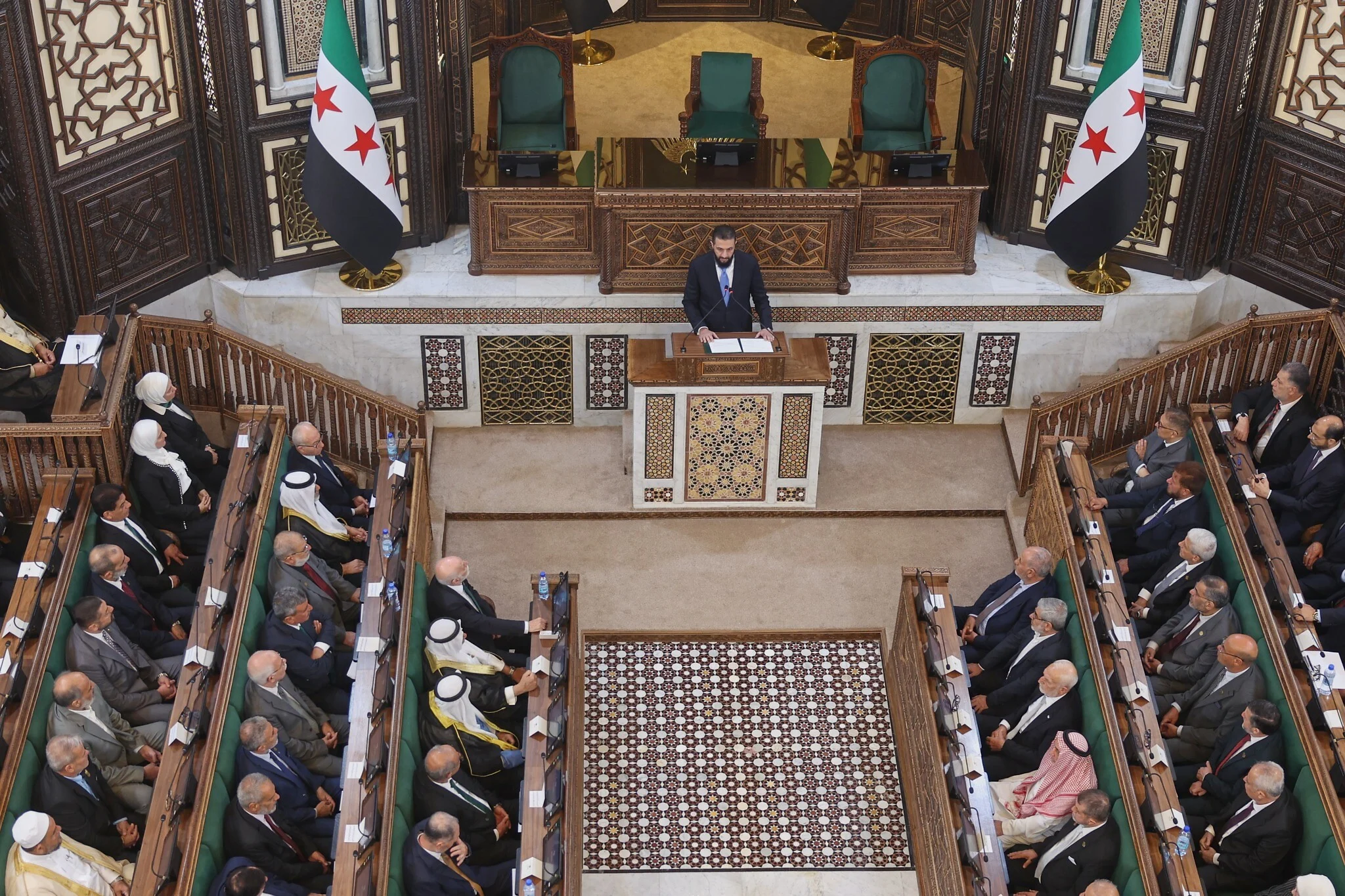
For the first time since Bashar Assad’s fall, Syria has a functioning legislature.
Syria’s new parliament convened its opening session in Damascus on Sunday, restarting a legislative process interrupted by years of civil war and decades of autocratic rule.
The moment is symbolically enormous. Whether it proves substantively so depends on what the body actually does next.
The Composition
The People’s Assembly has 210 members. How they arrived there matters.
- Two-thirds were elected through electoral colleges
- One-third were appointed directly by interim President Ahmed al-Sharaa
That split is the defining feature of this parliament. It is neither fully elected nor fully appointed — a hybrid that reflects the constraints of governing a country still emerging from catastrophe.
Critics will note that a president appointing a third of the legislature is an unusual foundation for democratic renewal. Defenders will argue that in a fractured, post-conflict state, some continuity and control is unavoidable.
Both positions have merit. Neither settles the question.
A Temporary Body
The assembly is not permanent by design.
It will serve a 30-month term, during which its central task is preparing for future elections.
In other words, this is a transitional parliament — a bridge institution meant to hold legislative authority while the machinery for genuine national elections is constructed.
Thirty months is a meaningful window. It is long enough to draft real legislation and short enough to preserve pressure toward a fuller democratic process.
Al-Sharaa’s Message
Interim President Ahmed al-Sharaa addressed the parliamentarians directly.
“After liberating our homeland and regaining our freedom, we are all moving toward consolidating the state,” he said.
That word — consolidating — carries weight. Syria’s problem is not only political legitimacy. It is basic state capacity: institutions, courts, ministries, the ability to enforce law across territory.
The Speaker
After taking their oaths, legislators elected Abdul Hamid al-Awak as speaker.
His biography is instructive.
Al-Awak comes from northeastern Hassakeh province. According to Syria’s state-run SANA news agency, he served for a decade as a judge in the Justice Ministry.
Reports indicate he was among the many Syrian officials who defected from the Assad government in the early days of the uprising, leaving for Turkey.
That trajectory — an insider who broke with the regime and went into exile — is common among figures now assuming authority in Damascus. It confers a particular kind of legitimacy: technical competence combined with a documented refusal to serve Assad.
The Weight of What Came Before
The context surrounding this parliament cannot be understated.
The Assad family ruled Syria for decades. The civil war that followed the 2011 uprising killed approximately half a million people.
Cities were flattened. Millions were displaced, internally and abroad. An entire generation grew up knowing only conflict.
A parliament convening in Damascus is, against that backdrop, a genuinely remarkable event — regardless of how imperfect its composition may be.
What This Body Must Actually Do
The tasks ahead are formidable and largely unglamorous.
A functioning legislature in post-war Syria will need to address:
- Drafting laws to replace decades of regime-era statutes
- Establishing the legal framework for future elections
- Addressing property, refugee return, and reconstruction
- Building judicial independence essentially from nothing
- Navigating the country’s deep sectarian and regional divisions
None of these are solved by convening a session. All of them require sustained legislative work over years.
The Honest Assessment
It would be easy to describe Sunday as a triumph of democracy. It would also be inaccurate.
This is a transitional parliament, partly appointed by a president, operating on a fixed clock, in a country whose institutions were hollowed out by dictatorship and then destroyed by war.
What it represents is not democracy achieved. It is democracy attempted — a first structural step in a process that could still fail in a dozen ways.
But it is a step, and it is being taken in a chamber in Damascus where, until recently, nothing of the kind was conceivable.
The next thirty months will determine whether it means anything.
Author