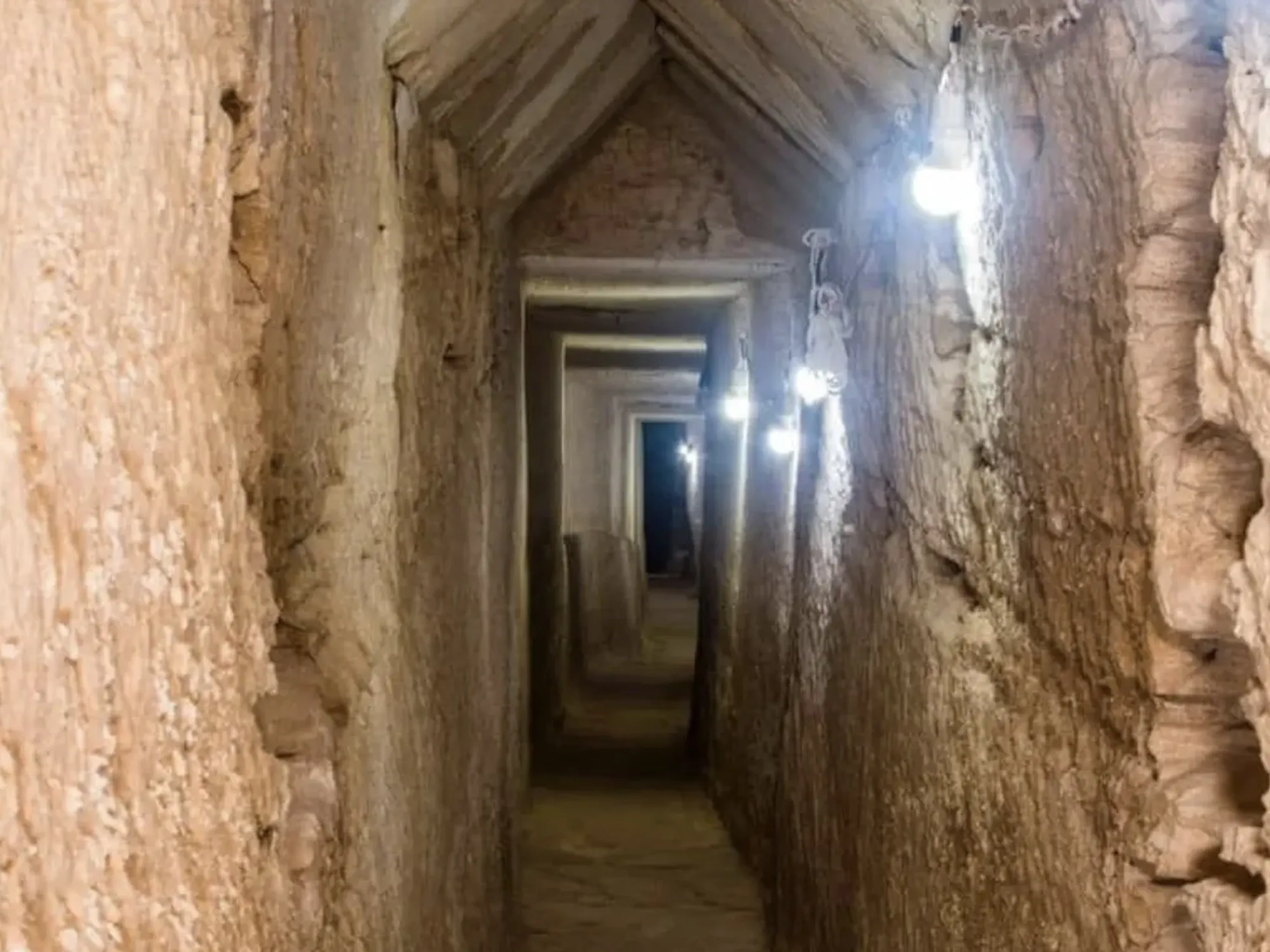
Beneath the hillside at Sheikh Abd el-Qurna, on Luxor’s west bank, archaeologists have opened a tomb no one knew existed.
Inside, painted walls carry a name repeated again and again: Paser.
The Sheikh Abd el-Qurna tomb discovery adds another figure to the crowded, still-incomplete record of New Kingdom Thebes — and offers a rare glimpse of an elite Egyptian and his wife, preserved in colour beneath a thin layer of sediment.
Who Found It
The excavation was carried out by a Dutch archaeological mission from Leiden University, led by Dr Karina van den Hoeven.
The work took place at the Jabanat el-Qurna site during the current season, as part of a long-term research project investigating the Lower Sheikh Abd el-Qurna area and its sprawling New Kingdom cemetery.
According to Egypt’s Ministry of Tourism and Antiquities, the tomb lies east of Tomb No. 45 — an area the mission has been investigating alongside the Supreme Council of Antiquities since 2018.
The project is not purely excavation. It combines digging with conservation and risk management, with the aim of producing the first comprehensive study of the area while protecting what remains.
What the Tomb Looks Like
The structure follows the standard architectural template of elite private tombs at New Kingdom Thebes.
Its components:
- An open courtyard at the entrance
- A rock-cut chapel with a T-shaped layout
- Underground burial chambers below
Within the courtyard, archaeologists identified several well-preserved features, including mudbrick walls containing a niche built to hold a funerary stela, and a staircase flanked by ramps leading to the tomb entrance.
These are not incidental details. They tell you the tomb was designed for visitation — for the living to come, leave offerings, and remember.
The Paintings
The interior is where the discovery becomes vivid.
Inscriptions repeatedly name Paser as the tomb’s owner. The artistic style of those inscriptions independently points to a New Kingdom date.
Portions of the painted decoration remain obscured beneath sediment. But the visible scenes are legible.
They show Paser worshipping before several deities within shrine settings — the tomb owner presenting himself to the gods.
Another surviving painting depicts Paser seated alongside his wife before an offering table.
That motif is common in New Kingdom funerary art, and its meaning is direct: it symbolises sustenance in the afterlife. Food, drink, and continuity, permanently rendered on stone so the dead would never go without.
Who Was Paser?
That question remains open.
The name appears repeatedly. The tomb’s scale and design mark him as elite. Beyond that, the record is still being read.
“The team will continue documenting and studying the tomb to identify those buried within it and reconstruct their identities,” said Dr Hisham Al-Leithy, Secretary-General of the Supreme Council of Antiquities.
He added that the research will place the cemetery within its broader historical and archaeological context, aiming to understand how Lower Sheikh Abd el-Qurna and its surrounding funerary landscape developed over time.
That framing matters. A single tomb tells you about one man. A cemetery, properly studied, tells you about a society.
What Happens Next
Dr van den Hoeven said the mission will begin structural stabilisation, conservation and restoration of the painted decorations in future seasons.
The sediment currently covering parts of the artwork will be carefully removed — a delicate process, since the paint beneath has survived three millennia precisely because it was buried.
She indicated that continued work at the site is expected to yield further discoveries, deepening understanding of the Theban necropolis and the people interred there.
Why This Keeps Happening
Egypt continues to produce discoveries at a pace that surprises even specialists.
Minister of Tourism and Antiquities Sherif Fathy praised the missions working across the country, noting that such finds keep revealing new dimensions of ancient Egyptian civilisation while strengthening Egypt’s standing as a leading archaeological destination.
The Sheikh Abd el-Qurna necropolis has been studied for well over a century. Scholars have mapped it, catalogued it, and published on it extensively.
And a previously unknown tomb was still sitting there, painted and waiting.
The Human Detail
Strip away the archaeology and one image remains.
A man and his wife, seated together at a table, painted on a wall inside a hill in Luxor. Someone commissioned that scene so the two of them would eat together forever.
More than three thousand years later, a Dutch team walked in and found them still sitting there.
Author