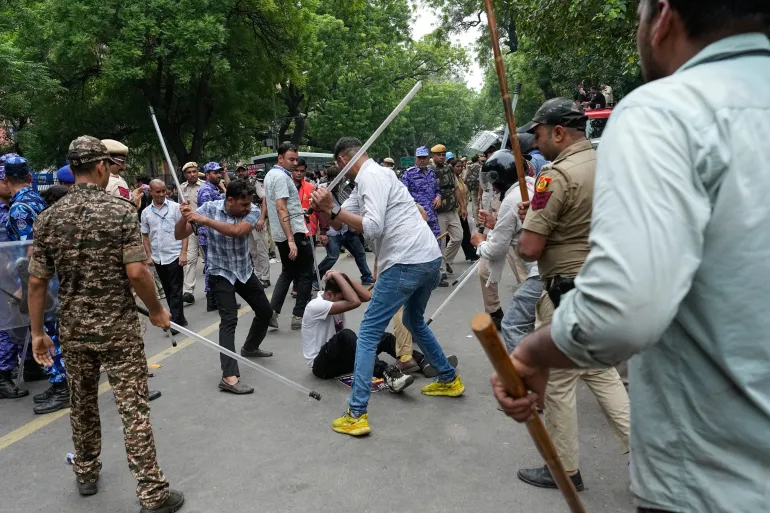
The Cockroach movement protest in New Delhi entered a defiant new phase Tuesday, with demonstrators refusing to vacate their sit-in site a day after police deployed tear gas and batons against thousands attempting to march on Parliament.
Hundreds remain camped at Jantar Mantar, the capital’s designated protest ground, ringed by a heavy police presence. Their central demand has not changed: the resignation of Education Minister Dharmendra Pradhan over what they describe as failures in India’s examination system.
“We Are Going to Continue”
Abhijeet Dipke, founder of the Cockroach Janta Party, stated the position plainly. The protest goes on.
What began roughly two months ago as satire has become something else entirely. The movement now draws students, working professionals and families across the country, organized around exam paper leaks, unemployment and a broader demand for government accountability.
Monday’s confrontation marked its most significant moment so far.
What the Footage Showed
Video from the clash circulated rapidly across social media and shaped public reaction more than any official account.
Some clips showed police striking protesters with batons and dragging demonstrators away. Others captured young people crying and pleading with officers not to hit them.
A different set of images showed something else: protesters standing their ground and absorbing baton strikes without retreating.
Both kinds of footage fed the outrage, for different reasons.
The Injury Count
Delhi Police reported nearly 180 people injured in total:
- 118 security personnel
- 60 protesters
The distribution of those numbers has itself become contested, with protesters questioning how a crackdown described as necessary for crowd control produced more injuries among police than among demonstrators.
Voices From the Ground
Sona Bisht, a 20-year-old student who was present Monday, said the police response had hardened rather than broken the movement.
She argued that if the government believes such tactics will stop Gen Z, it is mistaken. The protest, she said, is about education and about securing their futures, and they will not move until their demands are met.
Rabina Kashyap, a 26-year-old working professional, joined only Tuesday, after watching the tear gas and baton charges against students.
Her explanation was disarmingly simple. She said she has nothing to do with the protest itself, but that this is India, her country, and these are her people, so she will stand with them.
That kind of secondary recruitment, driven by the crackdown rather than the original cause, is often what turns a protest into a movement.
A Late and Failed Outreach
After nearly a month of official silence, the government made its first apparent attempt at engagement Monday, when a senior minister met with movement representatives.
It did not work.
Movement leaders said they wanted action rather than assurances. Their specific demands include:
- Pradhan’s resignation
- Substantive reforms to the examination system
- Compensation for families of students who died by suicide following alleged exam irregularities
That last demand is the one that gives the movement its emotional weight. The protest is not abstract policy advocacy; it is anchored in deaths that participants attribute directly to systemic failure.
An Accusation of Bad Faith
Dipke went further, accusing authorities of breaking their word.
According to him, police carried out the baton charge after protesters had been invited to talks. If accurate, that sequence explains why the outreach failed to lower tensions and why demonstrators now treat government offers with suspicion.
International Criticism
Amnesty International issued a statement late Monday saying the police action demonstrated how peaceful dissent is being suppressed in India.
The group argued that authorities are meant to protect and facilitate peaceful protest rather than suppress it, noting that freedom of peaceful assembly is protected both under international human rights law and by India’s own constitution.
A Rare Challenge
The movement represents an unusual public confrontation with Prime Minister Narendra Modi’s government during its third term.
It has revived longstanding criticism of how the administration handles dissent and how readily force is used in response to demonstrations.
Momentum built over the weekend after activist Sonam Wangchuk, whose three-week hunger strike had become a symbol of the campaign, was forcibly taken to a hospital by police.
That intervention, intended to defuse a situation, appears to have amplified it instead.
Why This Movement Is Different
Several features distinguish the Cockroach movement from typical student agitations.
Its origins in satire gave it cultural reach before it had political weight, allowing it to spread through networks that formal political organizing rarely penetrates.
Its grievances are economic and personal rather than ideological. Exam leaks and unemployment affect a generation regardless of political alignment, which makes the coalition harder to characterize and harder to dismiss.
And its participants are young enough that the standard tools of political management, patronage and party affiliation, have limited purchase.
Where It Goes Next
The immediate standoff is straightforward. Protesters will not leave Jantar Mantar. The government has offered talks but not the resignation being demanded.
Neither side has an obvious way to climb down.
For the government, conceding a minister’s resignation to street pressure sets a precedent it will not want to establish. For the movement, accepting assurances after Monday would confirm the suspicion that the outreach was never serious.
What happens at Jantar Mantar over the coming days will likely determine whether this remains a Delhi protest or becomes something the government has to answer for nationally.
Author