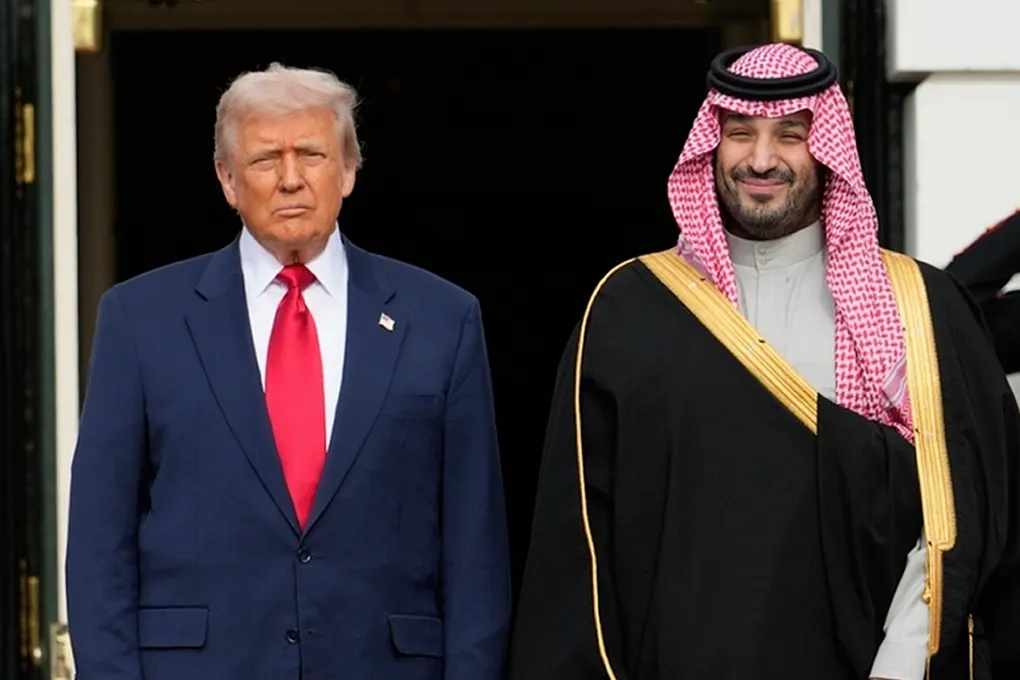
Saudi uranium enrichment is reportedly headed toward American approval. According to news reports citing people familiar with the matter, President Trump has signed off on an agreement that could give the kingdom the ability to enrich uranium for a civilian nuclear programme.
He is expected to ask Congress to approve it.
The timing is what makes this extraordinary. The United States is currently at war with Iran, and one of the stated purposes of that war is preventing Tehran from enriching uranium on its own soil.
What the Deal Reportedly Contains
The arrangement is expected to run 30 years and involve American firms, with Westinghouse among those developing the programme.
It could permit construction of a uranium enrichment facility inside Saudi Arabia, following a joint US-Saudi study. The proposal itself is not new. Versions of it have been under discussion for years across multiple administrations.
The Biden administration at one point wanted to tie Saudi access to the technology to normalising relations with Israel. Riyadh has continued to refuse that condition, and it appears the linkage did not survive.
The Monitoring Gap
Here is the detail that will drive most of the opposition.
The agreement is likely to lack the enhanced IAEA monitoring contained in the additional protocol, the framework Iran operated under during the 2015 nuclear deal.
That’s a substantial omission. The additional protocol gives inspectors broader access and shorter notice periods, and it exists precisely to catch activity that routine safeguards would miss.
Saudi Arabia is an IAEA member state, and the agency both promotes peaceful nuclear work and conducts inspections to verify no clandestine weapons programme exists. But membership and enhanced monitoring are not the same thing.
The Objection, Stated Bluntly
Rosemary Kelanic, who heads the Middle East programme at Defense Priorities, did not hedge.
“Giving Saudi Arabia uranium enrichment technology is a terrible idea on many counts. But it’s especially idiotic to do it in the middle of a war over Iran’s nuclear programme,” she wrote.
She called the move reckless and contrary to American interests, then raised the sharpest version of the concern: “Saudi enrichment would put immense pressure on Iran to get the bomb. Is Trump TRYING to provoke Iran into weaponising?”
The Counterargument
Supporters frame it differently. In this reading, Saudi Arabia has matured into a country genuinely seeking to diversify its energy mix away from oil, and treating it as a proliferation risk misreads its intentions.
There’s also a competitive logic that has driven American thinking for years. Negotiators across administrations have worried that if Washington refuses, Riyadh will simply obtain the technology from someone else, likely Russia or China, with far weaker safeguards attached.
An administration report to Congress earlier this year made that case directly, urging support for the deal partly to prevent strategic competitors from seizing an opening that would undermine US national security for decades.
The same report argued that expanded nuclear cooperation would help America reestablish leadership in the global civilian nuclear market and gain influence in countries hosting its reactors.
How This Looks From Tehran
The double standard will not go unnoticed in Iran, where the argument over whether to pursue nuclear weapons is genuinely contested rather than settled.
Iran has consistently denied seeking a bomb. Saudi Arabia has said in the past that it would need one if Iran acquired one.
Now Iran is being bombed and sanctioned over domestic enrichment while its principal regional rival appears set to receive that same capability with American assistance.
The negotiating history sharpens the contrast. In Geneva talks in February, before the war began, the US demanded Iran commit to suspending any right to enrich domestically for 10 to 20 years. Iran was prepared to discuss three years.
Separately, Washington had been open to a regional enrichment consortium involving Saudi Arabia, Iran, the US and the United Arab Emirates. That would have distributed the capability rather than concentrating it in one rival’s hands.
The Pakistan Factor
There’s another layer that complicates any assessment of Saudi intentions.
After Israel struck Qatar targeting Hamas officials, Saudi Arabia and nuclear-armed Pakistan signed a mutual defence pact. Pakistan’s defence minister subsequently said his country’s nuclear programme would be made available to Saudi Arabia if needed.
That statement was widely read as a warning aimed at Israel, long understood to be the only nuclear-armed state in the region.
It also means Saudi Arabia already has a declared pathway to nuclear deterrence that doesn’t require enriching anything itself.
The UAE Comparison
The most instructive contrast sits next door.
The United Arab Emirates signed a 123 agreement with the United States to build its Barakah nuclear power plant with South Korean assistance. Crucially, it did so without seeking enrichment capability.
Nonproliferation experts have held that arrangement up as the gold standard for countries pursuing nuclear power: full civilian benefit, no enrichment, no proliferation pathway.
Saudi Arabia is asking for something the UAE declined to request.
Congress Gets a Say
Nuclear cooperation agreements, known as 123 agreements, are subject to congressional review, and lawmakers have the power to block them.
Opposition is expected, centred on the absence of adequate monitoring safeguards restricting Saudi enrichment.
The groundwork was laid last November, when Crown Prince Mohammed bin Salman visited Washington and the White House announced a US-Saudi nuclear cooperation framework. That announcement described a legal foundation for a decades-long, multibillion-dollar partnership, framed as consistent with strong nonproliferation standards.
Whether the final agreement matches that description is exactly what Congress will be evaluating.
The Broader Question
One technical point deserves emphasis. Enrichment to 90% purity is only one step toward a weapon. A country would still need to build a functioning device and, realistically, miniaturise it for delivery. Enrichment capability is not a bomb.
But it is the hardest and most closely guarded step, which is why nonproliferation policy has focused on it for decades and why the war with Iran is being fought partly over it.
That’s the contradiction at the heart of this. The United States is destroying centrifuges in one country while helping build the capacity for them in another, roughly 700 miles away.
There may be a coherent strategic logic for treating allies and adversaries differently. There usually is. Whether that logic survives contact with how it will be perceived across the region is a separate question entirely, and the answer will shape Middle Eastern nuclear politics long after this war ends.
Author
-
Lucienne Albrecht is Luxe Chronicle’s wealth and lifestyle editor, celebrated for her elegant perspective on finance, legacy, and global luxury culture. With a flair for blending sophistication with insight, she brings a distinctly feminine voice to the world of high society and wealth.