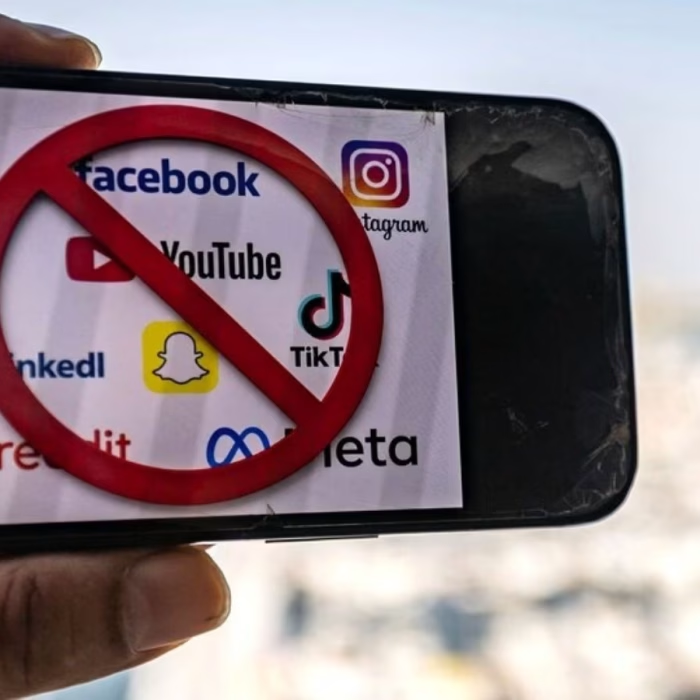
The France social media ban passed both chambers of Parliament on Tuesday, making France the first European Union country to bar children under 15 from the platforms outright.
The legislation also prohibits mobile phone use in high schools.
It stands as one of the last major measures of Emmanuel Macron’s second term, and it arrives as governments across the world reach the same conclusion at roughly the same time: voluntary safeguards from tech companies have not worked.
A Mother’s Case for the Law
The advocacy behind the bill came heavily from parents, and some of them brought difficult stories.
Gaëlle Berbonde, 52, who lives in the Paris region, framed the issue as one of basic protection.
“We’ve been campaigning for this bill from the start because, frankly, we have no other option, no other way to counter tech giants,” she said. “The only thing we can do is protect our children, just as we protect our children from drinking alcohol.”
Her daughter received her first smartphone in seventh grade. The family installed a parental control app to monitor her activity, but Berbonde said she did not really understand what TikTok was.
Within months, the family discovered their daughter was self-harming and suffering from anorexia and depression. She spent a year and a half in hospital. She is now 16, and she is well.
Several French families have sued TikTok over teen suicides they attribute to harmful content on the platform.
What the Law Actually Covers
The ban is not total. Online encyclopedias and educational or scientific directories are exempt, preserving access to research and reference material.
Macron wants the measure in force by the start of the school year in September. That timeline may slip, since a review of the bill’s compliance with the French Constitution is likely and could delay implementation.
“France is leading the way in Europe in protecting our children and our teenagers,” Macron said. “We will keep on going.”
The Objections
Lawmakers from the left-wing France Unbowed party voted against it, raising three distinct concerns:
- The constitutionality of the measure is unclear
- Enforcement would effectively eliminate online anonymity
- The ban would be impossible to enforce in practice
That second point deserves attention. Verifying that a user is over 15 requires knowing who they are, and any robust age-verification system necessarily reduces the ability to use platforms anonymously. That trade-off applies to adults too, not just children.
The Practical Problems Start Now
Ines Legendre, a legal adviser with the online protection group e-Enfance, cautioned that passage does not mean immediate effect.
“We’ll also have to address the issue of existing accounts for those under 15. How do we identify them? How do we suspend them? And then there’s the question of age verification for all new accounts that will come into effect,” she said.
These are not minor implementation details. Millions of existing accounts belong to users whose ages are unverified and self-reported. Removing them requires either identifying them reliably or forcing verification across an entire user base.
The Numbers Behind the Push
France’s health watchdog laid out the scale of the problem in a report published in December.
- One in two teenagers spends between two and five hours daily on a smartphone
- Around 90% of children aged 12 to 17 use smartphones daily to access the internet
- Of those, 58% use their devices for social networks
The report tied social network use to a range of harms, including diminished self-esteem and increased exposure to content involving risky behaviours such as self-harm, drug use and suicide.
A Late Rewrite to Satisfy Brussels
The bill nearly collided with EU law. The European Commission determined that its most recent version overlapped with the Digital Services Act, the bloc’s framework for online safety.
Lawmakers held final negotiations Monday and agreed on an amended version, which then went to both chambers for the decisive vote.
That friction points to a structural tension. Individual member states are moving faster than the EU as a whole, and national laws risk duplicating or conflicting with bloc-wide rules.
France Is Not Alone
The global shift has been rapid.
Australia went first in 2024, removing under-16s from social media entirely. Its law holds platforms including TikTok, Facebook, Snapchat, Reddit, X and Instagram liable for fines reaching 50 million Australian dollars, roughly $35 million, if they fail to keep children under 16 off their services.
In Europe, momentum has built quickly:
- Spanish Prime Minister Pedro Sánchez announced in February that Spain wants to restrict access for under-16s
- Denmark and Greece have unveiled plans for youth bans
- The United Kingdom has said it will consider barring young teenagers
Brussels Is Moving Too
European Commission President Ursula von der Leyen called earlier this month for limits on children’s social media use.
A special EU panel examining the question recommended blocking access for anyone under 13 until technology companies can demonstrate their platforms are safe. Von der Leyen went further on young children, saying those under 3 should have no screen exposure at all.
She singled out infinite scrolling as an addictive design feature that companies need to address.
The Commission is expected to put forward a proposal for the 27 member states to consider before long.
The Question Nobody Has Answered
The moral argument for these laws is strong, and the data on adolescent mental health gives it weight. Berbonde’s comparison to alcohol restrictions is not unreasonable: societies routinely limit children’s access to things adults may use freely.
The unresolved question is technical rather than ethical.
Age verification at scale has never been solved cleanly anywhere. The options are all imperfect: government ID checks, which create privacy risk and exclude those without documents; biometric estimation, which is inaccurate and invasive; or parental attestation, which is trivially circumvented.
France has now committed to solving a problem that no country has yet solved. Australia’s rollout will provide some evidence, and the constitutional review will test whether the measure survives in its current form.
For parents like Berbonde, those complications matter less than the principle. She watched her daughter nearly disappear into a platform she did not understand, and the law is her answer to what happened.
Whether it works is a question the next school year will begin to answer.
Author
-
Lucienne Albrecht is Luxe Chronicle’s wealth and lifestyle editor, celebrated for her elegant perspective on finance, legacy, and global luxury culture. With a flair for blending sophistication with insight, she brings a distinctly feminine voice to the world of high society and wealth.