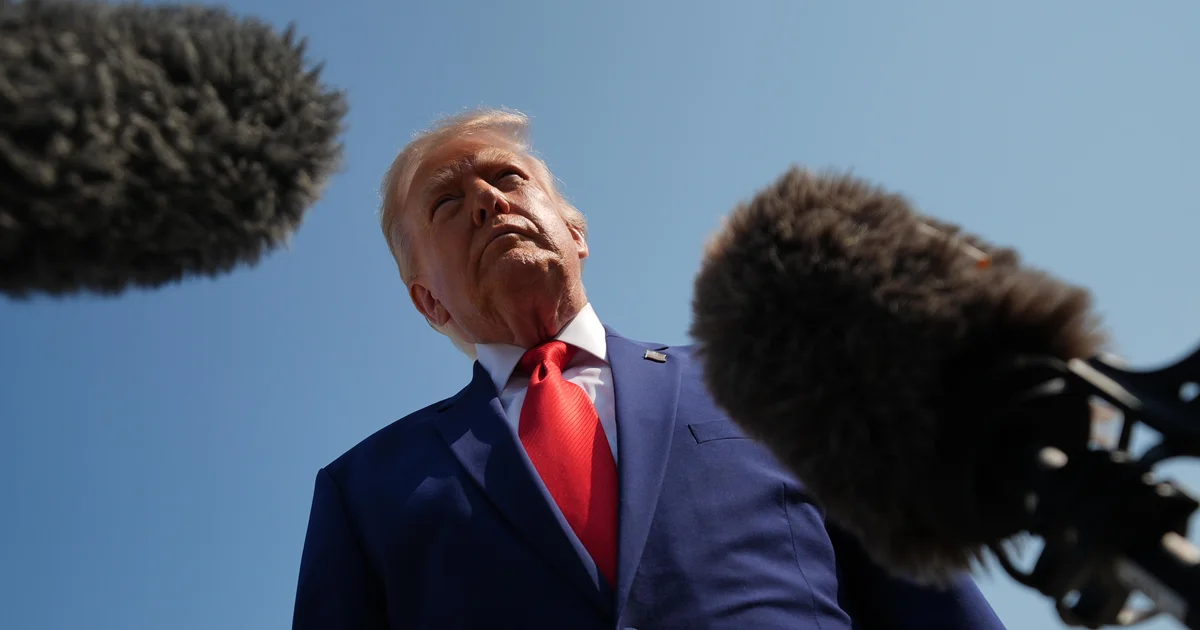
The Trump war campaign split screen on display Wednesday compressed two irreconcilable roles into a single day. In the morning, the president stood in silence at Dover Air Force Base as four American service members completed their final journey home. By afternoon, he was working a Georgia high school stadium crowd, riffing on tax cuts and stock market highs to sustained applause.
The distance between those two settings is not measured in miles.
Two Roles, One Calendar
This marked Trump’s third dignified transfer since the Iran conflict began. The fallen were identified as 1st Lt. Tyler J. Feehan, Sgt. Michael E. Swinton, Sgt. Angel S. Rampersad, and Pvt. Isabella Gonzales. He met privately with their families beforehand.
En route to Dover, he described such ceremonies as among the hardest duties the presidency imposes.
Hours later in Marietta, the tone had shifted entirely. He characterized the conflict as a skirmish, said Iran is absorbing severe damage and wants a deal, then added that Tehran keeps altering terms after agreeing to them.
Both appearances were authentic to something the president is doing. That is precisely what makes the juxtaposition so difficult to look at.
The Numbers Behind the Anxiety
Republican strategists watching this unfold are not particularly comforted.
GOP strategist Matthew Bartlett, who served in the State Department during Trump’s first term, laid out the collision bluntly: midterms arriving into a difficult reality, presidential approval slipping toward the thirties, a war the president initiated that he may be unable to either win or conclude, and an economy he described as frothy.
His summary — a brutal atmosphere for Republicans — reflects an assessment increasingly common in party circles.
The polling reinforces it. Recent YouGov data placed Trump’s approval in territory that historically precedes significant midterm losses.
The Base Is Wobbling
More concerning for the White House is where the erosion is happening.
New polling shows only slightly more than a third of Trump’s MAGA supporters now consider the Iran war worth its economic cost — a drop of 13 points since May. Another 37 percent of self-identified MAGA voters say continued American involvement is acceptable only if costs stop climbing.
That is a conditional endorsement, and conditions have a way of not holding.
The economic mechanism is direct. Renewed bombing has sent gasoline prices climbing again after a brief reprieve. Voters who never followed the strategic debate feel the war every time they fill a tank.
The Explanation Gap
Criticism has come from unexpected directions, including from people who support the underlying policy.
Elliott Abrams, who served as special representative for Iran during Trump’s first term, offered a pointed assessment. He said the president has still not explained the war to Americans, alternating between claiming Iran’s nuclear program has been destroyed and insisting the fighting must continue to prevent Iran from obtaining weapons.
Those two claims cannot both be fully true, and the tension between them has gone unaddressed.
Abrams was careful to separate his critique from the policy itself. He believes attacking Iran is correct and credited Trump for attending the Dover ceremony personally rather than avoiding it. His objection is narrower and arguably harder to dismiss: the explanation is inadequate.
The Rally Itself
In Georgia, Trump spent time discussing the family of one fallen soldier who was present before moving into familiar territory.
His policy list ran through:
- Tax cuts under the One Big Beautiful Bill
- No tax on tips and no tax on overtime
- Trump Accounts, the new children’s savings program
- Lower prescription drug prices
- Rising stock market and 401(k) balances
- Falling rent costs in the Atlanta area
He also delivered the reliable applause lines. Boos arrived on cue for communists, Sen. Jon Ossoff, and the press. Cheers followed a claim about Venezuela. A reference to sleepy Joe drew laughter.
It was, by every indication, an effective rally.
The Optics Problem
Emily Horne, formerly a National Security Council spokesperson under President Biden, argued the sequencing itself was the offense.
Her position was that a president’s role at a dignified transfer is to confront the consequences of his own orders — and that using such a ceremony as a prelude to a campaign event inverts its purpose entirely.
The criticism lands partly because the two events required such different emotional registers within the same day.
The Defense
Administration allies rejected the framing outright.
Simone Ledeen, a former deputy assistant defense secretary in Trump’s first term, said she saw no contradiction. The president fulfilled his obligation as commander in chief at Dover and made his economic case in Georgia, she argued, noting that presidents do not get to handle one challenge at a time.
White House spokesperson Kush Desai put it more colloquially — the president can walk and chew gum simultaneously. He framed national security and economic prosperity as mutually dependent, each impossible without the other.
That argument has genuine merit as a description of executive responsibility. Whether it addresses the emotional dissonance is a separate matter.
The Post That Didn’t Help
On Tuesday, Trump had responded to criticism over troop deaths by noting on social media that casualties in Iran remain lower than in Afghanistan or Vietnam.
Bartlett called the post rather crass, adding that it revealed a White House backed into a corner — underwater, in his phrasing, and unsure which direction leads up.
Comparative casualty statistics are a factually accurate response to a question nobody grieving is actually asking.
What Wednesday Exposed
Trump has said the costs will prove brief and worth paying to keep a dangerous regime from nuclear capability, even accounting for American deaths. He repeated a version of that Wednesday, saying the fallen had believed strongly that Iran cannot be permitted a nuclear weapon.
The structural problem is that he is campaigning against conditions he helped produce. The war is his. The gas prices trace back to it. The approval decline tracks alongside it.
Republicans have spent months asking him to return to the trail and talk about affordability. He did exactly that on Wednesday — several hours after standing on a tarmac at Dover.
Both halves of that day are now part of the case he is making to voters. He does not get to present only one.
Author
-
Lucienne Albrecht is Luxe Chronicle’s wealth and lifestyle editor, celebrated for her elegant perspective on finance, legacy, and global luxury culture. With a flair for blending sophistication with insight, she brings a distinctly feminine voice to the world of high society and wealth.