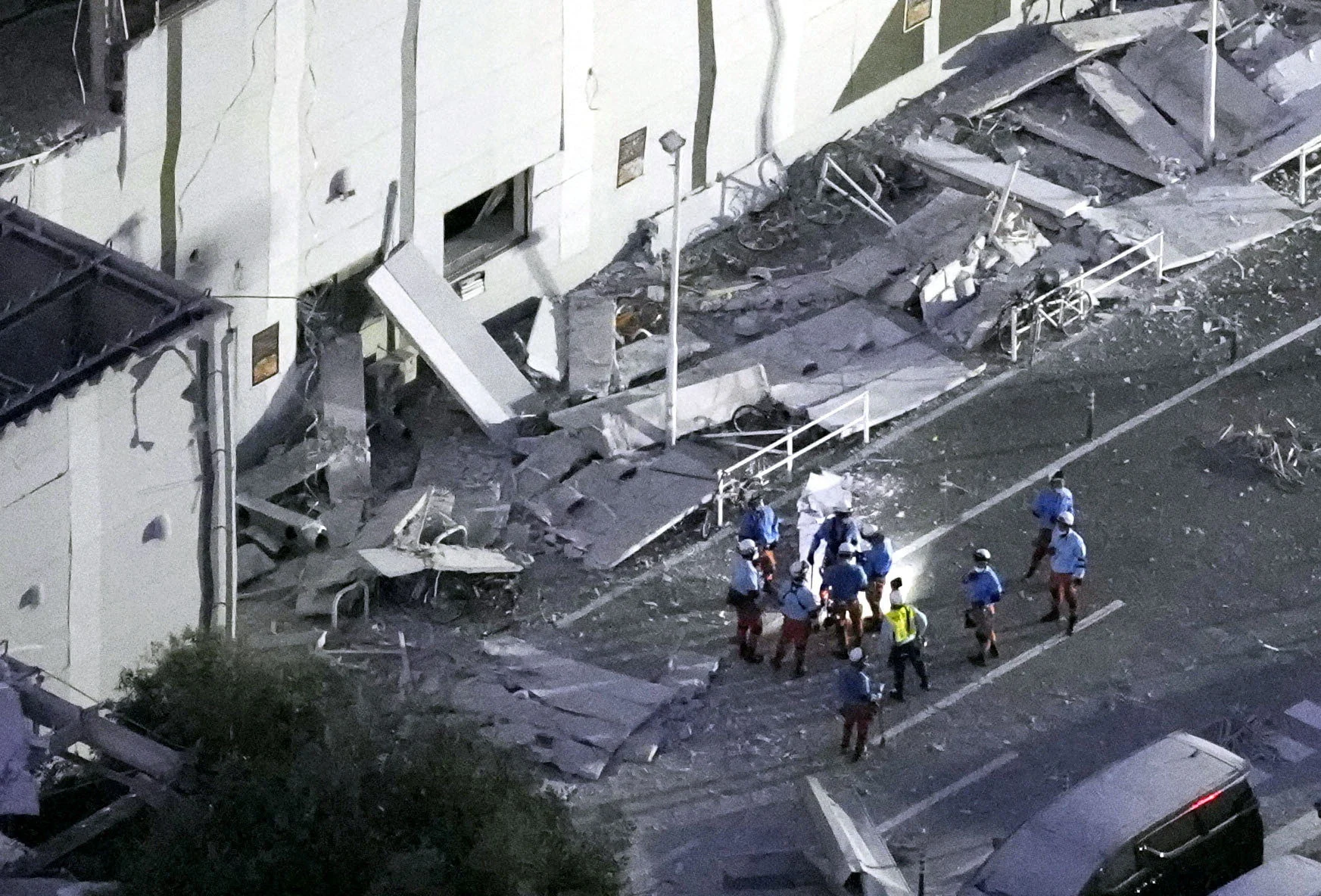
The Kyushu earthquake that struck Japan’s southern main island on Tuesday measured magnitude 7.1 and brought down part of a shopping center, leaving dozens of people unaccounted for and sending scores more to hospitals. A tsunami advisory went out shortly after the shaking stopped and was withdrawn within two hours.
Rescue crews spent the day working through debris at the site of the worst structural failure, where an unknown number of people remained trapped.
The Collapse at Kashima Town
The most urgent situation is at the Aeon Mall shopping center in Kashima Town, where the second floor gave way.
Kyodo News, citing local police, reported that somewhere between 20 and 30 employees were missing following the collapse. Several other people had already been pulled from the rubble and taken to hospitals by the time those figures were released.
The precise number of people inside when the floor failed has not been established, which is typical in the early hours after a commercial building comes down during business hours. Staff rosters give responders a starting point for employees, but customer counts remain guesswork until the search is complete.
Where It Happened
The affected region sits roughly 540 miles southwest of Tokyo, on the western side of Kyushu.
The Japan Meteorological Agency issued a tsunami advisory covering the Ariake and Yatsushiro Seas along the coasts of Kumamoto prefecture and three neighboring prefectures. That advisory was lifted within two hours, indicating the seafloor displacement was not sufficient to generate a dangerous wave.
Injuries Across the Region
Hospitals in the area received patients throughout the day. Kyodo reported that a facility in Yatsushiro city admitted approximately 40 injured people, while about 50 others were brought to a hospital in Kumamoto city.
Those numbers are separate from casualties at the shopping center and reflect the broader pattern of quake injuries: falling objects, collapsing interior fixtures, broken glass and falls during the shaking itself.
What Officials Have Confirmed
Prime Minister Sanae Takaichi told reporters that damage reports had come in involving roads, bridges and buildings, along with power outages and fires. She noted that details remained unclear, which is standard in the first hours as local governments compile assessments.
Two pieces of reassuring information emerged quickly. Japan’s Fire and Disaster Management Agency said it had received no reports of damage to major public facilities or critical infrastructure. The Nuclear Regulation Authority reported that inspections at three nearby nuclear power plants found no abnormalities.
That second point matters enormously in Japan, where any significant seismic event immediately raises questions about nuclear facilities. The confirmation came early and was unambiguous.
The Defense Ministry dispatched aircraft to conduct aerial surveys of the affected area.
Transport Shut Down
Movement across Kyushu ground to a halt.
Shinkansen bullet train service and local rail lines were suspended so crews could inspect track, tunnels and elevated structures for damage. Japan’s rail operators halt service automatically after significant tremors and resume only after physical inspection, a protocol that has prevented derailments in past events.
It did not prevent one on Tuesday. Kyodo reported that a train derailed and tipped onto its side at Yatsushiro station.
Aso Kumamoto Airport closed its runway. A notice posted on the airport’s website said there was no prospect of resuming operations, without providing further explanation.
Damage to a Landmark
Among the reported damage was harm to the stone walls at Kumamoto Castle, one of the region’s most recognizable historic structures.
For residents, that detail carries weight beyond the physical loss. The castle sustained major damage in the 2016 Kumamoto earthquake and became a symbol of the region’s recovery, with restoration work continuing for years afterward.
Memories of 2016
The comparison to a decade ago surfaced immediately among people who lived through both.
Hiroki Shimoda, an official at Mifune town hall, described watching roof tiles slide off nearby houses and crash to the ground. The shaking, he said, brought back the 2016 quake and frightened him.
That earlier disaster killed more than 50 people in Kumamoto and reshaped how the region thinks about seismic risk. For many residents, Tuesday’s tremor was not an unfamiliar experience but a repetition of one they had hoped not to have again.
The Danger Is Not Over
Shinji Kiyomoto of the Japan Meteorological Agency urged residents to stay cautious over the next two to three days.
That warning reflects standard seismological guidance rather than a specific prediction. Large earthquakes are typically followed by aftershock sequences, and the strongest aftershocks tend to arrive within the first several days. A magnitude 7.1 event can produce aftershocks in the magnitude 5 to 6 range, which is more than sufficient to bring down structures already weakened by the main shock.
This is why authorities discourage people from re-entering damaged buildings to retrieve belongings during that window. A wall that survived the first event may not survive the second.
What Comes Next
The immediate priority remains the search at the Aeon Mall site, where the count of missing employees has not changed publicly and where rescue work continues.
Beyond that, the sequence is familiar to a country that has built its infrastructure and its emergency planning around seismic reality: engineers will inspect rail lines and reopen them in stages, the airport will assess runway conditions, utilities will restore power sector by sector, and municipal governments will complete the damage surveys that turn early fragmentary reports into a full accounting.
Japan’s preparedness is among the most thorough in the world, and the early confirmations about nuclear plants and major infrastructure suggest much of that preparation held. But building codes protect structures, not everyone inside them, and on Tuesday one commercial building in Kashima Town did not hold.
Families waiting for word about the people who were working there when the second floor came down are still waiting.
Author
-
Lucienne Albrecht is Luxe Chronicle’s wealth and lifestyle editor, celebrated for her elegant perspective on finance, legacy, and global luxury culture. With a flair for blending sophistication with insight, she brings a distinctly feminine voice to the world of high society and wealth.