A Sanctions Bill With a Tariff Engine Inside: What the Graham Act Would Hand the White House
The Russia sanctions bill that cleared its first Senate hurdle this week is being sold as a statement of national resolve — and it is one. Eighty-six senators voted to advance it, with Rand Paul the lone Republican opposed, and Ukrainian President Volodymyr Zelensky watched from the chamber. The vote came hours after senators buried the man whose name is now on the legislation.
But the bill does more than tighten financial restrictions on Moscow and Tehran. Folded into it are trade authorities that would let the White House impose extraordinarily steep tariffs on some of the world’s largest economies, with considerable discretion over who qualifies as a target.
That is the part drawing objections from people who otherwise support the sanctions.
The Sanctions Half
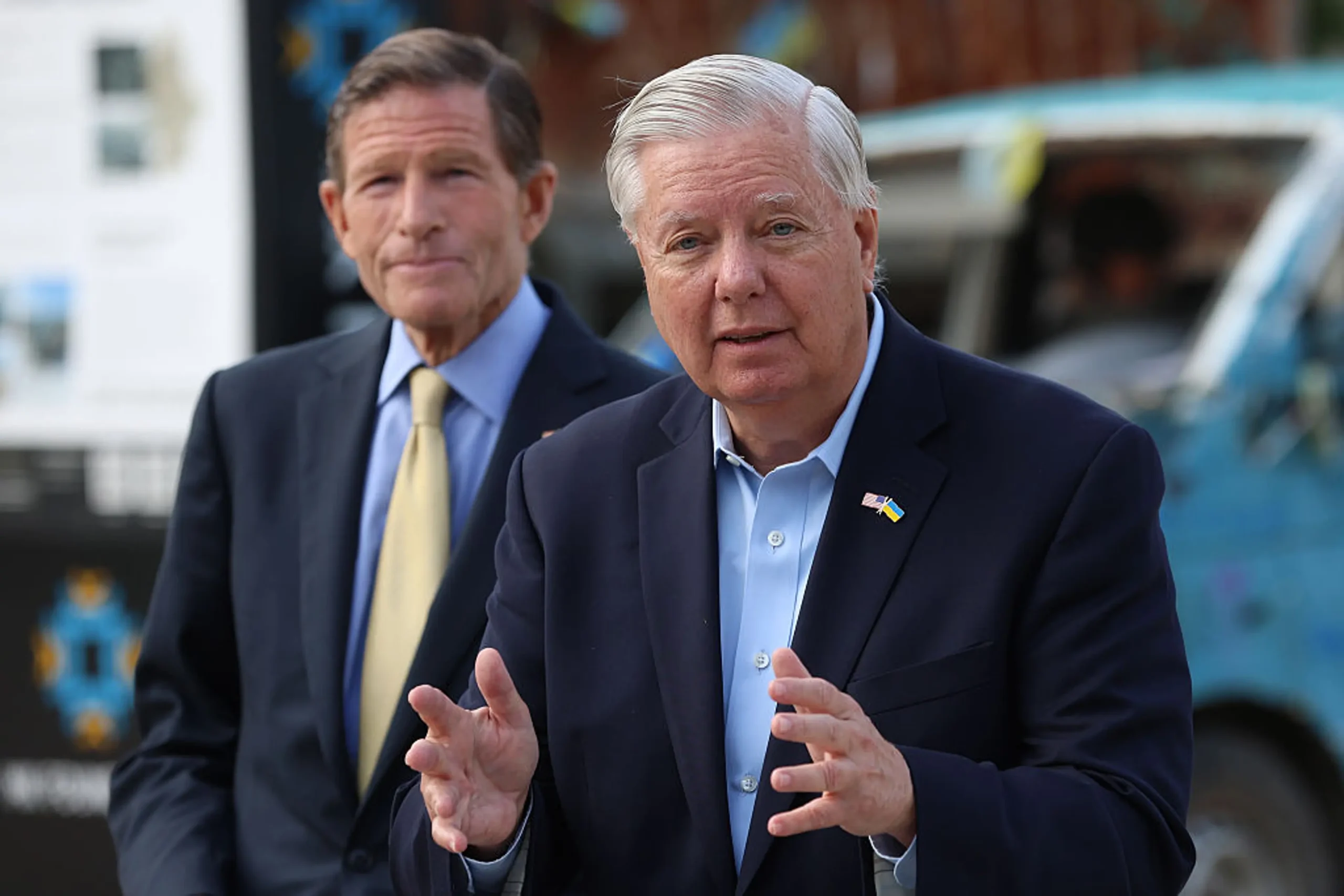
The measure, designed by the late Senator Lindsey Graham and co-authored with Democrat Richard Blumenthal, imposes primary and secondary sanctions on Russia and on entities supporting its war in Ukraine. The targets include Russian officials, oligarchs and their families, banks and financial institutions, and the so-called shadow fleet — the network of aging tankers used to move Russian crude around Western restrictions.
It also renews an Iran sanctions authority dating to 1996 that governs funding for the country’s energy and weapons sectors, which was set to expire at the end of this year, extending it through 2031. A congressional override mechanism would prevent a president from lifting sanctions without legislative review.
The Tariff Half
Here is where the bill becomes something other than a sanctions package.
If enacted, it would authorize:
- Tariffs of up to 500 percent on Russian imports, which consist mostly of fertilizers
- Tariffs of up to 100 percent on the five largest importers of Russian oil and gas
- Tariffs of up to 100 percent on the top five countries assisting Russian sanctions evasion
The practical targets are China, India and, depending on interpretation, some European Union member states. China and India together are estimated to account for roughly 70 percent of Russia’s energy export revenue, so the theory of the bill is to squeeze the buyers rather than the seller — presenting them with a choice between Russian energy and American market access.
Why It Is Written This Way
The design is not accidental. In February, the Supreme Court held that the administration’s use of an international emergency statute to impose tariffs was unlawful and ordered roughly $160 billion in collected duties refunded.
This bill routes tariff authority through Congress’s own constitutional power over trade, which makes it far more durable against the kind of challenge that dismantled the earlier approach. In effect, it restores tools the Court took away — by legislating them rather than asserting them.
The president has since revived his trade agenda by other means, imposing roughly 10 percent duties on goods from more than 80 countries this month under Section 301 of the Trade Act of 1974, citing other nations’ failure to enforce bans on forced-labor goods. He has also said he intends to impose 100 percent tariffs on imported generic drugs beginning in 2028.
The Delegation Objection
The criticism is not mainly about Russia. It is about who decides.
Scott Lincicome of the Cato Institute argued that key language in the bill is vague and that the president has shown a consistent willingness to exploit ambiguity in tariff statutes to impose additional import taxes — concluding that anyone should be reluctant to hand him new authority of this kind.
Senator Peter Welch, who voted against advancing the measure while defending its purpose, made the same point from the floor. He described a fatal lack of specificity about which countries could count as facilitators, what conduct qualifies, and how much of it is required — warning that as written it approaches a blanket transfer of congressional tariff power to the executive, usable against nearly any country.
Senator Maggie Hassan, writing after the vote, argued that tariffs are paid by American businesses and consumers and would not help Ukraine win the war.
Nearly two dozen trade associations, including the U.S. Chamber of Commerce, the Retail Industry Leaders Association and the National Foreign Trade Council, wrote to Senate leaders asking that the tariff authority be stripped out. They warned that duties at this scale would raise costs on consumer goods and manufacturing inputs while forcing companies to make sourcing and pricing decisions months ahead under deep uncertainty. Tariffs, they argued, are a blunt instrument that penalizes law-abiding American firms.
Guardrails, and Their Limits
Negotiators did add constraints late in the process. Only the top five importers of Russian oil or gas are eligible. Countries taking meaningful steps to reduce purchases could see rates lowered or removed.
The bill also grants the president a waiver — he may decline to impose sanctions by explaining to Congress why an exemption serves the national interest. The White House has consistently argued that flexibility is essential when negotiating.
Critics note that both features cut in the same direction: the administration retains substantial latitude to decide who the biggest buyers are, and equal latitude not to act at all.
A White House official said the bill emerged from months of negotiation among agencies, the White House and lawmakers, and reflects bipartisan national security aims.
Does It Work?
Russia’s embassy in Washington argued the legislation is self-defeating, contending that with instability in the Persian Gulf, war with Iran, an approaching energy crunch and rising pump prices ahead of midterm elections, restricting Russian resource exports would hurt the United States most.
That is an interested party making a self-serving argument. But a version of the concern exists domestically too, given that gasoline has moved above four dollars a gallon.
There is also a track record. The administration imposed tariffs on India last year over its Russian oil purchases; they failed to change India’s buying and were later rescinded.
Ben Harris, a former Treasury official who helped design the Russian oil price cap, said he was encouraged by bipartisan legislation that could force tighter enforcement and more pressure on shadow-fleet tankers. He was less encouraged about execution, describing the administration’s record on sanctioning Russia’s oil industry as poor and its objectives as unclear from the outset.
What Happens Next
The House does not return until August and is expected to take up the Senate text under suspension of the rules — no amendments, two-thirds majority required. Some senior Democrats have already objected to expanding tariff authority, which makes that threshold non-trivial.
Complicating matters further, the president has publicly asked that Iran be added to the tariff provisions rather than just the sanctions ones, saying it is what Graham wanted. Reopening the text for that change could invite amendments on the very tariff language that nearly derailed Democratic support in the first place.
Several senators who voted yes said they hope to improve the bill later. Whether that opportunity comes before or after the authority is on the books is the question now.
Author