Measured in Homes, Not Acres: How the Bench Fire Is Reshaping Life at Warm Springs
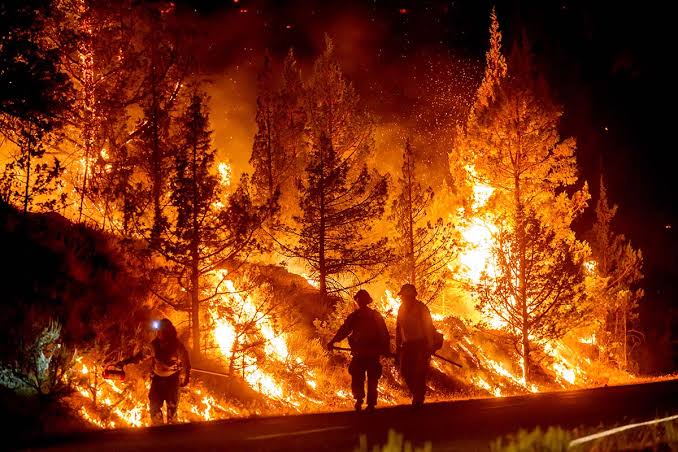
The Bench Fire is usually described the way wildfires always are — in acres, containment percentages and crew counts. On the Warm Springs Reservation in central Oregon, people are counting something else: houses that generations of a family passed through, and the belongings that went with them.
Six primary residences and five outbuildings have burned so far. Damage assessments are still underway, so that number is not final. Around 41 homes have been threatened.
For a community of this size, six is not a small number.
How It Grew
The fire started on July 23. Its cause remains under investigation.
For a few days it existed as two separate incidents, the Bench and the Beachcomb, together covering under 10,000 acres as of Sunday morning. By the following evening they had merged and quadrupled in size, and officials consolidated them under the Bench Fire name. The combined fire reached roughly 40,000 acres and sat at zero percent containment through Tuesday.
Then it jumped again — expanding by close to 20,000 acres in under 24 hours on Wednesday, pushing past 60,000 acres.
Fire managers have warned of potential for extreme behavior, wind-driven runs and long-range spotting, and have described three separate fronts posing a threat to the Warm Springs community.
Trapped Between Closures
The evacuation numbers give some sense of the disruption. More than 3,800 residents have left, while roughly 6,000 are sheltering in place. Most of the reservation has been under a Level 3 “Go Now” notice.
But leaving was not always possible. When the Level 3 alert went out on Saturday, the fire had already crossed Highway 26, and closures at both ends of the reservation left some families packed and waiting with nowhere to drive.
One resident, Alysia Klick’ump, described loading a camper with her husband and then discovering the highway was shut in both directions, leaving them up until the early hours of the morning with no route out.
That detail explains a lot about why the situation on the ground became a supply problem so quickly.
What the Community Is Short Of
The reservation is experiencing significant shortages of daily essentials — food, clothing, water. Residents who stayed are contending with heavy smoke, power interruptions and concerns about the water system.
Families who left with only what they were wearing arrived at shelters needing everything.
The specific requests circulating from relief organizers include:
- Bottled water and food that requires no cooking
- Blankets and personal hygiene kits
- Basic medical supplies
- Supplies for children and for pets
- Fans and air filters
- Gift cards and hotel donations
Air quality has become its own problem. The Oregon Department of Environmental Quality has included Jefferson County in a wildfire-related advisory, and smoke has spread well beyond the fire perimeter.
A Different Chain of Command
One aspect of this disaster that has confused people trying to help is the structure of the response.
Because the Confederated Tribes of Warm Springs is a sovereign nation, federal relief flows directly to the tribe rather than through Oregon’s state emergency system. That distinction matters practically: standard state channels are not the route, and assistance is coordinated through tribal government and federal partners.
Tribal Council Chairman Dennis White III declared a state of emergency for the Warm Springs nation on July 25.
Edward R. Henderson, the tribe’s secretary-treasurer and chief executive, has been describing conditions publicly and has pointed people toward the tribe’s official channels for both immediate needs and the longer recovery.
The Tribe’s Own Fund
On Tuesday, the Confederated Tribes of Warm Springs established a wildfire recovery fund to accept financial contributions for immediate needs tied to the Bench Fire.
The tribal government has also said it welcomes donated goods and volunteer help, but asks that both be arranged in advance through designated tribal contacts rather than delivered unannounced. Relief coordinators across the state have echoed that request for a practical reason: unrequested supplies arriving at busy evacuation sites create work rather than relieving it.
Tribal representatives have been direct about the timeline ahead. Containment is the near-term goal. Rebuilding homes and structures, caring for displaced members and restoring the land is described as a long road.
Neighbors Stepping In
Support has come from around the region, including from neighboring tribes.
In the Portland area, a collective of Warm Springs tribal members and supporters organized an emergency supply drive. Candice Jimenez, a citizen of the Confederated Tribes of Warm Springs now living in Portland, framed the effort simply as a community taking care of its own.
Collection points have operated at businesses including Bison Coffeehouse in northeast Portland, whose owner Loretta Guzman has helped gather water and essentials, along with additional sites in Portland and Gresham. Organizers have said financial donations are the most urgent need, alongside toiletries and non-perishable food.
Fundraising efforts have also sprung up across Central Oregon.
The Statewide Picture
The Bench Fire is one piece of an exceptionally difficult stretch for Oregon. More than a million acres have burned across the state over recent weeks.
Thousands of firefighters have been deployed from within Oregon, from elsewhere in the United States and from other countries. At one point this week, more than 6,200 people statewide were under Level 3 evacuation orders, with another 26,000 at lower levels.
Fire managers say they have turned back several major threats over the past week. The Bench Fire has not been one of them yet.
How to Help Without Getting in the Way
For anyone wanting to contribute, the guidance from relief professionals is consistent and worth repeating.
Money goes furthest. Organizations can buy precisely what is needed, in the right quantities, without the transport and sorting costs that physical donations carry. For the Warm Springs response specifically, the tribe’s own recovery fund is the direct route.
If you plan to give goods, contact an established shelter or the tribal coordinators first. In Oregon, calling 211 or visiting 211info.org will identify vetted organizations currently active in wildfire response.
And follow the tribe’s own updates, where leaders are posting both current needs and the longer-term ones — because the second category will still exist long after the acreage stops climbing and the news trucks leave.
Author
-
Lucienne Albrecht is Luxe Chronicle’s wealth and lifestyle editor, celebrated for her elegant perspective on finance, legacy, and global luxury culture. With a flair for blending sophistication with insight, she brings a distinctly feminine voice to the world of high society and wealth.