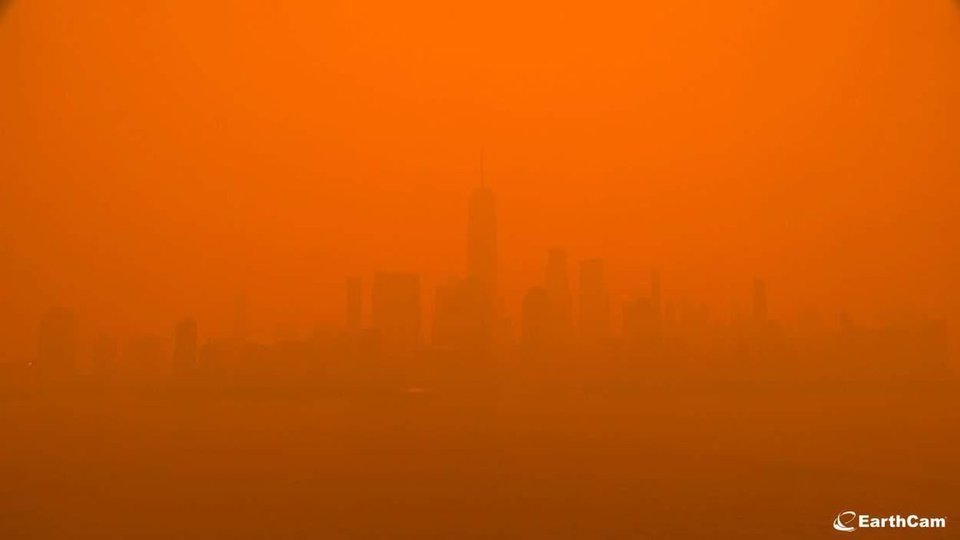
Washington wildfire smoke air quality has deteriorated sharply this week, with entire regions of the state now blanketed in haze thick enough to trigger official health warnings. What began as a handful of blazes has grown into one of the more disruptive fire situations the state has faced in recent memory, and the smoke is not staying put — it is drifting well beyond Washington’s borders.
A State Under Fire
Several major fires are burning simultaneously across Washington, and each is contributing its own share of smoke to the atmosphere. Among the most significant are the Spokane Complex fires, the Little Giant Fire, and the Sinlahekin Fire. Together, they have pushed smoke into valleys, over mountain passes, and across communities that are hundreds of miles from any active flame.
The combination proved especially punishing over the weekend. Forecasters had already flagged the danger ahead of time, and conditions unfolded largely as feared.
Why Conditions Turned So Quickly
Weather is often the deciding factor in whether a fire smolders or explodes, and this past weekend delivered nearly every ingredient a wildfire needs to spread fast.
The National Weather Service took the unusual step of issuing a “particularly dangerous situation” alert on Saturday — language reserved for scenarios where the risk is well above the ordinary. Three factors converged:
- Humidity levels dropped to dangerously low readings, leaving vegetation parched and primed to ignite.
- Strong, gusting winds pushed flames across the landscape faster than crews could contain them.
- Dry fuels — grasses, brush, and timber that had been baking for weeks — carried fire easily from one patch to the next.
Under those conditions, small ignitions became major incidents in a matter of hours rather than days.
Spokane Bears the Brunt
Nowhere has the toll been heavier than in the Spokane area, where three separate fires took hold at roughly the same time.
The Old Trails Fire has been the most destructive of the group. Preliminary assessments indicate that at least 700 structures have been lost — a figure that includes homes, outbuildings, and businesses. Roughly 65,000 residents were ordered to evacuate as the fire advanced, one of the largest displacement events the region has seen from a single wildfire.
For those forced to leave, the immediate concern has been shelter and safety. For the far larger population downwind, the concern is what all that combustion is doing to the air.
Smoke Spreads as Winds Shift
By Monday, the picture had changed again. Continued fire growth, paired with a shift in wind direction, funneled dense smoke into areas that had previously been spared.
The Wenatchee and Chelan areas were hit particularly hard, with readings climbing into the “very unhealthy” and even “hazardous” categories by Monday afternoon. At those levels, the health guidance is no longer aimed only at sensitive groups — everyone is advised to limit time outdoors, regardless of age or underlying health conditions.
Where the Air Quality Alerts Stand
An air quality alert now covers the majority of Washington, and the timelines differ depending on where you live.
Eastern Washington: The National Weather Service office in Spokane has issued the alert with no fixed end date, describing it as in effect “until further notice.” That open-ended wording reflects genuine uncertainty about when fire behavior and wind patterns will improve.
Western Washington: For King, Kitsap, Pierce, Snohomish, and Thurston counties, the alert runs through 5 p.m. Wednesday — a shorter window, though one that could be extended if conditions worsen.
Smoke has also crossed state lines. Alerts extend into much of Oregon, across Idaho, and into portions of Montana, a reminder that wildfire smoke pays no attention to jurisdictional boundaries.
Following Conditions in Real Time
Because smoke concentrations can change within a single afternoon, checking a live map is far more useful than relying on a morning forecast.
AirNow serves as the primary public resource for this. It is not a single agency but a partnership that includes the National Oceanic and Atmospheric Administration and the Environmental Protection Agency, and it consolidates monitoring data from across the country into a continuously updated view of air quality and smoke movement.
The platform shows current Air Quality Index values by location, along with the position of active fires and smoke plumes — allowing residents to see not only what conditions are now, but where the smoke may be headed.
Making Sense of the Numbers
The Air Quality Index compresses complex pollution data into a single value. Here is the practical translation:
- 0–50 (Good): No restrictions needed.
- 51–100 (Moderate): Unusually sensitive individuals may notice mild effects.
- 101–150 (Unhealthy for Sensitive Groups): Children, older adults, and people with asthma or heart conditions should ease up on outdoor exertion.
- 151–200 (Unhealthy): Everyone may begin experiencing effects; sensitive groups more seriously.
- 201–300 (Very Unhealthy): Health alert territory — significant risk for the general population.
- 301+ (Hazardous): Emergency conditions. Stay indoors.
Practical Steps to Protect Yourself
When smoke settles in, a few straightforward measures make a measurable difference:
- Keep windows and doors closed, especially overnight when smoke tends to settle into low-lying areas.
- Run air conditioning on recirculate rather than pulling in outside air.
- Use a HEPA air purifier in whatever room you spend the most time in — a bedroom is usually the best choice.
- Skip outdoor workouts. Heavy breathing draws fine particles deeper into the lungs.
- Wear an N95 or P100 respirator if you must go outside. Cloth masks and surgical masks do very little against the fine particulate matter in smoke.
- Watch for warning signs such as persistent coughing, chest tightness, wheezing, or unusual fatigue, and seek medical care if symptoms escalate.
Looking Ahead
The path forward depends heavily on weather. Cooler temperatures, higher humidity, or a sustained wind shift could clear the air within days. Continued heat and dry conditions could extend the current situation considerably.
For now, the most reliable approach is a simple one: check the live air quality map before making outdoor plans, take the alerts seriously, and pay attention to how you feel. Smoke exposure is cumulative, and the precautions that seem excessive on day one often prove worthwhile by day five.
Author
-
Lucienne Albrecht is Luxe Chronicle’s wealth and lifestyle editor, celebrated for her elegant perspective on finance, legacy, and global luxury culture. With a flair for blending sophistication with insight, she brings a distinctly feminine voice to the world of high society and wealth.