Massachusetts storm flooding turned an ordinary Monday into a day of closed roads, stranded drivers and emergency calls after a slow-moving band of thunderstorms parked itself over the state. What began before sunrise as steady rain escalated into a full day of disruption stretching from the Connecticut River Valley to the South Shore — and, tragically, one fatality.
A Morning That Started Underwater
The trouble was already underway before most commuters had finished their coffee.
By around 6:30 a.m., police in Longmeadow were telling residents that flooding had spread “all over town.” Officers singled out Bliss Road near the Longmeadow shops and Bliss Court as areas drivers should skip entirely.
Roughly an hour later, Chicopee police issued a similar bulletin. Multiple roads across the city had taken on water, and the department’s advice was blunt: stop driving through large puddles. What looks like a shallow inconvenience frequently is not.
South Hadley followed at about 8:30 a.m., with police reporting flooding on several streets and urging caution from anyone who had to be out.
The pattern repeating across three communities in two hours told the story — this was not localized street ponding. Drainage systems across western Massachusetts were being overwhelmed at roughly the same time.
Trees Down, Roads Blocked
As the morning wore on, water was joined by a second problem: falling timber.
In Leominster, emergency management officials asked residents dealing with flooded homes, downed trees or fallen wires to call 911 rather than trying to handle the situation themselves. Downed lines in particular should always be treated as live.
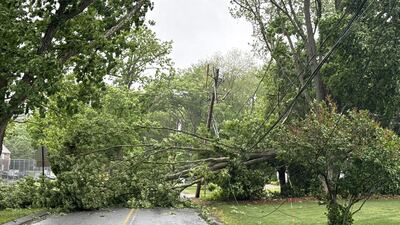
Petersham police closed a stretch of Woodward Road between the Swift River and Carter Pond Road after a tree came down across the pavement. Crews cleared the obstruction and the road later reopened.
Westminster faced a similar issue late in the morning, when a fallen tree blocked Spruce Road near number 38. Police shut the road and notified National Grid, since downed trees and compromised utility infrastructure so often arrive as a package.
Power and Communications Take a Hit
The storm’s reach extended beyond pavement and branches.
The Lakeville Fire Department reported a significant power outage affecting neighborhoods south of Highland Road. Meanwhile, officials in Agawam announced that storm damage had disrupted the town’s network systems — knocking out some phone service, degrading connectivity and interrupting public access television channels.
For residents in affected areas, that combination is especially awkward: losing electricity is inconvenient, but losing the ability to reach town services at the same time compounds the problem.
Belchertown and Springfield See Infrastructure Damage
In Belchertown, firefighters closed South Street near number 495 shortly after 11 a.m. because of flooding. The road reopened by about 12:45 p.m., though crews cautioned drivers about standing water still lingering near 531 Franklin St. and 10 Pine St.
Springfield sustained the most serious infrastructure damage of the day. Just before 1 p.m., the city’s Department of Public Works reported a partial roadway collapse combined with a culvert failure along North Branch Parkway, between Sunrise Terrace and North Brook Road. That stretch is closed indefinitely.
Culvert failures are a particular hazard because the damage often hides beneath a surface that still looks intact — a road can appear passable right up until it gives way.
A Fatality in Plymouth
The day’s most devastating development came around 1 p.m. in Plymouth, where a woman standing in the backyard of a home was struck by a falling tree. According to Plymouth police, she suffered life-threatening injuries and later died.
It is a stark reminder that severe weather risk does not end at the roadway. Saturated soil dramatically weakens a tree’s grip, and gusty winds can bring down limbs — or entire trunks — with almost no warning, even in yards that feel perfectly safe.
Princeton’s Warning: Don’t Test the Water
By mid-afternoon, flooding had spread into Princeton, where officials flagged problems from 132 Mirick Road to the Beaman Road intersection, along with Allen Hill and Merriam roads.
Their message captured the core danger better than any statistic could. Police urged residents not to drive through flooded roadways at all, noting that even shallow-looking water can be hazardous and may hide serious damage to the road beneath. They encouraged anyone without an urgent reason to travel to postpone the trip until conditions improved — and stressed that barricades and closure signs exist for a reason.
It is advice worth internalizing. Just a foot of moving water is enough to float most passenger vehicles, and two feet will carry away a truck or SUV.
Documented Across the State
Social media filled quickly with footage of the day’s impacts. Residents posted photos and video of flooding in Brockton, Springfield, Chicopee, Fitchburg and Leominster — a geographic spread that underscored how broadly the system had swept across the state rather than concentrating in any single region.
Outage Numbers Stay Modest
One piece of good news: the electrical grid held up better than the roads did.
As of 3 p.m., real-time tracking from the Massachusetts Emergency Management Agency showed roughly 1,122 homes and businesses without power statewide — a relatively contained figure for a storm of this scope. Bourne and Brewster took the worst of it, with close to 300 customers in the dark in each community.
The Threat Wasn’t Over Yet
Monday afternoon carried the possibility of a second round.
The National Weather Service warned that isolated severe storms remained possible in the corridor east of I-91 and west of I-95 through 8 p.m. Damaging wind gusts and additional heavy rainfall stood out as the primary concerns — a worrying combination given how saturated the ground had already become. Soil that has absorbed hours of rain sheds additional water rather than soaking it up, meaning later storms produce flooding faster than earlier ones did.
Staying Safe When Storms Stack Up
A few practical habits make a real difference on days like this:
- Turn around, don’t drown. Never drive into water of unknown depth, and never go around a barricade.
- Keep clear of downed wires, and assume every fallen line is energized.
- Stay away from large trees during high winds, particularly after prolonged rain has loosened the soil.
- Charge devices early when outages look likely in your area.
- Report hazards promptly — flooding in a home, a blocked road, or a downed line all warrant a 911 call.
Monday’s storm did most of its damage quietly, one flooded street and fallen branch at a time. But in Plymouth, it took a life — proof that these systems deserve genuine respect, not just a glance out the window.
Author
-
Lucienne Albrecht is Luxe Chronicle’s wealth and lifestyle editor, celebrated for her elegant perspective on finance, legacy, and global luxury culture. With a flair for blending sophistication with insight, she brings a distinctly feminine voice to the world of high society and wealth.