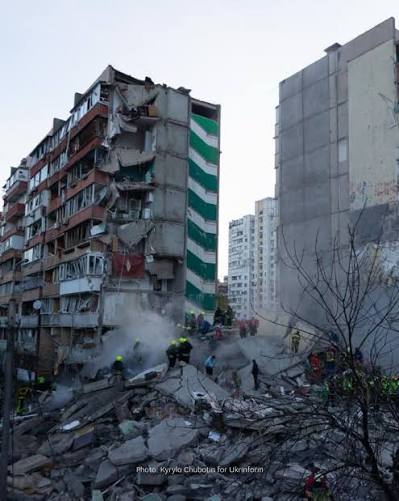
The WHO warehouse Dnipro strike has drawn an unusually sharp statement from the head of the World Health Organization, after a Russian attack destroyed a facility holding medical equipment and other humanitarian supplies.
According to Director-General Tedros Adhanom Ghebreyesus, UN staff had been attempting to evacuate health supplies from the site. Roughly 170 pallets, more than half the stored total, were still inside when the strike hit.
Writing on X, Tedros said he could not state it loudly enough: attacks on health care must stop. Without protection, he wrote, people are cut off from lifesaving treatment. Even wars have rules, he added, and one of them is that health must be protected.
Why That Statement Carries Weight
Heads of UN agencies typically avoid language this direct, which is part of why the post registered.
The underlying principle is not rhetorical. International humanitarian law affords specific protection to medical facilities, personnel and supplies, on the reasoning that destroying them harms civilians who have no part in the fighting and whose need for care outlasts the conflict itself.
A warehouse of medical stock is not a single hospital. It is the supply chain feeding many of them, which means the effect spreads across a region rather than a building.
Zelensky’s Warning on North Korean Deployments
Separately, Volodymyr Zelensky said North Korea is preparing to send as many as 50,000 soldiers to support Russia’s war effort.
His assessment of what Pyongyang gains from the arrangement was specific. North Korea would acquire experience in modern warfare, he said, along with licences to manufacture more advanced Russian technology.
That second element is arguably the more consequential. Combat experience decays. Production licences do not.
Zelensky paired the warning with an appeal to South Korea, asking for support in an area where Ukraine faces shortages, meaning air defence systems.
The Air Defence Problem
That request connects to the central military difficulty Ukraine now faces.
UK defence secretary Wes Streeting has urged allies to reinforce Ukraine’s air defences before winter arrives, warning that Vladimir Putin will attempt to use the cold months as a weapon against Kyiv.
The concern is grounded in recent history. Russia has previously concentrated strikes on heating and power infrastructure during winter, when losing electricity is not merely disruptive but dangerous.
A Phase Defined by Distance
Military analysis suggests the war has entered a new stage, with both sides deploying growing numbers of long-range munitions to strike deep inside the other’s territory.
Early this summer brought a wave of optimism in media coverage as Ukraine escalated strikes at extraordinary ranges into Russia, with limited Russian capacity to prevent them.
That optimism requires a counterweight. With interceptor stocks depleted, Ukraine has little ability to blunt incoming Russian missile attacks.
At present those attacks strike residential areas with minimal warning, producing casualties and disruption. The greater fear is what happens as temperatures drop. If heating and power infrastructure is targeted again this winter, the effect on Ukraine’s ability to keep people alive could exceed last year’s.
The asymmetry is worth stating plainly: hitting targets far inside Russia demonstrates reach, but reach does not defend Ukrainian cities. Offensive capability and defensive capability are separate problems, and Ukraine currently has more of the former than the latter.
Elsewhere on the Front
Russian authorities said six people died in a Ukrainian drone attack on Belgorod.
Russia also claimed the capture of two villages in eastern Ukraine.
Neither claim has been independently verified, and battlefield reporting from both sides typically requires corroboration before it can be treated as established.
What to Watch
Three threads will shape the coming months.
Whether allied governments move quickly enough on air defence resupply to change Ukraine’s interceptor situation before winter. Whether the North Korean deployment Zelensky described materialises at the scale he indicated. And whether Russia repeats its energy infrastructure campaign as temperatures fall.
The strike on the Dnipro warehouse fits a pattern that has defined this war for years: targets that are not front lines, affecting people who are not combatants, in ways that accumulate rather than resolve.
A note on sourcing: this account works from statements and reporting available at the time of writing. Claims by both governments remain contested, and casualty and territorial figures in active conflict are frequently revised.
Author
-
Lucienne Albrecht is Luxe Chronicle’s wealth and lifestyle editor, celebrated for her elegant perspective on finance, legacy, and global luxury culture. With a flair for blending sophistication with insight, she brings a distinctly feminine voice to the world of high society and wealth.