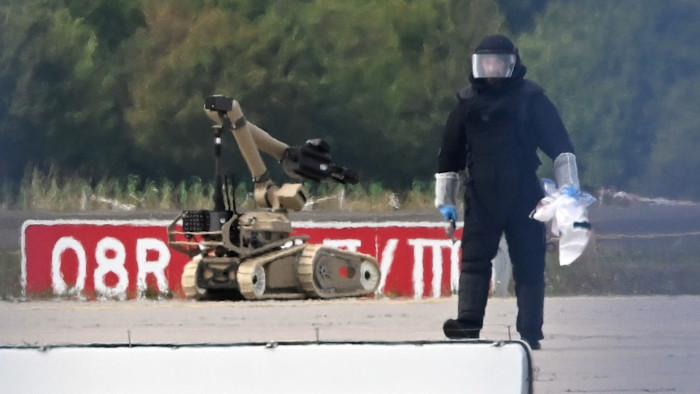
Germany hybrid warfare is now the government’s own framing for what it says is happening to the country every single day. Interior Minister Alexander Dobrindt made the characterization explicit over the weekend, days after an explosive-laden drone turned up at an airport in the country’s east.
Speaking to Bild am Sonntag on Sunday, Dobrindt said foreign powers are attempting to subdue Germany politically and socially by generating fear.
His summary was blunt. Germany is not at war, he said, but it is a daily target of hybrid warfare.
He described espionage, sabotage, cyberattacks and covert operations aimed at destabilising the country or causing direct harm as a constant reality.
He did not name any country.
The Drone at Leipzig
The comments followed the discovery on Tuesday of a drone loaded with explosives at Leipzig/Halle Airport in eastern Germany.
Several German lawmakers publicly attributed the incident to Russia, which has been at war with Ukraine since its full-scale invasion in 2022.
Russia’s embassy in Berlin rejected that on Friday, calling the Leipzig episode a fabricated provocation and describing it as another instance of unsubstantiated accusations directed at Moscow.
No official attribution has been made by the German government.
What Hybrid Warfare Actually Means
The term gets used loosely, so it is worth defining.
Hybrid warfare describes hostile activity that stays deliberately below the threshold that would trigger a conventional military response. Sabotage of infrastructure. Cyber intrusions into utilities or government systems. Disinformation campaigns. Drone incursions over sensitive sites. Covert operations conducted through intermediaries.
The design principle is deniability. Each incident is ambiguous enough that attribution takes time and certainty is elusive, which makes proportionate retaliation politically difficult. A country can be under sustained pressure without any single event justifying the invocation of a defence treaty.
That is precisely the position Dobrindt is describing.
Germany’s Response Plans
According to Bild, citing government sources, Germany intends to substantially expand its counter-drone capacity.
The interior ministry reportedly wants to double the federal government’s team of anti-drone specialists from 150 to 300, and to increase its network of related bases from four to eight.
Whether that scale is adequate is debatable. Detecting and neutralising small drones over a country the size of Germany is an enormously difficult technical problem, and 300 specialists is a modest figure against the number of sensitive sites requiring coverage.
More Sightings Across the Region
The Leipzig discovery was not isolated.
Germany’s armed forces said Saturday that two drones were observed late Thursday over a military base site in Mechernich, in North Rhine-Westphalia.
Separately, a drone exploded in Bulgaria on Saturday near the Trans-Balkan gas pipeline. Bulgaria’s defence ministry said there was no reason to believe the incident was deliberate. Ukraine said it was cooperating with Bulgarian authorities to establish the circumstances.
Taken individually, each incident admits multiple explanations. Taken together, they have renewed concern that Russia’s war in Ukraine is spilling into neighbouring NATO territory in forms that are difficult to categorise.
The Attribution Problem
NATO and European Union officials have blamed Russia for earlier drone sightings. Russia has rejected every such allegation.
This standoff is structural rather than incidental. Small drones can be launched from close range by a handful of people, leave minimal forensic evidence, and are commercially available. Proving state direction to a legal or diplomatic standard is genuinely hard, even when circumstantial patterns look obvious to intelligence services.
The result is a category of incident that governments treat seriously in private while stopping short of formal accusation in public.
Why This Matters Beyond Germany
The broader concern is what happens if these incidents escalate.
NATO’s mutual defence commitment is built around armed attack, a concept designed for conventional aggression. A drone that explodes near a pipeline or is discovered at an airport does not fit neatly into that framework, and deliberately so.
That gap between what alliances are built to answer and what is actually occurring is where hybrid pressure operates most effectively. Dobrindt’s decision to describe it publicly, in those terms, suggests Berlin considers the pattern established enough to name even without naming a culprit.
A note on sourcing: attribution for these incidents remains unresolved. Russia has denied involvement, no formal German government attribution has been issued, and investigations in both Germany and Bulgaria are ongoing.
Author
-
Lucienne Albrecht is Luxe Chronicle’s wealth and lifestyle editor, celebrated for her elegant perspective on finance, legacy, and global luxury culture. With a flair for blending sophistication with insight, she brings a distinctly feminine voice to the world of high society and wealth.