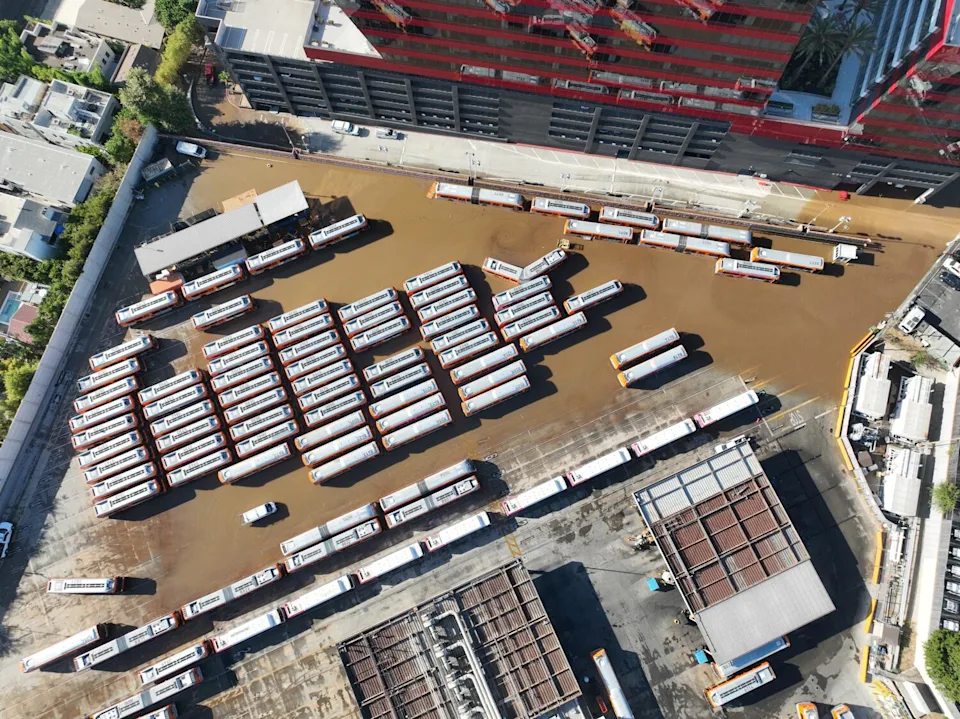
The LADWP pipe replacement program is missing its own benchmarks, and a rupture in West Hollywood this week put the consequences on display in the most literal way possible.
A 110-year-old line failed Wednesday, sending water across the neighborhood. AIR7 aerial footage captured the break from above, showing the scale of a failure that occurred in infrastructure most residents never think about until it fails.
The Numbers Behind the Shortfall
LADWP’s own 2025-2026 Water Infrastructure Plan Report documents the gap.
During the 2024-25 fiscal year, the utility replaced 11,500 feet of pipe with earthquake-resilient material. Its target for that same period was 17,600 feet.
That’s a shortfall of roughly 6,100 feet — about 35 percent below what the utility set out to accomplish.
The distinction matters because earthquake-resilient pipe isn’t a routine upgrade. In a seismically active region, it’s the difference between a system that bends during a major quake and one that shatters, potentially crippling water supply and firefighting capacity precisely when both are most needed.
How Much Pipe Needs Attention
Six percent of LADWP’s distribution mainline pipes carry a high-priority classification for replacement.
That percentage sounds manageable until it’s measured against the scale of a system serving a city the size of Los Angeles. Six percent of a network spanning thousands of miles represents an enormous volume of pipe operating in condition urgent enough that the utility itself has flagged it.
The utility told Eyewitness News it expects to replace 246,047 feet of pipe this year — a substantially larger figure than the previous year’s total, suggesting an intended acceleration.
Whether that target is met is the question the last fiscal year raises.
An Expert Assessment: Competence, Not Cash
Lucio Soibelman, a professor at USC’s Viterbi School of Engineering, offered an evaluation that avoids the easy blame.
He credited LADWP with running a solid replacement program that has produced measurable results in reduced leak rates. His criticism wasn’t aimed at the utility’s technical judgment or planning.
His assessment was financial. He said the department knows what it’s doing but lacks the budget to actually solve the problem.
That framing shifts the conversation. If the constraint is expertise, the fix is management. If the constraint is money, the fix requires decisions from elected officials and ratepayers about what they’re willing to fund.
A Question the Utility Wouldn’t Answer
Twelve years ago, Eyewitness News covered a major pipe burst roughly half a mile away on Sunset Boulevard.
Asked whether the line that failed Wednesday had a prior history of failures, LADWP did not answer directly. The utility instead issued a statement highlighting its leak rate, which it said runs 36 percent below the national average.
That statistic is genuinely favorable, and worth acknowledging. But it responds to a different question than the one asked.
A system-wide leak rate says nothing about whether a specific segment of century-old pipe had been flagged, monitored, or scheduled for replacement before it burst. Those are the records that would indicate whether this failure was foreseeable.
Why Century-Old Pipe Is Still in Service
A pipe installed around 1915 remaining in active use isn’t unusual in older American cities, and understanding why explains the scale of the challenge.
Water mains are buried, invisible, and generally functional until the moment they aren’t. Replacement requires excavating streets, disrupting traffic, and spending heavily on infrastructure no voter can see. Deferred maintenance carries no immediate political cost — right up until a street floods.
Several factors compound the problem:
- Cast iron and other early materials corrode gradually over decades
- Ground movement, seismic activity, and temperature cycling stress joints over time
- Failures are difficult to predict without extensive monitoring, which itself costs money
- Replacement competes for funding against more visible civic priorities
- The backlog grows faster than most utilities can address it
What Wednesday’s Break Actually Demonstrates
A single failure doesn’t prove systemic collapse. Old pipe fails; that’s expected.
What the West Hollywood break illustrates is the arithmetic problem underneath. When a utility falls 35 percent short of its replacement goal in a year, the inventory of aging pipe doesn’t hold steady — it grows. Every year of underperformance adds to a backlog that becomes more expensive and more urgent to address later.
Meanwhile, the pipes already in the ground keep getting older.
The Seismic Dimension
Los Angeles faces a risk profile most cities don’t share.
Earthquake-resilient pipe exists specifically because a major seismic event could sever water delivery across large areas simultaneously. That scenario affects drinking water, sanitation, and — critically — the ability to fight fires that frequently follow major quakes.
Falling behind on that particular category of replacement carries implications well beyond flooded streets on a Wednesday afternoon.
What Comes Next
The core question is budgetary. Soibelman’s assessment points toward a funding gap rather than a management failure, which means meaningful acceleration depends on decisions about rates and capital allocation.
The near-term test is whether LADWP hits its 246,047-foot target this year after missing last year’s smaller goal. That figure represents a significant scaling up, and meeting it would suggest the utility has resolved whatever constrained it previously.
7 On Your Side Investigates has said it will continue pursuing answers, including on the failure history of the line that broke Wednesday.
For residents, the practical reality is unchanged. The pipes beneath their streets are old, replacement is proceeding slower than planned, and the next failure will likely arrive without warning — in a neighborhood no one predicted, on a line no one was watching.
Author