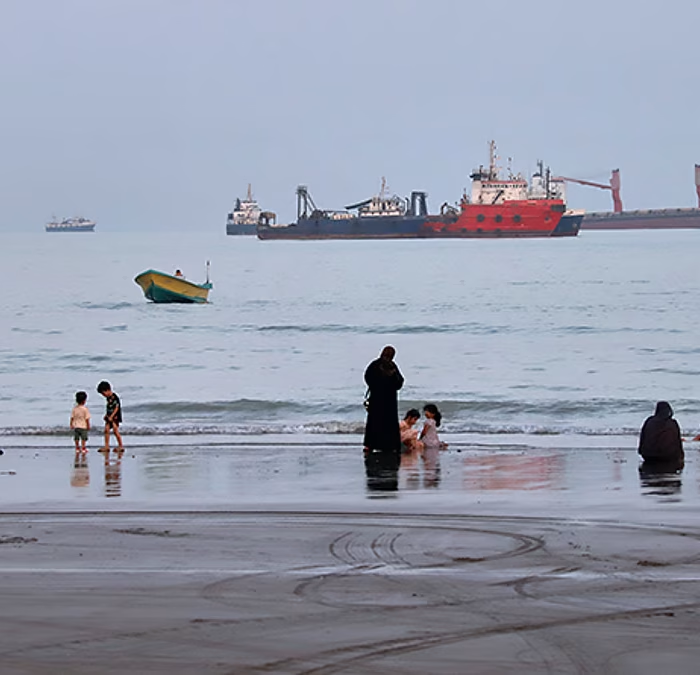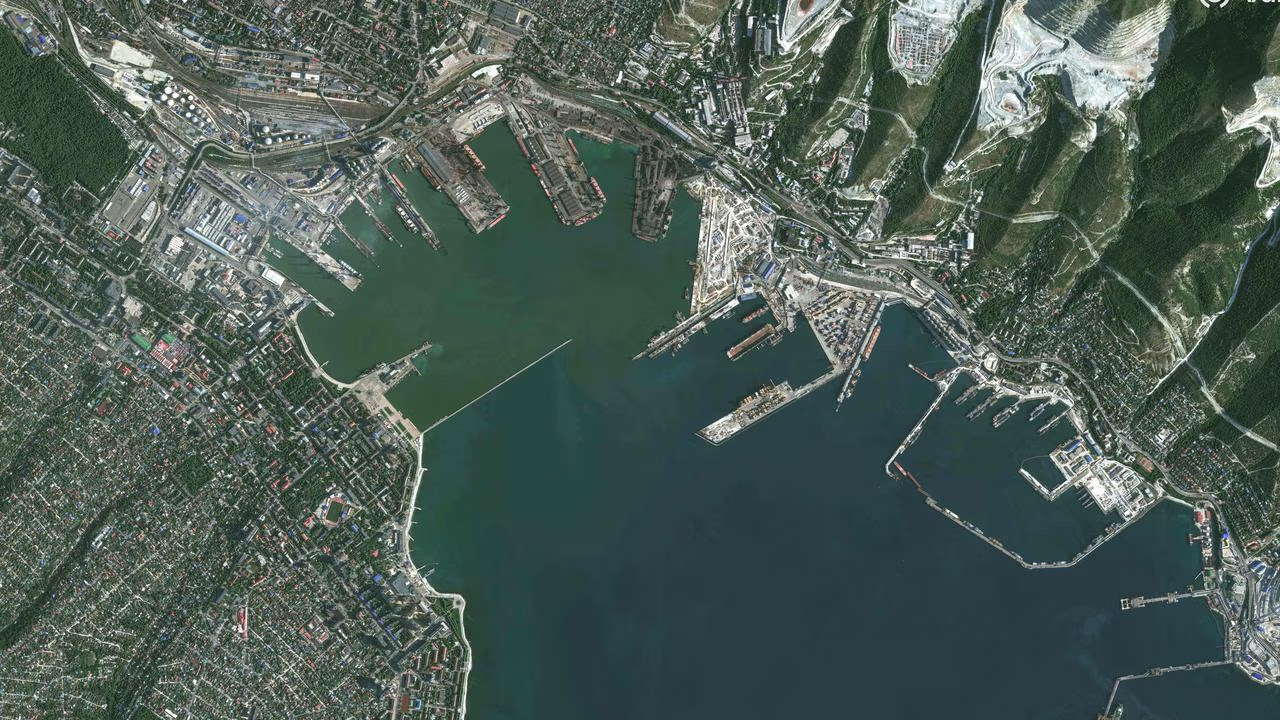
The Novorossiysk attack has widened the war’s reach into global commodity markets, after Ukraine struck warships and major grain export terminals at the Russian Black Sea port. Moscow responded with warnings that world food supplies would suffer.
Novorossiysk serves a dual role as both a naval base and one of Russia’s most important export gateways, which is precisely why it has become such a contested target.
Casualties and Damage
Regional governor Veniamin Kondratyev said three people were killed, including an eight-year-old child, with a further 24 injured.
Two Russian grain trading companies reported damage from the strike, according to multiple media accounts. Russia’s Agriculture Ministry said Wednesday it was working to redirect cargo flows toward ports on the Baltic and Caspian Seas as well as overland routes.
That redirection is not a simple substitution. Alternative ports lack comparable bulk grain handling capacity, and land transport costs considerably more per tonne than sea freight.
Ukraine’s Account
President Volodymyr Zelenskyy characterised the operation as a success, describing a combination of long-range drones and other weapons deployed against Russian fleet vessels in the bay area.
He listed the Admiral Essen and Admiral Makarov frigates among the targets struck, along with a large landing ship, a corvette, and additional vessels.
Notably, his statement made no reference to grain terminals. He said other Russian facilities helping finance the war had also been hit, arguing that Ukraine is entitled to respond to Russia’s war and that Moscow holds the ability to end it.
That framing matters. By emphasising naval and financing targets rather than agricultural infrastructure, Kyiv positions the strike as military rather than as an attack on food supply.
Moscow’s Framing
Russian Foreign Ministry spokesperson Maria Zakharova took the opposite approach, accusing Ukraine of attempting to provoke chaos in global food markets and suggesting this serves the interests of certain Western countries. She did not elaborate on which ones or how.
She argued the strikes worsen shortages of grain and fertiliser, push global food prices upward, and increase costs for countries across the Global South and East, describing those nations as hostages to irresponsible policies.
Both governments are making arguments aimed at international audiences, particularly food-importing countries whose sympathies carry diplomatic weight.
The Market Reality
Whatever the rhetoric, the underlying economics are straightforward.
Russia is the world’s largest wheat exporter. Ukraine is also a major agricultural exporter. Both have been striking each other’s Black Sea export infrastructure in recent weeks, and global wheat prices have moved higher as a result.
The Black Sea region accounts for a substantial share of internationally traded wheat. When shipping through it becomes riskier, the effects appear quickly in insurance premiums, freight rates, and futures prices.
Numbers Already Showing Strain
Agricultural consultancy SovEcon reported earlier this week that Russia appears on course to export between 3 and 3.4 million metric tons of wheat this month.
For context, the five-year August average sits around 5 million tons.
The consultancy noted this could represent the weakest August total since the 2016-2017 agricultural season, and that it follows an already soft July.
Two consecutive months of depressed exports from the world’s largest supplier is the kind of pattern that concerns buyers well beyond the immediate conflict zone.
Who Actually Feels This
Wheat price increases do not land evenly.
Countries that import a large share of their grain, particularly across North Africa, the Middle East, and parts of Asia, are most exposed. Many of these markets have limited capacity to absorb price shocks, and bread costs carry political weight in ways that other commodities do not.
Fertiliser is the less visible half of the problem. Russia is a major supplier, and constrained availability affects planting decisions in other countries, which shifts harvests a season or two out rather than immediately.
Shipping and Insurance
Even undamaged infrastructure suffers when risk rises.
War-risk insurance premiums for vessels calling at Black Sea ports increase sharply after strikes. Some shipowners decline the route entirely, and charterers become reluctant to commit.
The practical result is that export volumes fall well below what physical capacity would allow. A port does not need to be destroyed to stop functioning effectively.
The Wider Military Picture
The strike sits within a broader escalation. Russian forces have increased missile attacks on Ukrainian cities in recent weeks, a pattern analysts attribute in part to Kyiv’s shortage of ballistic missile interceptors.
Both sides appear to be targeting economic capacity alongside military assets, treating export revenue as a legitimate part of the other’s war-fighting ability.
What to Watch
Several indicators will show whether this becomes a sustained disruption or a temporary spike.
Export volumes from Novorossiysk over the coming weeks will reveal how much capacity was genuinely lost versus temporarily halted.
Insurance rates for Black Sea transits give a real-time reading on perceived risk.
Wheat futures will reflect whether traders expect the constraint to persist into the next quarter.
Any announcements from major importers about alternative sourcing would signal that the disruption is being treated as durable.
For now, the immediate facts are narrow: a significant strike on a dual-purpose port, damage to grain handling infrastructure and naval vessels, three deaths including a child, and a market already trending in an uncomfortable direction before this week began.
Author
-
Lucienne Albrecht is Luxe Chronicle’s wealth and lifestyle editor, celebrated for her elegant perspective on finance, legacy, and global luxury culture. With a flair for blending sophistication with insight, she brings a distinctly feminine voice to the world of high society and wealth.