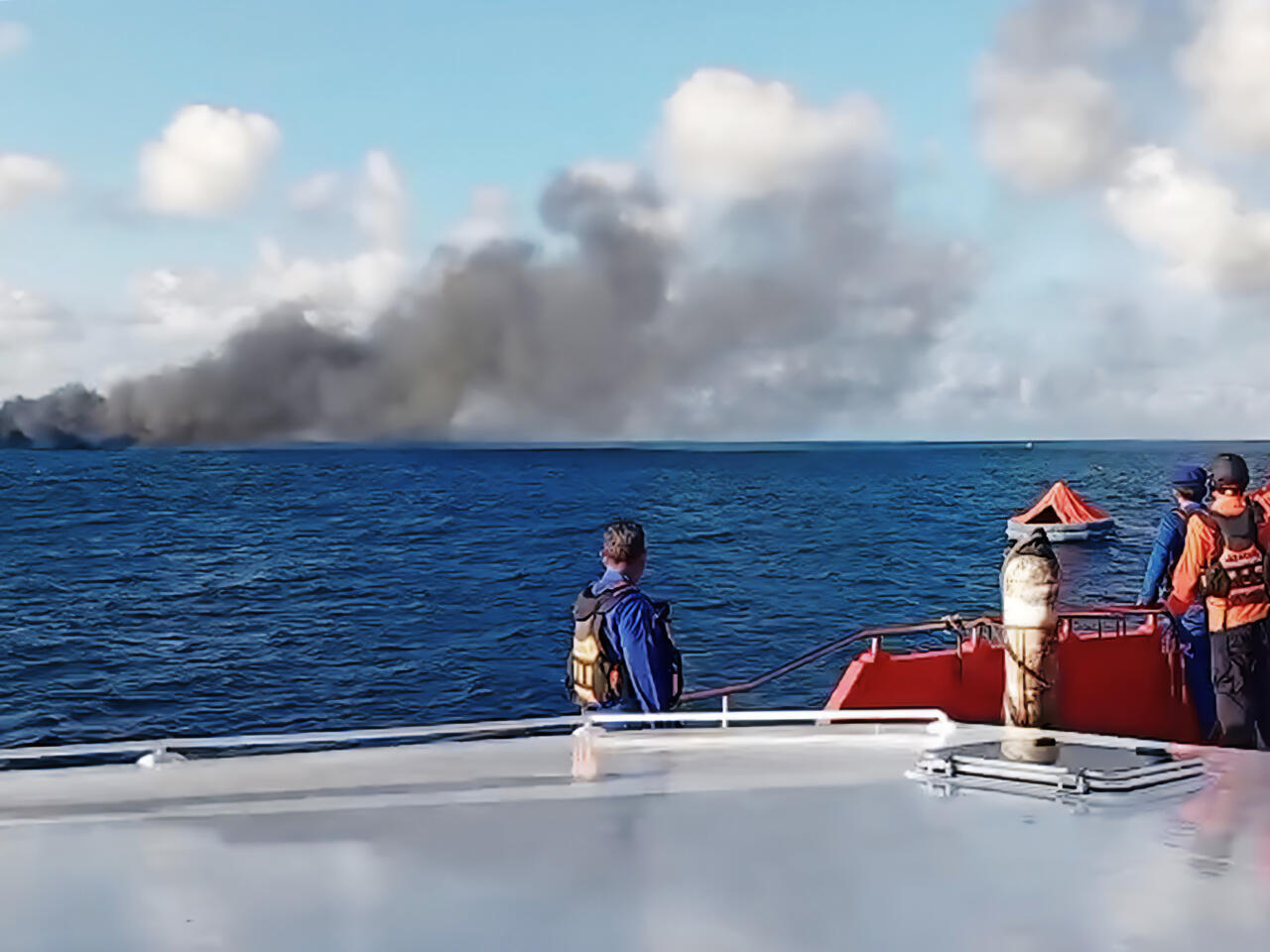
A ferry fire in rough seas between Bali and Lombok has left at least one person dead and prompted a large rescue operation that pulled 211 people from the water and the burning vessel. Several passengers remain unaccounted for as the search continues.
Footage released by Indonesia’s National Search and Rescue Agency showed survivors in life jackets packed into an inflatable raft on choppy water while thick black smoke poured from the ship behind them.
What Happened
The Putri Yasmin was sailing from Bali to Lombok in West Nusa Tenggara province when fire broke out at around 4:15 a.m. Wednesday.
Alongside its passengers, the vessel was carrying 44 vehicles and 53 motorcycles.
The Search and Rescue Office in Mataram, the provincial capital, received an emergency report roughly half an hour later and dispatched personnel and vessels immediately.
By early Thursday, rescuers had evacuated 211 people including seven foreign tourists, and recovered the body of a 19-year-old Indonesian woman.
At least two injured passengers were taken to a nearby hospital.
Families Still Waiting
The search continued into Thursday.
Relatives gathered at a command post established at the port, where at least five people reported family members still missing. Their names were posted at the centre.
Muhammad Hariyadi, who leads the Mataram Search and Rescue Office, said the safety of all passengers and crew remained the top priority.
A Discrepancy That Demands Explanation
One detail has drawn particular scrutiny.
Initial reports based on the vessel’s manifest listed 131 people aboard, including 17 crew members. Hours later, officials confirmed that far more people had actually been on the ship.
The gap between 131 listed and 211 rescued is substantial, and it is not a rounding error.
Discrepancies between manifests and actual passenger numbers are common in Indonesia, but authorities have not explained why the difference was this large in this case.
Transportation Minister Dudy Purwagandhi said officials would examine the issue, describing it as a serious matter that will be thoroughly investigated as part of the ministry’s evaluation.
The practical consequence is severe. When rescuers do not know how many people were aboard, they cannot know when a search is complete. That uncertainty is precisely what the families at the port are living with now.
How the Fire Started
Syamsurizal, who heads the Lembar Port Authority in Lombok, said survivors described the blaze beginning in a cargo truck before spreading rapidly through the vessel.
The heat drove some passengers to jump into the sea.
Vehicle decks present a well-known hazard on roll-on roll-off ferries. Fuel, cargo, and enclosed space combine badly, and fire can move quickly through a confined deck before crews can contain it.
Investigators from the National Transportation Safety Committee are working to establish the cause.
A Difficult Rescue
Hariyadi said six vessels, a helicopter, two inflatable boats, and two private yachts took part in the response.
Conditions worked against them. Waves reported as high as four metres complicated the operation considerably, making transfers between craft dangerous and reducing visibility for anyone in the water.
Rough seas also matter for survivability. People who jumped to escape the heat faced immediate difficulty staying afloat and being spotted.
About the Vessel
The Putri Yasmin measures 62 metres and was built in Japan in 1992.
Its stated capacity is 220 passengers and 55 vehicles. It operates primarily on the Bali to Lombok route, a crossing that typically takes four to five hours.
The passenger figure of 211 sits close to that limit, which makes the earlier manifest count of 131 harder to reconcile.
A Familiar Pattern
This incident came less than two weeks after another Indonesian ferry, the Mutiara Sentosa 2, caught fire in waters off Java, leaving at least five people dead.
Indonesia comprises more than 17,000 islands, and ferries serve as fundamental transport infrastructure rather than a tourist convenience. Millions of journeys occur annually.
Disasters recur with troubling regularity. Weak enforcement of safety regulations is frequently identified as a contributing factor, alongside overcrowding, ageing vessels, and inconsistent record-keeping.
The Underlying Issues
Several structural problems tend to surface after incidents like this one.
Manifests that do not reflect actual passengers make both rescue and accountability difficult.
Vehicle deck fire suppression systems on older vessels may not meet current standards.
Life-saving equipment sufficient for the manifest count may be inadequate for the real number aboard.
Enforcement capacity across thousands of routes and operators is limited relative to the scale of the network.
None of these are new observations. They appear in review after review following Indonesian maritime accidents.
What Comes Next
The search operation continues for those still unaccounted for. Investigators will work to determine the fire’s origin and how it spread so quickly.
The manifest discrepancy will form a separate strand of inquiry, and it may prove the more consequential one. Establishing how 80 additional people came to be aboard without appearing in the records could matter more for preventing the next incident than identifying which truck caught fire.
For now, one family is grieving a 19-year-old woman, five families are waiting for news, and 211 people are ashore who spent the early hours of Wednesday morning in open water.
Author